


It was officially just a tennis match. What was really being played out on Court 7 at Roland Garros was whether sport gets to move on—while Russia is still occupying Ukraine and killing Ukrainians.
Extra security around the relatively minor Court 7. No polite handshake before or after the match. The tension was tangible long before the first yellow ball was struck.
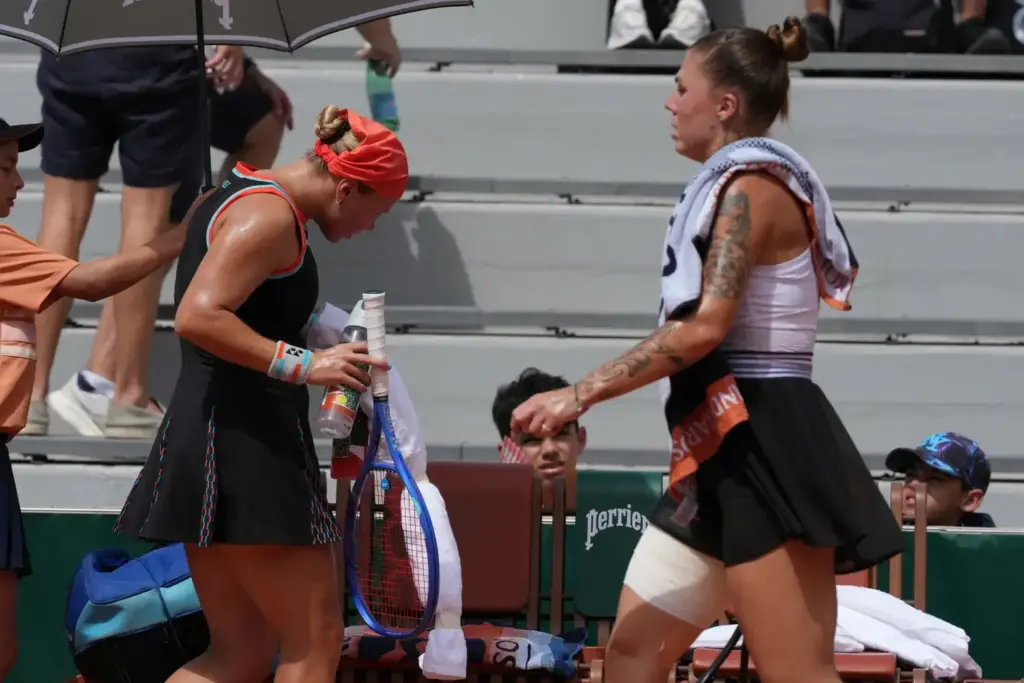
When Ukraine's Oleksandra Oliynykova faced Russia's Diana Shnaider at the French Open on Saturday, the match was officially a third-round contest. It was also a very public collision between two visions of what sport is supposed to be during wartime—a part of sanctions and a tool to isolate the aggressor, or a space that pretends politics ends at the baseline.
Four years after Russia's full-scale invasion of Ukraine, Russian athletes are slowly being welcomed back by international sports federations—while Russia is still occupying close to 20% of Ukraine and bombing the rest of the country almost every night.
Vladimir Putin himself has said Russia is intensifying the attacks to force Kyiv to surrender. Overnight on Monday, at least 22 people were killed across Ukraine in one of the largest missile and drone barrages of the year, with strikes on residential buildings in Kyiv and Dnipro.
The 25-year-old Oleksandra Oliynykova was not having it.
Before the match, she centered her criticism on Shnaider's appearance at a Gazprom-sponsored exhibition match in Russia last year, and on Shnaider's social media activity—what Oliynykova described as liking "pro-Kremlin" and "pro-war" posts.
The woman behind the protest
For Oliynykova the war is not an abstract geopolitical dispute to be discussed between matches and forgotten by the next tournament.
She continues to live and train in Kyiv. Her father and her boyfriend have both volunteered for the Ukrainian army.
That reality helps explain why she has become one of the most outspoken Ukrainian voices in sport. She has been backed by other Ukrainian players too—Ukraine has eight women among the top 100, and several have publicly supported her stand.
Last week, after winning her first-round match, world No. 15 Marta Kostyuk described receiving photos, three hours before stepping on court, of a residential building destroyed by a Russian missile 100 meters from her parents' home in Kyiv. Her mother, sister, and aunt were inside the house during the attack.
Oliynykova directly challenges the idea that Russian athletes should be considered politically neutral in the first place. And she is doing it with panache.
"I'm incredibly proud of myself today. I think it was one of the most difficult matches of my career," Kostyuk said in her on-court interview. "This morning, 100 meters from my parents' house, the missile destroyed the building. It was a very difficult morning. I didn't know how this match is gonna turn out for me. I didn't know how I would handle it. I've been crying part of the morning."
What makes Oliynykova unusual is that she is so directly challenging the idea that Russian athletes should be considered politically neutral in the first place. And she is doing it with panache.
Ahead of her match with Shnaider, Oliynykova publicly presented screenshots and photographs which she argues show links between Russian athletes, state-sponsored events, and pro-Kremlin narratives.
Her criticism focused particularly on Shnaider's participation in a Gazprom-sponsored exhibition event in St. Petersburg in 2025. Gazprom is the Russian state-controlled energy giant that has historically contributed close to 10% of Russia's federal budget—and, by extension, to its war effort.
Oliynykova described Gazprom as "a company which is financing war crimes" and compared playing at such an event to "playing in Nazi Germany for Gestapo officers, on the tournament organized by a company which built Auschwitz."
"My home is being attacked by Gazprom money," she said.
"You can be sanctioned if you are participating in a tournament organized by a betting company," she added. "But if they have this mechanism, why will they not use this for the tournament organized by a war crimes sponsor?"
Oliynykova also accused the tennis world of silence: "Everybody is silent about what this person did."
Trending Now
Diana Shnaider just wants to play tennis, she says
In the end, the Russian won the match relatively easily, 7-5, 6-1.
Afterwards, Shnaider dismissed Oliynykova's accusations relating to her participation in the Gazprom-backed exhibition event and her alleged pro-Russian activity on social media.
"I don't know anything about what she said," Shnaider told reporters. "Wasn't interested at all."
She added that playing exhibition matches in Russia offers her a rare opportunity to spend time with family during the tour season.
Shnaider declined to discuss the war. "About social media, I have no idea what she found. I have no idea, so I don't have any comments on that," she said. "I'm not going to speak anything about the situation. I'm here just to speak about tennis and about my game."
Post-match is not post-war
Following her defeat, Oliynykova delivered an emotional statement insisting that her position was not about politics but about what she called "humanity."
"I know that some people disagree with my actions. I know that some people would prefer that I stay silent. But what I do is not about politics, it's about humanity."
"When people are being killed," she said, "while children are dying, when violence is justified or celebrated, we cannot pretend that nothing is happening. We cannot look away."
That is what makes her clash with Shnaider significant beyond tennis.
The match exposed a deeper divide that international federations increasingly prefer not to discuss publicly. In 2022, the central question was whether Russian athletes should be excluded from global competition. By 2026, many sports bodies have quietly shifted to a different question: under what conditions should they be allowed back?
Tennis effectively answered that question early. Russian and Belarusian players continued competing as neutral athletes, stripped of national symbols but not excluded from the sport. The arrangement generated controversy, but over time it became normalized.
The same model is now used by federations governing judo, aquatics, gymnastics, university sport, equestrian sport, several winter sports, and ice hockey. Several other federations are on the fence, but about to lose their balance.
The pattern is consistent. Rather than announcing dramatic reversals of sanctions, federations have tended to move incrementally—creating neutral-athlete pathways, restoring eligibility, loosening restrictions, and avoiding large public declarations.
Oliynykova's intervention challenges precisely that quiet normalization.
That is why the dispute resonated far beyond a court at the French Open. One side is asking whether sport should not move on. The other is asking why it should, while Russia is still occupying Ukraine and killing Ukrainians.
"This war, it defines my life, because my future is in Ukraine," Oliynykova said. "My father, he's coming back to the army. My boyfriend, he's a soldier. Everything in my life is defined by war."
This is the first in a series on how international sport is negotiating its relationship with sanctions and Russia's invasion of Ukraine.
Read Also
-
“Now it’s your turn”: US envoys planned to show Moscow a refinery pause and a diesel deal, then ask for something back, a source tells Reuters
-
“A warning to companies that remain”: Russia takes control of Nestlé and Auchan’s assets – companies that stayed in Russia following the full-scale invasion of Ukraine
-
“I can travel back to Finland and be safe. That is a luxury”: Sanna Marin on the Russian strike that stopped her train from Kyiv


