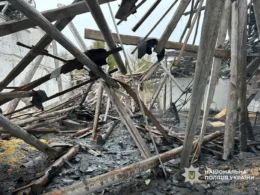
The missile Russia used to strike Kyiv Oblast on 10 July contained more than 140 foreign components. Without such parts, Russia could not build its weapons, presidential sanctions commissioner Vladyslav Vlasiuk said, according to Ukrinform.
The breakdown of one missile is a map of how sanctions leak. Examining the wreckage of the Iskander, a cluster munition, investigators identified its entire component base: more than 140 foreign components, made in the US (62), Switzerland (8), Germany (5), Taiwan (4), China (2), and Japan (1), alongside 36 Russian components and 11 Belarusian.
At least 20 of its parts were made in 2025, dating the missile's production to 2025 as well, meaning the foreign components reached Russia and were incorporated into a fired weapon within roughly a year, despite the sanctions meant to stop exactly that.
Vlasiuk's sharpest point is about the European parts
The commissioner drew a specific conclusion about which components are the real chokepoints. In Ukraine's view, without access to foreign components, Russia could not produce such missiles at all, Vlasiuk said.
He singled out Western Europe. Chinese components are a separate topic, he said, but removing only the Western European components would effectively make the production of this missile impossible, which is why the question is not only for China but also for other countries whose manufacturers' products Ukraine still finds in Russian weapons.
Among the identified parts were products from the Swiss companies STMicroelectronics and Traco Power, from Japan's Panasonic Semiconductor, and 62 US-made components from various manufacturers. STMicroelectronics is a recurring name: Ukraine has repeatedly found its parts in Russian weapons and called on the producer to control where its products are sold.
The American share is the largest, and Vlasiuk noted the irony
A significant number of components originate from the US, Vlasiuk said, calling it, in a sense, a compliment to the quality of American microelectronics, while adding that it would obviously be better if that quality were unavailable to Russia.
American components account for 72% of the foreign parts found in Russian precision weapons, and in a single large-scale attack in October 2025, Ukraine identified over 100,000 foreign-made components inside the drones and missiles launched at its cities. The parts reach Russia not through elaborate smuggling but through ordinary commercial channels routed via intermediaries in third countries, which is the enforcement gap Ukraine keeps pressing its partners to close.