


- Ukrainian drones are now hitting hundreds of Russian cargo trucks every day, more than five times the war-long daily average
- Russian forces are struggling to harden their supply lines, so they may opt to just replace the trucks
- But losses on that scale could compel Russia to restore rusty Cold War surplus trucks
The Russian military keeps tens of thousands of old trucks in storage. It might need them soon. This spring, Ukrainian forces launched a counterlogistics campaign targeting Russian trucks, vans and other cargo vehicles across the logistical zone stretching 200 km behind the disputed gray zone.
The campaign of AI drone strikes is intensifying. And now the Russians are losing potentially hundreds of trucks every day. Far more than they can immediately replace with new production. While Russian ground forces possess tens of thousands of cargo vehicles, and buy thousands of new ones every year, they're currently on track to lose thousands per month.
If truck losses continue at the current rate, or get worse, the Russians may have no choice but to begin doing for trucks what they've long done for tanks: pull very old vehicles out of long-term storage and do their best to refurbish them for continued use.
It could be tough. "Russia has an immense number of stored trucks," analyst Jompy noted. They placed the number of old Cold War cargo vehicles in storage in Russia at 40,000 or 50,000. That's more trucks than most armies have in their entire inventories, but it's also just 100 days' worth of trucks at the current rate of loss across the logistical zone.
Worse for Russian logisticians, most of the stored trucks have been parked "for decades without proper maintenance," according to Jompy. "Most are junk."
How long Russia's current truck inventory lasts, and how urgently it may need to tap reserves of rusty older vehicles, depends on exactly how many trucks Ukrainian drones are knocking out every day.
Lots of losses
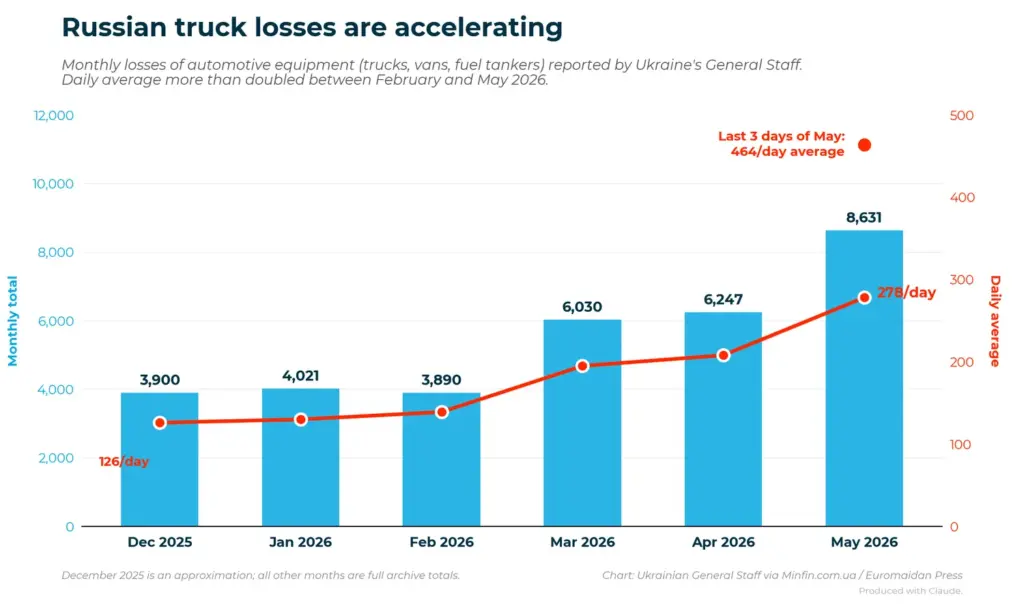
The Ukrainian general staff reported 483 destroyed Russian trucks on 30 May, another 524 on 31 May and 384 on 1 June. The average across the past three days is 463 trucks. That's more than five times Russia's average daily truck losses since widening its war on Ukraine in February 2022.
Trending Now
According to the Ukrainian defense ministry, Russia lost nearly 7,000 trucks in May, around 6,500 in April and slightly more than 6,000 in March. Cargo vehicle losses in previous months were much lower, including just 4,000 or so per month between December and February. That makes sense, as the Ukrainian counterlogistics campaign began in earnest as the weather warmed and the winter fog lifted over the Russian logistical zone this spring.
The intensifying drone raids on Russian supply lines out to a distance of 200 km marks a strategic pivot for Ukraine. As recently as late last year, Ukrainian leaders were under scrutiny for focusing their drone strikes on Russian infantry in the gray zone as well as on largely symbolic targets deep inside Russia. That bifurcated focus risked neglecting the logistical middle zone.
But that was before the spring pivot. Now the middle zone and its supply lines are the main focus of Ukraine's best new drones, including Swift Beat Hornets and other inexpensive fixed-wing drones with jam-resistant AI-targeting. "A battlefield runs on logistics," the Ukrainian defense ministry conceded. "Ukraine is making sure Russia's does not."

Electronic warfare might not save Russia's logistics, given how many of the Ukrainian drones ranging across the logistical zone have self-contained AI for targeting and don't need a low-lag connection to a distant operator in order to strike their targets.
Russia can fight back by deploying more air defenses along the main supply routes. The problem there is that Ukrainian drones are also targeting the air defenses, hitting hundreds of them in just the last year.
The Russians could also erect anti-drone nets over the most vulnerable highways. But there are hundreds of miles of roads, and nets are fragile.
Most likely, the Kremlin will try a little of everything to keep supplies and reinforcements flowing to the front-line regiments. The all-of-the-above logistical effort could very well include refurbishing—or at least trying to refurbish—a whole lot of very old trucks.
Read Also
-
Ukraine retook 240 square km north of Lyman and nobody reported it for three months
-
Ukraine is working down the short list of ships that shell its cities with cruise missiles. A Neptune reached one of them tied up at its own pier
-
Ukraine is sending its winning brigades to where the fighting is worst. The 46th just turned up outside Kramatorsk


