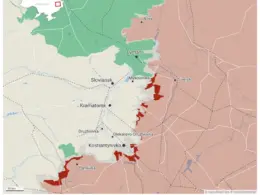
- So many of Ukraine's AI drones are filling the sky over occupied Ukraine that they sometimes cross paths
- The highly autonomous AI drones shrug off Russian jamming as they hunt Russian supply trucks
- The strikes on Russian logistics are weakening front-line regiments before they can even begin an assault
We don't know how many Hornet one-way attack drones US firm Swift Beat has produced for Ukraine. But there are enough of the approximately 2-meter wingspan drones that they occasionally cross paths with each other as they hunt for targets.
At least two of the drone meet-ups, one propeller-driven Hornet capturing another Hornet on its forward-looking camera, are captured in a new montage of drone strikes posted by the Ukrainian National Guard's 1st Azov Corps.
The crowded skies are the point. Ukrainian drone units are striking Russian supply trucks, depots and rear-area infrastructure deeper and more often than ever before—and the front-line regiments those trucks were meant to supply are arriving short on fuel, ammunition and people. When they arrive at all.
Also captured in the montage: a series of Hornet strikes on Russian trucks. This spring, Ukrainian drone forces dramatically escalated their strikes on the Russian logistical zone stretching a couple of hundred kilometers from the disputed gray zone.
The number of these mid-range strikes more than doubled between February and March to a new high of no fewer than 288 strikes, according to analysis group Tochnyi. That's 288 raids targeting Russian supply depots; the trucks, vans and trains that haul supplies; the electrical grid powering the rear-area logistical system; and the air defenses protecting all of the above.
The pace of mid-range drone strikes is only increasing. Tochnyi observed 99 mid-range strikes in just the first 10 days of April. Blowing up more of the Russians' supplies and reinforcements as they're en route to front-line regiments, Ukrainian drone units are weakening those regiments before they can even begin an assault across the gray zone.
For the Russians, "just reaching the front line (which is the prerequisite for an assault) has become very risky," French mapper and analyst Clément Molin noted. The intensifying attacks on Russian logistics may explain why Russia's traditional spring offensive is off to such an unimpressive start this year.
According to the Institute for the Study of War in Washington, D.C., Russian forces lost 67 square kilometers of Ukrainian territory in April after losing 31 square kilometers in March. Their last monthly gain, in February, was just 119 square kilometers.

Trending Now
From Mariupol to wherever's next
An array of Ukrainian drone types carry out the raids in the logistical zone, including Fire Point FP-1 and FP-2 drones that pilots on the ground directly control via satellite or mesh radio network. The first-person-view FP-1s and FP-2s are vulnerable to Russian jamming that can interrupt their control signals, however, which is why more Ukrainian units are deploying AI-assisted drones that rely less on direct human control.
AI-assisted drones including the Hornet. Yes, the drone pipes video back to its operators via satellite or mesh radio, but its onboard AI spots targets and steers the drone to a strike, all by itself. It's apparent that many Hornets are programmed to look for Russian trucks. And they're doing so as far away as the ruins of Mariupol, 100 km from the southeastern front line.
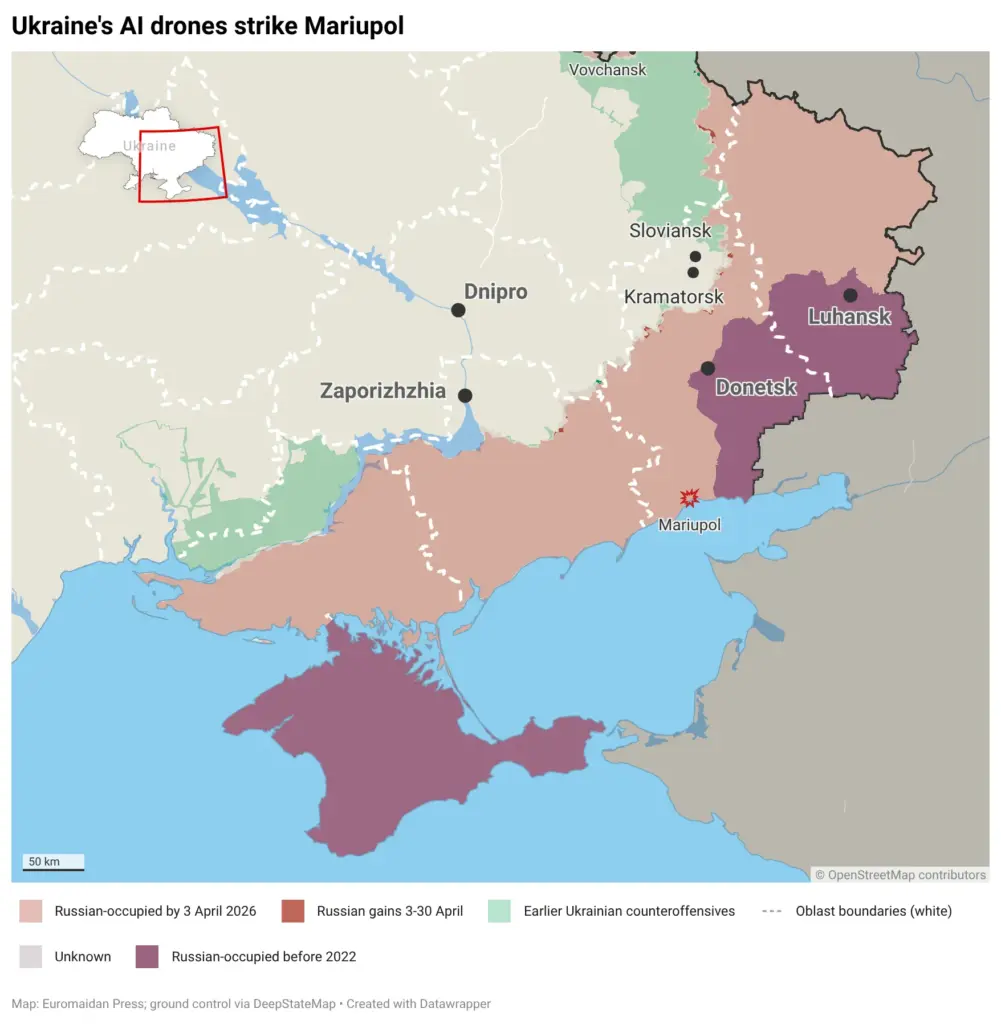
"Enemy forces are using Ukrainian roads in the city and its outskirts to move personnel and military hardware," the 1st Azov Corps stated. The corps "continues to establish a 'sanitary zone' for Russian logistics."
"The strike depth will increase," the 1st Azov Corps pledged as more drones fill the sky over the logistical zone and occasionally even cross paths. Hornets reportedly range as far as 150 km, so the corps isn't bluffing.
More drones will fly, farther and farther. More Russian trucks will burn. More Russian regiments will suffer shortages of people and supplies.

Read Also
-
Russia still parks its best bombers in the open. Ukraine has spent a year knocking out the air defenses that were supposed to protect them
-
Russia is losing the Black Sea grain war it started. Its answer is to sink civilian ships off Romania and Bulgaria
-
Russia is back at Dobropillia a year after it failed there. Now it’s the southern jaw of a pincer on Donbas’s last big free cities