


A Russian drone clipped one of Serhii’s wind turbines; his crew repaired the blade and carried on. He runs an oil-pressing plant in southern Ukraine, where the grid gives him about two hours of power and then 10 without. The turbine is one of six he has bought—Dutch machines, pulled from wind farms in the Netherlands for being too small, and shipped east.
In the Netherlands, a turbine like that is barely worth the paperwork. Over a blacked-out Ukrainian factory, it is worth shipping across a continent. That gap is turning into a market.
There is an active world market for refurbished wind turbines.
Bert van der Lingen
The market has formed largely on its own. Buyers like Serhii got their turbines through what Bert van der Lingen, vice-chairman of the Dutch wind association NedZero, calls “free market conditions”—private deals, one at a time—ahead of the Dutch government program meant to organize the trade, “Renewed Energy for Ukraine,” which began only in December 2025 and is still in start-up.
NedZero wrote to Euromaidan Press to correct an earlier report, drawn from the Dutch daily De Telegraaf, that called the turbines worn out. They are not.
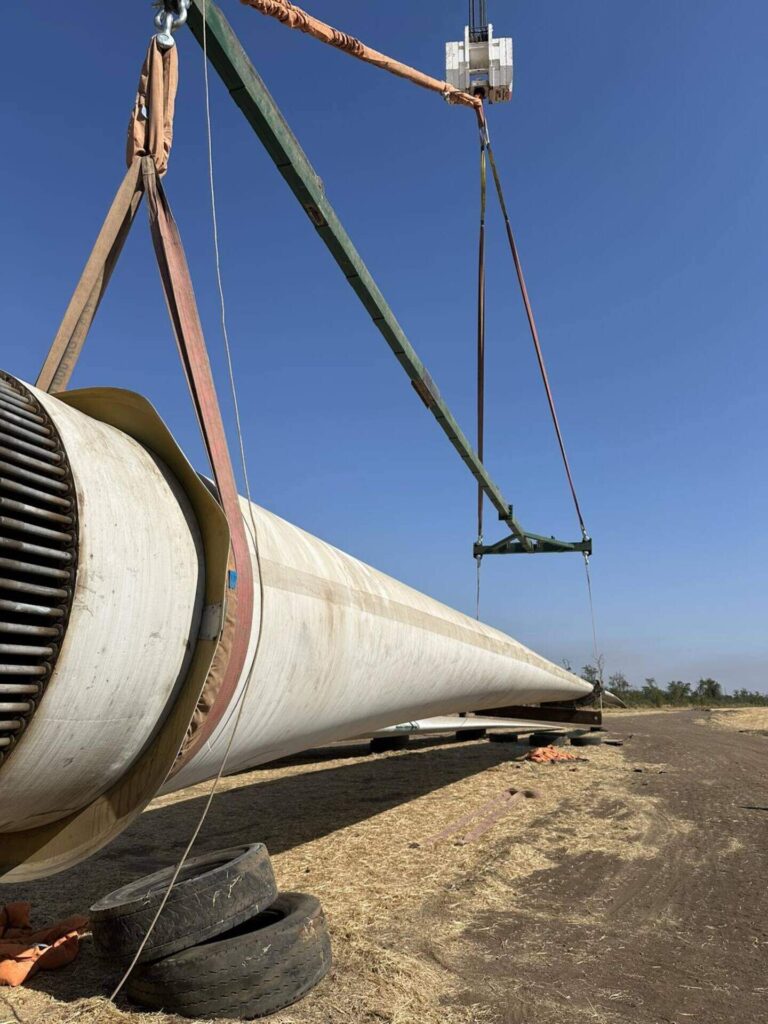
A machine comes down in the Netherlands only because a newer model on the same spot would earn five or six times as much. The old one still works. Stripped, inspected, and fitted with new bearings and a rebuilt gearbox, it has “fifteen to twenty years of technical life remaining.”
“This is a story we want to see grow,” van der Lingen added, “and getting the baseline right helps that.”

Why blacked-out Ukraine wants Europe’s spares
Ukraine is one buyer in a market that predates the war. “There is an active world market for refurbished wind turbines,” van der Lingen notes: Dutch machines freed up by repowering already spin from Poland and the Baltics to Jordan, Kenya, and Chile, sold with maintenance records and spare parts to match.
The supply is thin, and slow to move. By NedZero’s own survey, 486 Dutch turbines are due to come down over the decade to 2035—a floor, it says, since not every producer answered—and only a portion will be shipped anywhere, fewer still to Ukraine. A market like this gets built one deal at a time.
What makes Ukraine the eager buyer is what Russia has done to its lights. Four winters of strikes have destroyed or damaged more than 80% of the country’s power-generating capacity, by the energy ministry’s own count—its big Soviet-built plants are so few and so concentrated that one missile can darken a whole region.
Kyiv’s answer is to scatter generation so widely that no single strike can repeat the trick, an approach the ministry describes as “energy cells.” One refurbished turbine beside one factory is that doctrine at its smallest scale.
Trending Now

Wind farms are harder to destroy—so why won’t Ukraine let them scale? (INFOGRAPHICS)
Small, slow, and off the books
Money is the bottleneck. Development banks lend in amounts far too large for a handful of turbines—support from the big institutions starts at around €10 million ($11 million)—so small orders have to be bundled into projects large enough to finance. How many turbines reach Ukraine, the association says, depends on whether that bundling comes together.
Then there is the wiring. A turbine only makes power when the wind blows, not when the factory needs it. And most are built to shut down automatically when the grid fails, so a blackout silences them too—exactly when the factory needs them most—unless they are rewired, with batteries, to run on their own. That is what the microgrids are for.
NedZero cannot say how many Dutch turbines are already working in Ukraine. It has no consolidated count of what its country’s firms have delivered, nor of the megawatts they have added to the grid, and offers only to go and count them. What is coming free is on the books; what is already turning above a Ukrainian factory, holding its lights while the grid is dark, is not.


