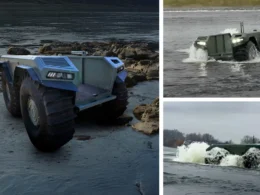
Ukraine's newest frontline motorcycle can carry two soldiers, avoid the mines that kill trucks, and recharge a unit's drones. The Defense Ministry codified the MUL.E, Ukraine's first all-wheel-drive electric motorcycle, and cleared it for use in the Armed Forces, the Defense Ministry announced.
Motorcycles have become one of the most sought-after vehicles on the front, alongside pickups, giving Ukrainian troops speed and mobility where logistics are hard, roads are absent, or small groups operate.
In 2026, Ukraine's Defense Procurement Agency contracted 1,500 motorcycles for the Armed Forces, three times last year's volume, and by bringing six companies into a competitive tender, it cut the final price and saved the state budget nearly $290,000. The MUL.E is the sharper end of that push: not just cheaper transport bought in bulk, but a purpose-built machine with capabilities no internal-combustion motorcycle has.
The MUL.E was developed at a Ukrainian defense enterprise in response to soldiers' requests for high-intensity modern warfare. It carries personnel with weapons, small cargo, and wounded across all surfaces, including off-road, and can tow a loaded trailer, per the Defense Ministry.
What sets MUL.E apart
During testing, the MUL.E confirmed its stated characteristics, the Defense Ministry said. Its distinctive features are the ones a conventional military motorcycle lacks: a 2×2 all-wheel-drive design, two independent motors for survivability if one fails, near-silent operation, fast deployment and packing, long autonomous running time, and significant range.
The mine resistance is the standout. The MUL.E's wide off-road tires and all-wheel drive let it cross difficult terrain, washed-out ground, sand, deep snow, and marsh, and because it exerts low ground pressure, roughly like an infantryman's foot, it does not trigger most mines designed to destroy cars and armored vehicles. A vehicle that can drive over anti-vehicle mines without setting them off is a real advantage on a front where mining has made many routes impassable.
Bike is also power station
The MUL.E's second role is what its makers call a bike-generator. A full charge lasts nearly 100 kilometers, and unlike other electric vehicles, the MUL.E does not simply stop when its batteries run out.
Mounted on the frame is an additional gasoline generator that recharges the onboard batteries. It is detachable, so it can be lifted off and used as a power source in its own right: charging the batteries of phones, communications equipment, and FPV drones, or supplying electricity to a unit in field conditions. That turns the motorcycle into mobile infrastructure.
A small group operating far from any grid can ride the MUL.E in silently, then use it to keep their drones and radios powered.
The dual function fits Ukraine's wider drive toward electric frontline transport that is quiet and hard to detect. Ukraine approved the WOLFSTORM electric motorcycle in June 2026, an 80 km/h machine that defeats thermal and acoustic detection and carries two soldiers in full gear.
The MUL.E adds all-wheel drive, mine resistance, and a generator to that concept, extending what an electric two-wheeler can do for the small mobile groups that increasingly define how Ukraine fights.
Read also
-
Ukraine approves 80 km/h electric motorcycle that defeats thermal imaging and acoustic detection. It carries two soldiers in full gear
-
Russia holds 2,000 people hostage in Oleshky without food or water—Ukraine flew 4,000 kg of food to locals across the Dnipro
-
New Vivaldi tactic: Ukraine’s ground robots, each carrying two Bullspike grenade launchers, attack Russian positions and then detonate inside their shelters