


The numbers are impressive. But two days in Gdańsk—25 and 26 June—revealed developments that matter more than any single agreement. The conference showed how European thinking about Ukraine is changing from postwar reconstruction to wartime resilience, from humanitarian support to strategic investment.
It also exposed the distance that still separates political declarations from the scale of action Ukraine needs.
With Russia showing no sign of halting its invasion, the speed at which Ukraine rebuilds its economy, energy grid, and arms industry has become inseparable from its ability to keep fighting.
Recovery during war
The most important shift from previous Ukraine Recovery Conferences is not in the numbers but in the logic. Partners have stopped talking about recovery as something that begins after. Alongside the first €3.2 billion tranche, the President of the EU Commission, Ursula von der Leyen, announced a separate €6 billion tranche specifically for drone production.
That is no longer humanitarian support, or even "reconstruction" in the classical sense — it is wartime capability funding, operating under the banner of a recovery conference.
At the closing press conference, Ukraine's Economy Minister Oleksii Soboliev called the conference "the most practical in history." Not the most generous — the most practical. That is effectively an acknowledgment that since Lugano 2022, the format has traveled from a declarative forum to a transactional platform.
But "practical" has its limits. One topic quietly circulating in the margins was a certain fatigue around forums about Ukraine's future reconstruction. Investors show up. Agreements get signed.
Actual projects on the ground move considerably slower than signing ceremonies.
One example of success: a factory in the Bila Tserkva Industrial Park, built by an Italian investor within a year of the Rome conference. One factory in a year is not the scale Ukraine needs.

Defense joins the agenda
Von der Leyen announced in Gdańsk the expansion of defense cooperation between the EU and Ukraine in the field of drones. Defense technology has formally entered the reconstruction discourse. Defense Day, running in parallel, focused on concrete mechanisms — joint ventures, investment pipelines, and legal frameworks for integrating Ukrainian defense tech into allied supply chains.
But a gap remains between what was discussed at Defense Day and what filled the main panels. The defense sector was more prominently represented this year, yet prominence is not the same as priority. Of the roughly €10 billion in signed agreements, the bulk falls on energy, infrastructure, and financial instruments. The defense industry got its own side event, but not its own line in the final communiqué.
According to the Council on Foreign Relations, Ukraine produced around 4 million drones in 2025 and is on track for 5 to 6 million in 2026 — Kyiv's own Defense Ministry targets 7 million. The obstacle to scaling is not engineers or ideas; it is capital, certification, and the absence of integration into EU and NATO procurement ecosystems. Gdańsk mapped those obstacles. It did not remove them.

Russia has hit Ukraine’s energy system 6,000 times. Allies pledge €375 million at Gdansk conference, but fund is still short
Europe opens the door — slightly
On 15 June, ten days before the conference opened, the EU and Ukraine opened negotiations on the first "Fundamentals" cluster, covering the rule of law, fundamental rights, and democratic institutions.

Polish Foreign Minister Radosław Sikorski said that the process is only the first step on a long journey: to join, Ukraine must meet a string of criteria on the rule of law, anti-corruption, and the alignment of its legislation with European standards.
Trending Now
He noted the process grows more complex every year as the EU's legislative framework expands, and cited Poland — which spent about seven years in technical accession talks before becoming a full member. That was unlikely to surprise anyone. But it matters that it was said out loud, and not only in the corridors.
That slots in directly under the "Europe opens the door — slightly" subhead, ahead of the Polish-Ukrainian agreements paragraph. Nothing else in the report changes.
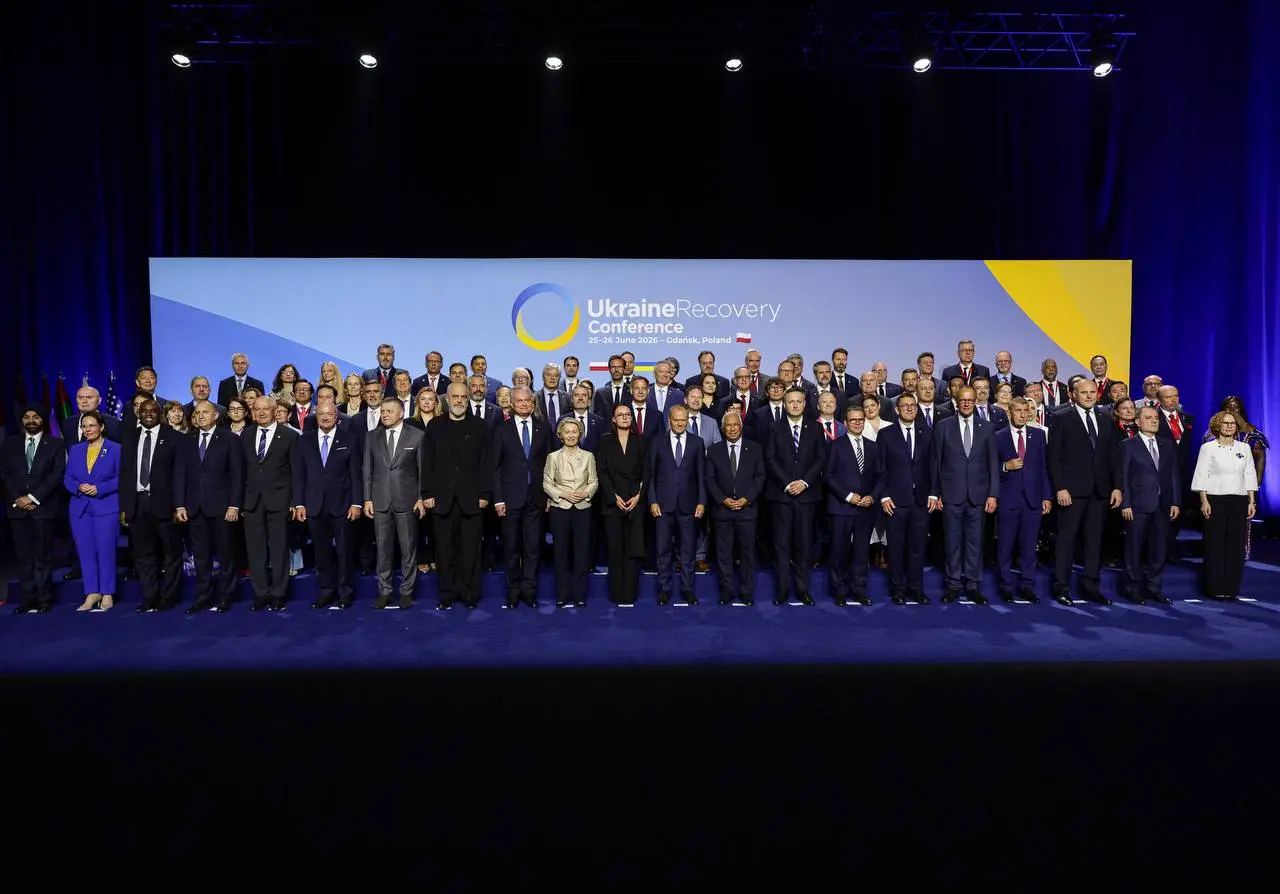
The diplomatic crisis between Poland and Ukraine had no significant effect on concrete outcomes: 15 of the 160 agreements were Ukrainian-Polish government-to-government deals, including cooperation between state-owned companies and credit agencies. Business separated itself from the presidential scandal. That is good news.
But Prime Minister Yulia Svyrydenko was not invited to the EU-member Eastern Flank summit, which took place in parallel with the conference. It is hard to imagine such a pointed exclusion had President Zelenskyy come to Gdańsk in person. The list of confirmed bilateral meetings she held over two days was limited to counterparts from the Czech Republic, Finland, Estonia, and the host, Donald Tusk. The president of Romania and the prime minister of Sweden flew into Gdańsk the same day — for the Eastern Flank summit, not for URC.
Diplomacy matters
Partners showed respect, but made clear that the level of representation affects the depth of discussions. That is not a footnote. At a conference where the weight of a voice is measured by who stands behind it, Ukraine arrived with its second-in-command.
Yulia Svyrydenko described the conference as a success that produced tangible results for Ukraine. But Zelenskyy framed Nawrocki's decision as domestic electoral maneuvering and said the Polish president had sought to derail the conference. If so, Nawrocki partly succeeded.
He did not cancel Gdańsk — but he changed its weight.
Without Zelenskyy, the conference remained a prime ministers' forum at a moment when Ukraine needed its head of state present not for protocol, but to sit at the tables where decisions on security guarantees and the pace of EU integration are actually made.
Two things are beyond dispute. First, European support for Ukraine is holding and, despite everything, growing. The conversation has shifted from humanitarian aid to strategic investment in a country at war. That shift is real.

Second, the distance between what was declared and what is sufficient remains large. Ukraine's external financing needs for 2026 stand at around $52 billion. Gdańsk closed part of that gap, not all of it. The defense industry received recognition, but not systematic integration into allied supply chains. EU accession moved, but the first cluster is not membership. And the largest continental donor's call to "freeze the front" sits uneasily at a conference dedicated to rebuilding a country where roughly 200 combat engagements occur every day.


