

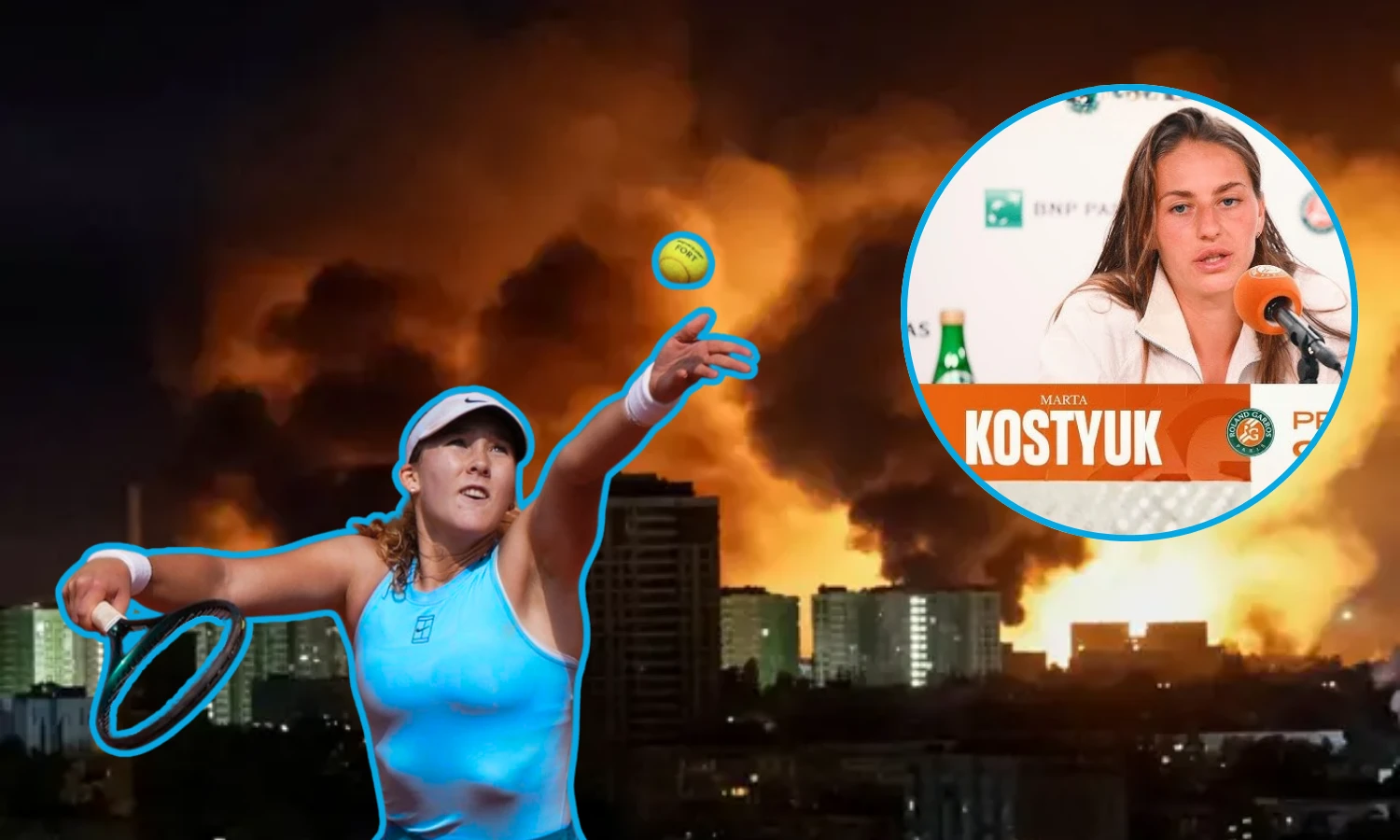
Russia bombed Kyiv and Dnipro on Monday night, killing 22 people and wounding more than 130. On Tuesday, Marta Kostyuk beat fellow Ukrainian Elina Svitolina to reach her first Grand Slam semifinal. On Thursday, she plays Russia's Mirra Andreeva.
It is the second time in five weeks the two have met for a major title shot. It is also the latest chapter in tennis's most sensitive and unavoidable storyline: the sport has quietly let Russian players keep competing through four years of full-scale war, and their Ukrainian opponents are increasingly unhappy about it.
Four years after Russia’s full-scale invasion of Ukraine, Russian athletes are slowly being welcomed back by many international sports federations.
Despite the fact that Russia is still occupying 20% of Ukraine and is raining bombs and missiles down over Ukraine every night.
A sequel
Five weeks ago, Kostyuk and Andreeva faced each other in the Madrid Open final, where the Ukrainian claimed the biggest title of her career with a 6–3, 7–5 victory—her first WTA 1000.
As has become customary in matches between Ukrainians and Russians, there was no handshake. Not before, not after.
Kostyuk ended her trophy speech with the words, "Glory to God and glory to Ukraine."
Andreeva, 19, broke down in tears during the same ceremony as she tried to thank her coach, former Wimbledon champion Conchita Martínez. She congratulated Kostyuk on what she called an "incredible victory."
The contrast was the picture of the spring clay season. Kostyuk's triumph carried obvious symbolic weight for Ukrainian supporters. Andreeva's tears underlined the pressure on one of the sport's brightest young talents.
Thursday's meeting arrives with both that history and unfinished business attached.
"I don't know how you can sleep at night"
On Tuesday, after her three-set quarter-final win over Svitolina—the first all-Ukrainian women's quarter-final at a Grand Slam in the Open era—Kostyuk did her on-court interview with tears running down her cheeks. She dedicated the win to Ukraine, referring directly to the previous night's attack.
"So many people are dead," she said. "I want to give this to the Ukrainian people."
At her press conference the next day, asked about her Russian opponents, she went further:
"They are all grown-ups. They know what's going on. They have phones. They have Instagram. They have news… I wish there was some more clear stance on what's going on, especially when your country is killing other people.
I don't know how you can sleep at night peacefully when you know that this is going on, and you have nothing to say about it."
She has been saying versions of this since 2022. She refuses to shake hands with Russian opponents who have not publicly opposed the war. Her argument has been consistent: a handshake reads as normality, and the war is not normal.
Trending Now
The numbers behind what she means are not abstract. Ukraine's Prosecutor General's Office has registered more than 190,000 war crimes committed by Russian forces since the full-scale invasion began. The UN Human Rights Monitoring Mission has verified more than 56,000 civilian casualties—a floor, not a ceiling. Russia still occupies roughly a fifth of Ukraine. The strikes that killed 22 people on Monday night used 656 drones and 73 missiles.
The political context tennis tried to leave outside
The picture is more complicated than a clean Russia-versus-Ukraine narrative. Andreeva has lived and trained in Spain through most of her adolescence and has worked under Martínez's guidance for the past two seasons. At 19, she belongs to a generation whose professional life has been shaped more by the tour than by the politics of the country on her player profile.
She has chosen to keep her public statements about tennis. She has not condemned the war. She has not endorsed it either.
That silence is itself the question Kostyuk keeps asking.
The tennis tours never banned Russians and Belarusians outright. The WTA, ATP, ITF, and Grand Slam Board agreed in March 2022 to let them continue competing as neutrals, without national flags or anthems. Wimbledon was the outlier—it banned them in 2022 and reversed in 2023. Since then, the only public friction has been the players themselves: the missing handshakes, the dedications, the press conferences that begin with overnight casualty counts.
Other sports have been less consistent. World Athletics held its ban longer. Some federations have eased their positions over the past year as Western governments have shifted focus elsewhere. The drift is one direction.
For Ukrainian players, the issue has never been whether individual Russian opponents are personally responsible. It is that the war is ongoing and the cost—tens of thousands of Ukrainians killed, millions displaced, cities under nightly drone attack—does not pause for the tournament calendar.
What Kostyuk thinks the match is for
Andreeva's rise over the past two seasons has been one of the best stories in women's tennis. She has been to a Roland Garros semifinal once before, as a 17-year-old in 2024. She is now No. 8 in the world and a Grand Slam contender before her 20th birthday.
None of which makes the match politically inert.
Kostyuk wants to use her platform, she told reporters in Paris.
"The biggest thing I can do is sit here and talk about it so more people can find out about it so they don't get used to this terrible life."
The French Open has long sold itself as international sport at its most transcendent—two weeks where the game stands above the world it is played in. The Andreeva–Kostyuk semi-final is a reminder that the world walks onto the court anyway, especially in wartime. It walks on with the player whose country is being bombed.
Read Also
-
“Now it’s your turn”: US envoys planned to show Moscow a refinery pause and a diesel deal, then ask for something back, a source tells Reuters
-
“A warning to companies that remain”: Russia takes control of Nestlé and Auchan’s assets – companies that stayed in Russia following the full-scale invasion of Ukraine
-
“I can travel back to Finland and be safe. That is a luxury”: Sanna Marin on the Russian strike that stopped her train from Kyiv


