


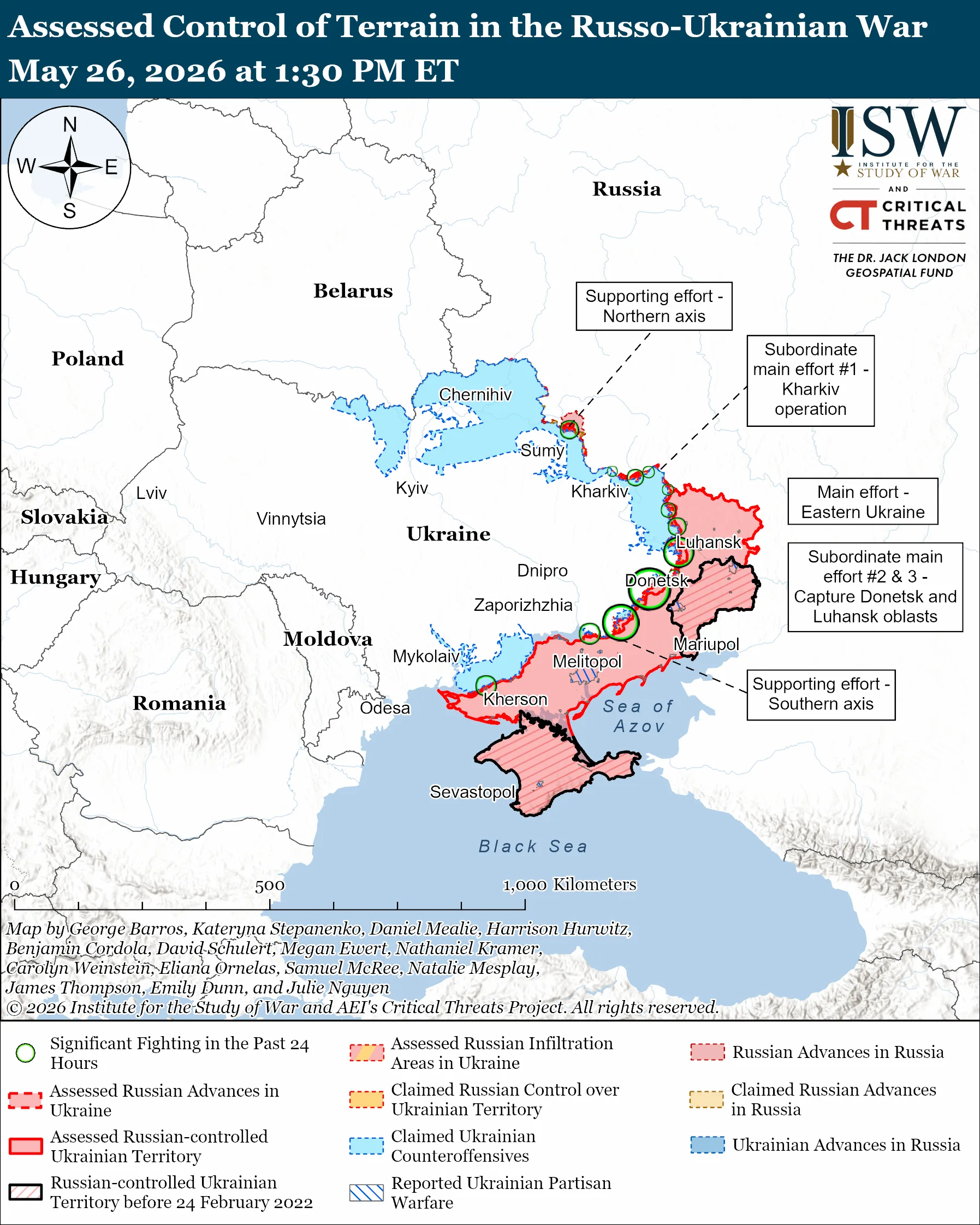
Belarus "is very unlikely to launch a ground invasion against Ukraine," yet Moscow and Minsk appear to be setting the informational groundwork to justify Russia launching drones at Ukraine from Belarus, the Institute for the Study of War (ISW) said on 26 May. ISW reads Belarusian Security Council Secretary Alexander Volfovich's same-day claim of 116 attempted Ukrainian drone crossings into Belarus as preparing the pretext. Belarusian airspace would let Russia hit Polish-Ukrainian supply lines that Moscow cannot easily reach from its own territory.
Lukashenka security chief's claim and its framing
Lieutenant General Volfovich claimed on 26 May that Belarusian forces have allegedly "recorded" 116 Ukrainian drone attempts to cross the international border into Belarus over the past week. He also stated that some of those crossings were intentional Ukrainian strikes on Belarusian border facilities.
The claim follows weeks of Ukrainian warnings that Moscow has been pushing Minsk to take military action against Kyiv or against an unspecified NATO state.
Why a ground invasion is not what ISW expects
ISW sees little chance Belarus will mount a ground push into Ukraine. The think tank reports no signs of Belarusian troop concentrations on the Ukrainian border at the scale a ground operation would require. Moscow itself does not have the spare combat-ready forces it would need to back a Belarusian incursion.

“First 500 targets already marked”: Ukraine has a response plan if Belarus enters war, says drone forces commander
Robert "Madyar" Brovdi, head of Ukraine's Unmanned Systems Forces (SBS), has already drawn red lines on that scenario: he warned on 26 May that "the first 500 targets are already marked" if Belarus enters Russia's war. He directed the warning at Belarusian leader Aliaksandr Lukashenka.
What Belarus airspace gives Russia
Russian forces are already hitting western Ukrainian oblasts from Russian soil but lack the precision to strike moving targets, the ISW assessment notes. Operating Shahed-class drones and lower-cost Molniyas from Belarusian soil would put the M-06 highway from Kyiv to the Polish border within precision range. The same applies to the rail line that carries Polish supplies into Ukraine. Remote control from Belarus would also let Russian operators hit moving convoys and trains.
Trending Now

Belarus is building training grounds, transport hubs, and logistical routes — Ukraine says Russia could use them for offensive at any time
Belarusian territory is already part of Russia's drone-strike chain. In February 2026, Ukrainian hackers exposed a six-month operation routing Russian Shaheds through Belarusian civilian cell towers and using signal repeaters installed on Belarusian rooftops to reach Kyiv, Rivne and Volyn oblasts. Ukraine dismantled that Mesh relay network later that month. By 2 May, Russia had shifted to airborne signal-relay balloons drifting from Belarus into Ukrainian airspace to keep its strike drones connected.
The Korosten precedent
A Russian drone operator based in Belarus already executed this kind of strike once. Ukrainian officials reported that on 22 December 2025, a Shahed-type drone derailed a freight train near Korosten, in Zhytomyr Oblast, northern Ukraine. Four railway workers were injured. The hit landed about 50 kilometers south of the Belarusian border.

“Not MANPADS — communications”: Expert says Russia’s real drone threat is turning Shaheds into 200 km FPV weapons
That strike showcased flying a Shahed remotely via FPV (first-person-view, remote-piloted) control onto a moving locomotive. A Ukrainian expert has since analyzed the technique as Russia's main evolving long-range drone threat. ISW frames the Korosten strike as Russia's operational template for its theater-wide campaign against Ukrainian rear logistics.


