

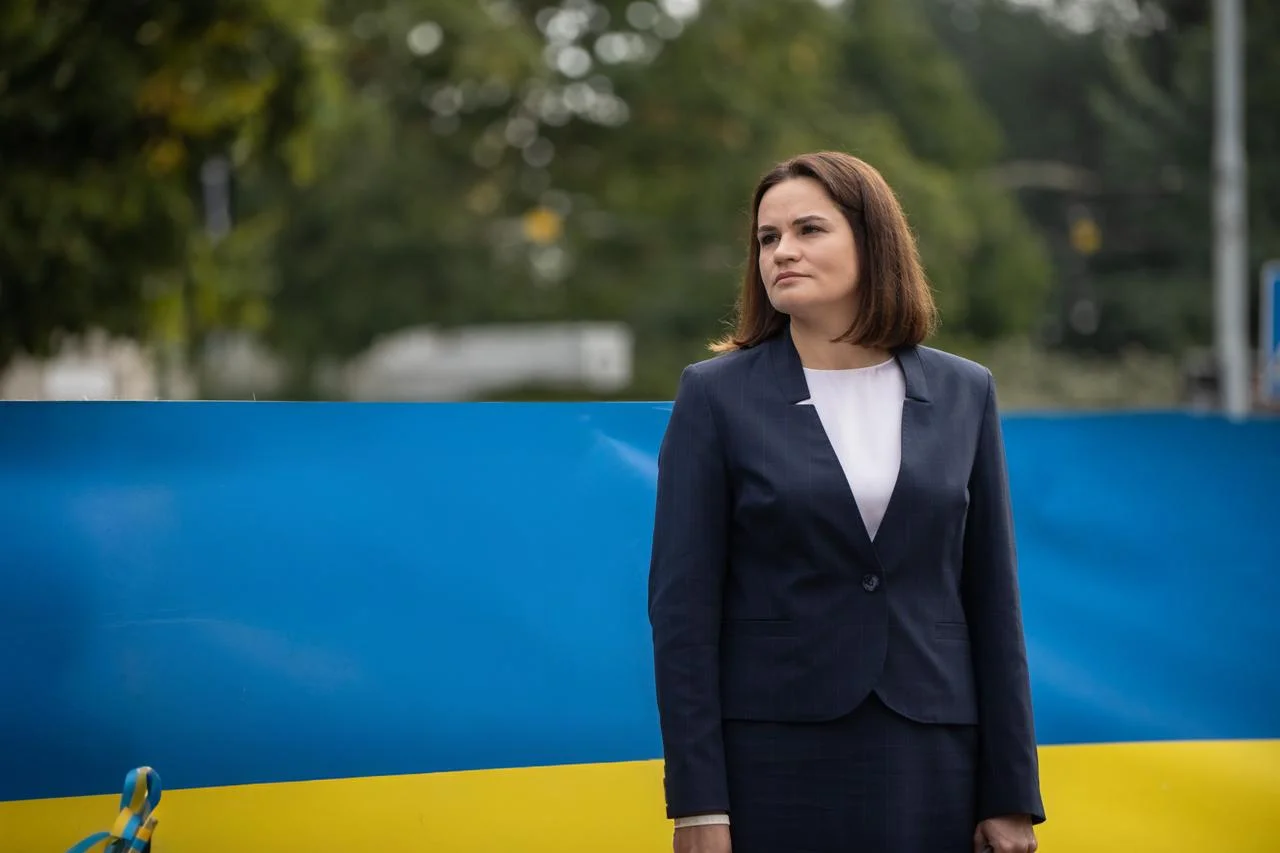
Today, Sviatlana Tsikhanouskaya paid her first official visit in Kyiv. It marks a milestone in relations between Ukraine and the Belarusian democracy movement.
Since Aliaksandr Lukashenka crushed the 2020 protests and handed Russia a staging ground for its 2022 invasion, Belarus's opposition has operated entirely from exile. Independent political parties have been banned. Most leading figures spent years in prison. The December 2025 prisoner releases—part of a deal involving the lifting of Western sanctions—brought several of them back into public life, along with renewed attention to where the movement stands on Ukraine.
The short answer: nearly unanimously in support. But the nuances matter, particularly for a movement that hopes one day to govern a country with deep historical, economic, and social ties to Russia.
Tsikhanouskaya: from diplomatic hedging to clear solidarity
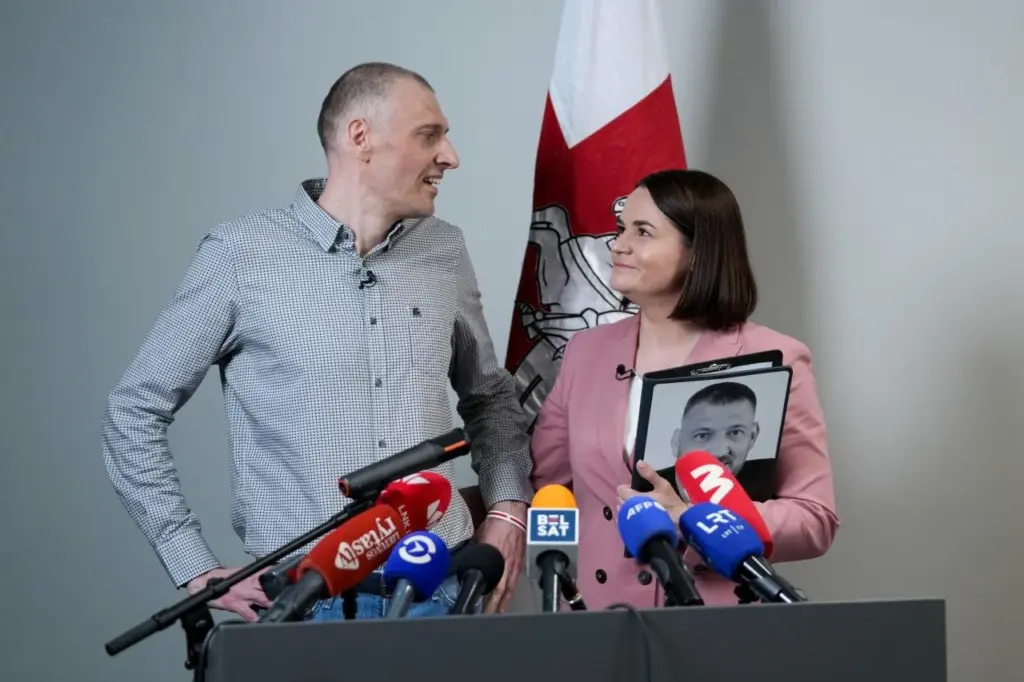
Sviatlana Tsikhanouskaya is the most internationally recognized figure in the Belarusian opposition. She entered politics in 2020 when her husband, video blogger Siarhei Tsikhanouski, was disqualified and later arrested ahead of the presidential election. She had no prior political experience; her stated goal was to free political prisoners and secure new elections.
On Crimea, her early statements were deliberately cautious. In September 2020, she told Lithuanian broadcaster LRT that the peninsula was "de jure Ukrainian and de facto Russian"—acknowledging international law while stopping short of a direct claim. By April 2021, she had abandoned the hedge and directly stated that Crimea is Ukrainian. "When you speak indefinitely, it doesn't mean you're wrong—you're just speaking diplomatic language," she told Eurointegration. "Now I've said it clearly."
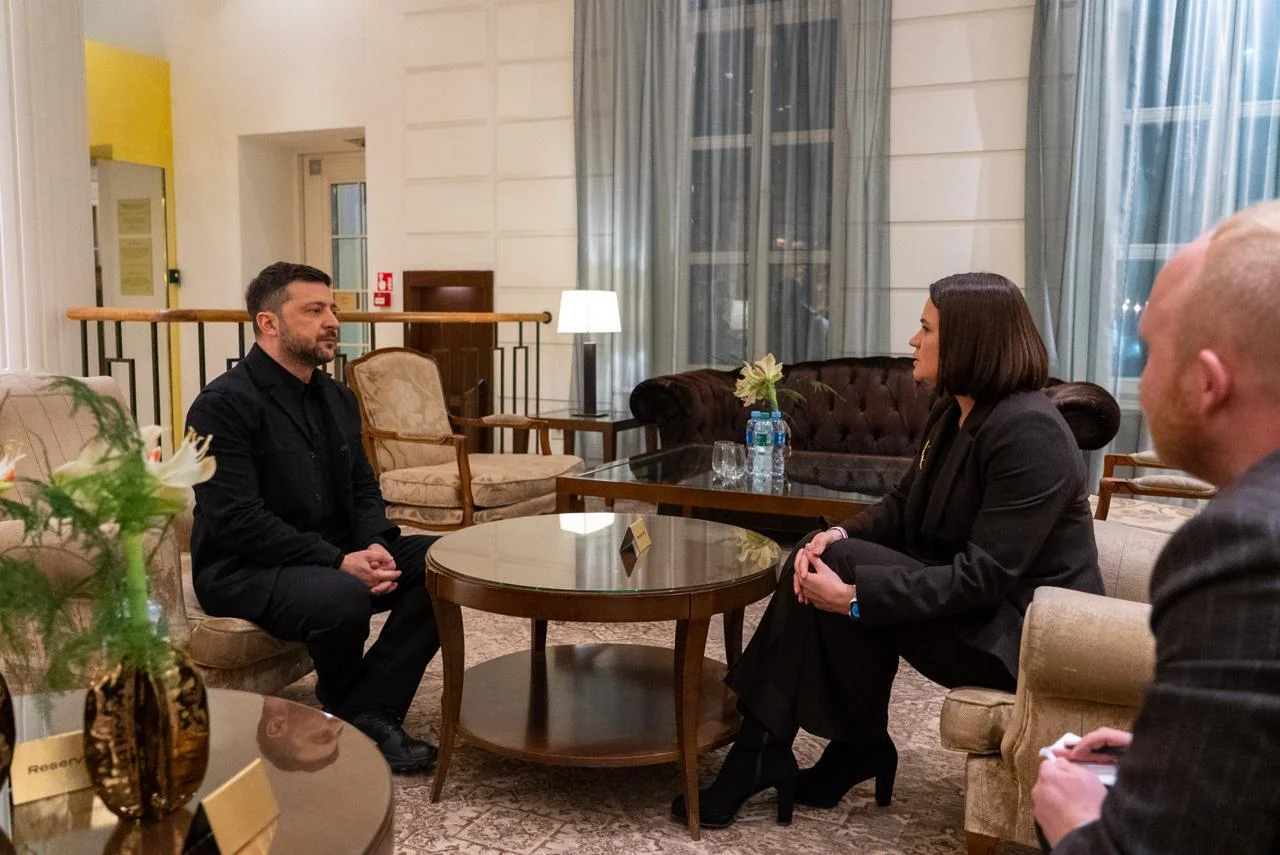
Since Russia's full-scale invasion, her position has hardened into something closer to a strategic doctrine. "There will be no free Belarus without a free Ukraine, and there will be no safe Ukraine without a free Belarus," she said in a 2023 DW interview, noting that hundreds of Belarusian volunteers were fighting in Ukrainian ranks. By 2025, she was describing Russia's war as "a war against freedom itself." Her office and the United Transitional Cabinet have supplied drones and equipment to the Kalinouski Regiment—a unit of Belarusian volunteers fighting for Ukraine. In August 2024, the regiment's deputy commander, Vadzim Kabanchuk, formally joined her transitional cabinet. In January 2026, she held her first full bilateral meeting with President Zelenskyy.
"We, Belarusians, know what Russia is. We know its imperial appetites. We know what tyranny is. We understand that today Ukraine is fighting not only for itself, but for all of us — including for a free Belarus", Tsikhanouskaya stated in an address marking the fourth anniversary of the full-scale invasion.
Five years after Belarus’ stolen election, Ukraine is still catching up on Tsikhanouskaya
Siarhei Tsikhanouski himself traveled to Russian-occupied Crimea in 2017 and was added to the Myrotvorets data base, a visit he later attributed to political indifference—he was not politically involved, and hadn't thought seriously about who the peninsula belonged to. In prison, he revised his position. In a 2021 statement, he declared Crimea should belong to Ukraine both de jure and de facto. After his 2025 release, he was unambiguous.
"I fully support Ukraine. President Zelenskyy has had to bear such a terrible burden. What I went through is nothing compared with what he has endured. He is a hero to me. I support him fully and unconditionally", he said at a press conference.
Babaryka: support for Ukraine, prolonged silence on Crimea
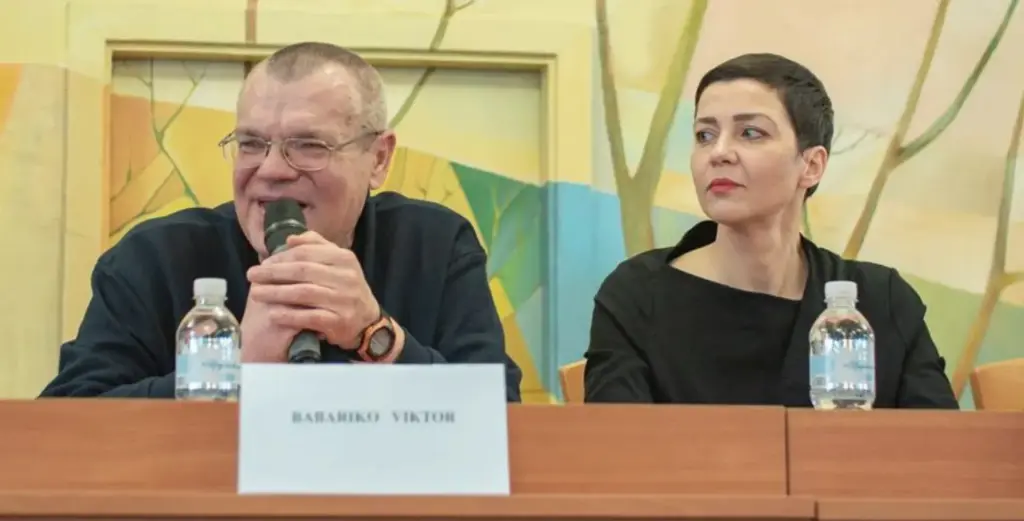
Viktar Babaryka was another major 2020 presidential candidate, and the most complicated figure in this picture. He was arrested on 18 June 2020 and sentenced to a lengthy prison term that ended only with his release in December 2025 in exchange for sanctions relief. A former head of Belgazprombank—a subsidiary of Russia's Gazprom—he had argued for a neutral Belarus that would exit the Collective Security Treaty Organization, a position that placed him at odds with Moscow despite his professional ties to it.
On Crimea, Babaryka long avoided a direct answer in public. In May 2020, asked who the peninsula belongs to, he quipped to Nasha Niva: "There's a beautiful answer: 'To Greece.'" After his December 2025 release, he again declined to answer the question directly—even as he voiced general support for Ukraine in a video call with Zelenskyy. His refusal sparked sharp discussion on Belarusian social media. Dissident and blogger Ihar Losik, who just like Babaryka, spent more than five years in prison commented on such statements in the following way:
“Even in incommunicado detention, there were different ways to learn about the events of the war in Ukraine, and after my release, everyone I spoke to was surprised at how I knew almost everything. [...] But my views on ‘whose Crimea is it’ and ‘who is the aggressor’ were not formed after the war, nor after my Ukrainian relatives went to fight as volunteers from the very beginning and were killed there by Putin’s forces. I believe that every adult and educated person should have made up their mind back in 2014, when Putin occupied Crimea and Donbas and shot down the Malaysian Boeing. It is surprising that even in 2025, despite many years in prison, someone still cannot answer these simple questions,” wrote Ihar Losik on Facebook.
Only later, in a February 2026 interview with Zerkalo, did Babaryka explicitly say that Crimea “legally and justly belongs to Ukraine,” while admitting that his 2025 answer had been “wrong.” He lives in exile in Berlin and declared his intention to return to politics. Babaryka's case is the partial exception to the broader shift. His correction came late, and only after public criticism within the opposition itself.
Maria Kalesnikava: no ambiguity on Crimea, but nuance on sanctions
Maria Kalesnikava was part of Viktar Babaryka's 2020 campaign team and quickly became one of the opposition's most prominent faces. Arrested in September 2020, she was held for over five years before her December 2025 release.
Her position on Ukraine was the most unequivocal of the major figures. In an interview after her release, she told Zerkalo that Crimea is unambiguously Ukrainian and that she had held this view since 2014. In a video call with President Zelenskyy, she voiced full support for Ukraine's fight for freedom and sovereignty.
She has also taken a distinct position on the internal opposition debate over sanctions, arguing they should be limited in scope to prevent Belarus from falling into deeper economic dependence on Russia—a view that has generated controversy within the exile community.
Veterans of the Belarusian dissident movement
Trending Now
Long before the 2020 protest generation, an older cohort of Belarusian dissidents had been sounding the alarm about Russian imperialism—and building concrete ties with Ukraine. For most of the post-Soviet period, however, their analysis was considered the concern of cultural nationalists rather than serious political analysis. The political mainstream, including the moderate opposition, focused elsewhere: on free elections, civil society, and the prospects of economic reform. The threats these dissidents named—to the Belarusian language, to Belarusian sovereignty, from Russian imperial ambition—were widely viewed as marginal issues, not strategic ones.
Zianon Pazniak, who ran against Lukashenka in 1994 and has lived in exile ever since, warned of Russian imperial ambitions that same year—nearly three decades before February 2022. He held a moment of silence for assassinated Chechen president Dzhokhar Dudayev at a 1996 rally, left Belarus immediately afterwards, and never returned.
In exile, he remained a famous but also controversial opposition politician, often known for getting into conflicts with other opposition politicians and accusing them - including Sviatlana Tsikhanouskaya - of being “agents of the regime”. He is therefore now seen as having comparatively little influence on the Belarusian opposition movement. However, Pazniak remained firm in his support for Ukraine and Belarusian volunteers fighting for Ukraine. In January 2023, he visited Kalinouski Regiment fighters in Bakhmut. Pazniak has consistently argued that Belarus is de facto under Russian occupation and that the war in Ukraine is simultaneously a war for Belarus's future.
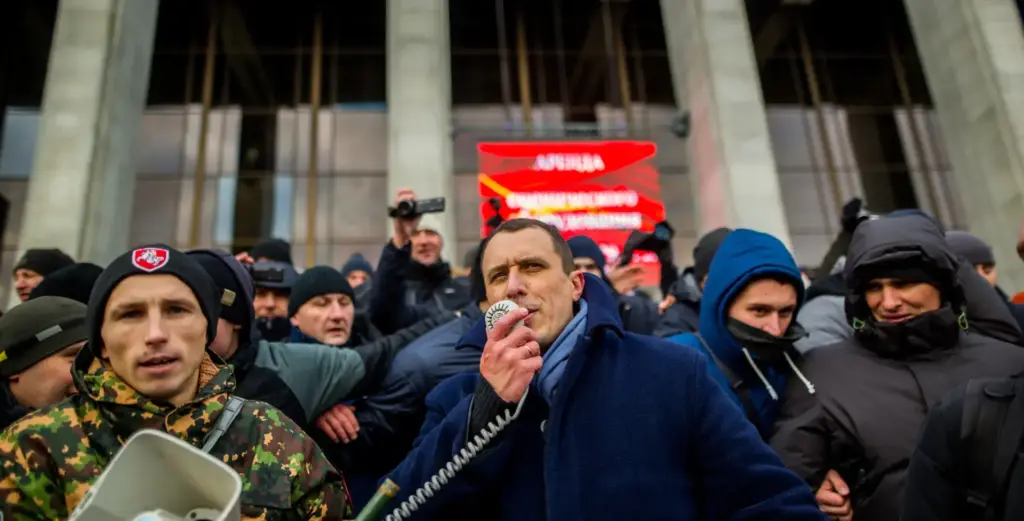
Pazniak co-founded the Belarusian Popular Front, whose alumni include Nobel Peace Prize laureate Ales Bialiatski and Pavel Sevyarynets, both released from prison in December 2025 after years of detention.
Sevyarynets was also one of the first leaders of the youth organization Young Front and later of the political party Belarusian Christian Democracy, both with longstanding pro-Ukrainian profiles. When a fellow Belarusian Christian Democracy member, Ales Charkashyn, died fighting for Ukraine in 2015, Sevyarynets attended the funeral and knelt at his tomb. The chairman of Young Front, Dzanis Urbanovich, joined Ukraine's territorial defense forces in 2022 along with six other organization members.
Mikalai Statkevich has a significantly dramatic story. A veteran dissident who left the Communist Party in 1991 in protest at the crackdown on Lithuanian independence, he had spent years warning that Russia intended to absorb Belarus. In 2019, together with Pavel Sevyarynets, he organized protests against the intensified integration process with Russia in Minsk. Arrested in May 2020, he was due for release in September 2025 but refused deportation to Lithuania, preferring to remain in Belarus. He was promptly rearrested, then released in February 2026 following a stroke.
Nobel laureate Bialiatski, commenting on Statkevich's conduct, said:
"You need incredible resilience to endure what he endured—I deeply respect it. And I think the question of Ukraine and Crimea was never a question for Mikalai. He's a person with a clear, firm position."
These figures had been making the case for decades. Their warnings—about Russian imperial ambitions, about the structural link between Belarusian and Ukrainian sovereignty—were widely viewed as cultural nationalism rather than mainstream political analysis until the events of 2020 and 2022. Today, most of the opposition agrees with them.
Free Belarus, free Ukraine: the opposition's shared logic
Five years ago, much of Belarus’s opposition tried to avoid drawing hard lines on questions like Crimea or Russia. That space is gone.
War, prison, and exile have forced choices that once seemed politically inconvenient. For most opposition figures, supporting Ukraine is no longer just a statement of values—it is a recognition of reality. As long as Russia props up Lukashenka, change in Belarus remains out of reach. And as long as Ukraine is fighting that same Russia, the two struggles are inevitably linked.
There are still differences in tone and emphasis. Belarus’s future leaders will have to reckon with a country deeply tied to Russia, and not everyone is ready to close every door. Babaryka’s hesitation shows that calculation hasn’t disappeared.
But the direction is unmistakable. Across generations, the opposition has largely aligned around a simple idea: Belarus cannot be free while Russia’s war continues—and Ukraine cannot be secure while Belarus remains under Lukashenka.
What was once a slogan now reads more like a strategy. Sviatlana Tsikhanouskaya's visit to Kyiv will reveal the potential of this strategy.
Read also
-
“A warning to companies that remain”: Russia takes control of Nestlé and Auchan’s assets – companies that stayed in Russia following the full-scale invasion of Ukraine
-
“I can travel back to Finland and be safe. That is a luxury”: Sanna Marin on the Russian strike that stopped her train from Kyiv
-
Ukraine put its own peace proposals on the table as two US envoys reached Kyiv for the first time
Read also
-
“A warning to companies that remain”: Russia takes control of Nestlé and Auchan’s assets – companies that stayed in Russia following the full-scale invasion of Ukraine
-
“I can travel back to Finland and be safe. That is a luxury”: Sanna Marin on the Russian strike that stopped her train from Kyiv
-
Ukraine put its own peace proposals on the table as two US envoys reached Kyiv for the first time


