


Ukraine's Unmanned Systems Forces (SBS) have begun firing unguided aviation rockets from long-range drones deep inside Russian-held territory, the force's commander Robert Brovdi, call sign Madyar, announced on 17 May 2026. The drones now add a stand-off rocket strike to their kamikaze role, a profile built to destroy the mobile teams that shield Russia's air defenses. The first confirmed strike hit a Black Sea Fleet site in occupied Crimea.
What Ukraine added to the drones
Brovdi said operators paired a 60-kilogram strike warhead with eight unguided rockets carried on the drone, used at depths of up to 500 kilometers. The NURS unguided aviation rockets, the Soviet-era S-5 and S-8 family, are normally fired by ground-attack jets like the Su-25 and helicopters such as the Mi-24 against targets on the ground.
No crewed aircraft can survive reaching the depths where these drones operate, which is why the combined kamikaze-plus-rockets method opens new options. Brovdi framed the program as a hunt for the gunners and shoulder-fired missile teams that guard Russian surface-to-air batteries, and taunted those crews directly. He said Russian air-defense work was being dismantled steadily, with "more and more systems already afraid to switch on" for fear of the drones above them.
The strike on occupied Crimea
Militarnyi noted that the Unmanned Systems Forces struck a strategic protected-communications node of Russia's Black Sea Fleet near the settlement of Myrnyi in occupied Crimea. The 1st Separate Center of Unmanned Systems released thermal video and said every strategic enemy site would be destroyed, with nowhere left to hide on land, at sea, or in the air.
Trending Now
The rocket fit on these drones first became known in mid-May 2026 through Russian Telegram channels. Russian military accounts claimed the drones hit mobile air-defense groups using two launchers of four rockets each. The same logic has driven Ukraine's wider effort to hunt the air-defense systems screening Russian forces in the occupied south.
A command post on the Arabat Spit
The Defense Forces also struck a Russian command post on the Arabat Spit in Kherson Oblast, Militarnyi reported. NASA's FIRMS satellite monitoring recorded a strong thermal signature at 02:58, and local residents reported an attack by six strike drones that set off a large fire.
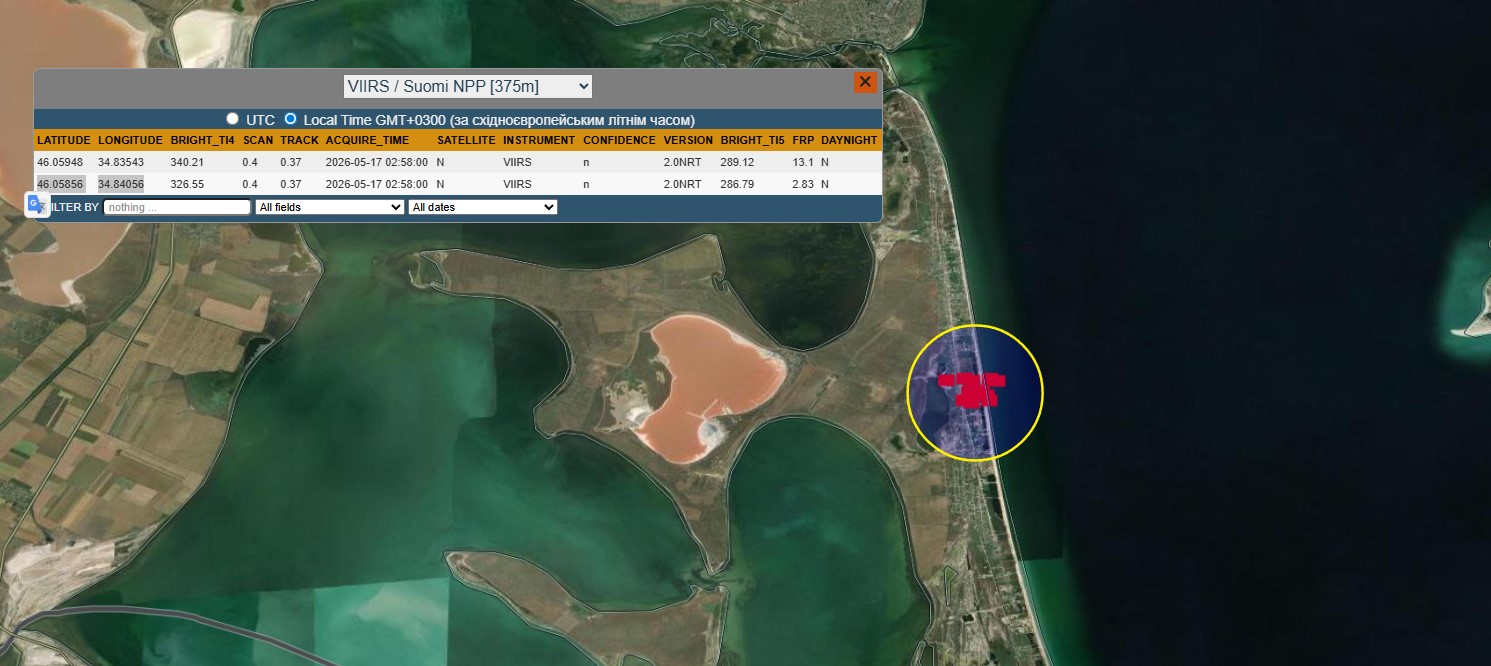
Russia has built a major base on the spit, including the headquarters of its Dnepr group of forces and training grounds. The main occupier headquarters is in the village of Shchaslyvtseve, at the seized Bryhantyna resort base, and Russian President Vladimir Putin allegedly visited that site in 2023.
Read also
-
Vivaldi’s secret weapon was the targeting, not the robots: Third Corps reconnaissance mapped Russian command nodes, then hit them to cause panic
-
Russian spies ran a campaign against Kyiv on Anthropic’s Claude, and the AI chatbot’s maker caught them at it
-
One Russian drone held up seven flights in Moldova, Zelenskyy’s trip to Norway for King Harald V’s funeral among them


