


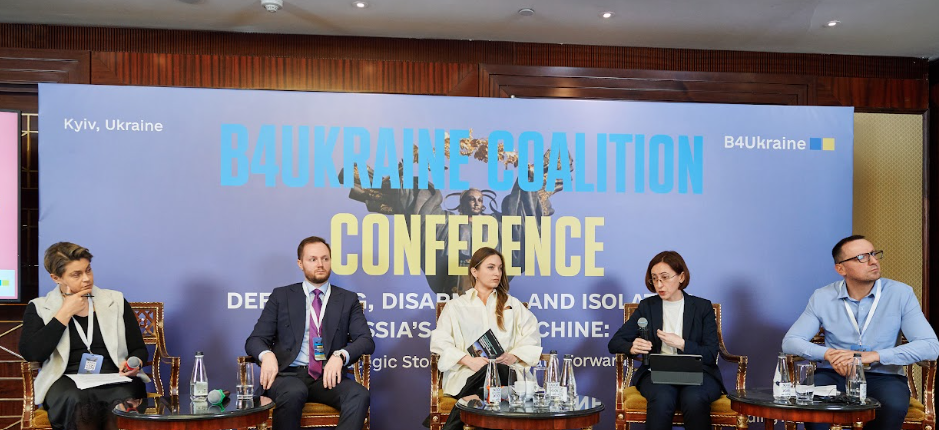
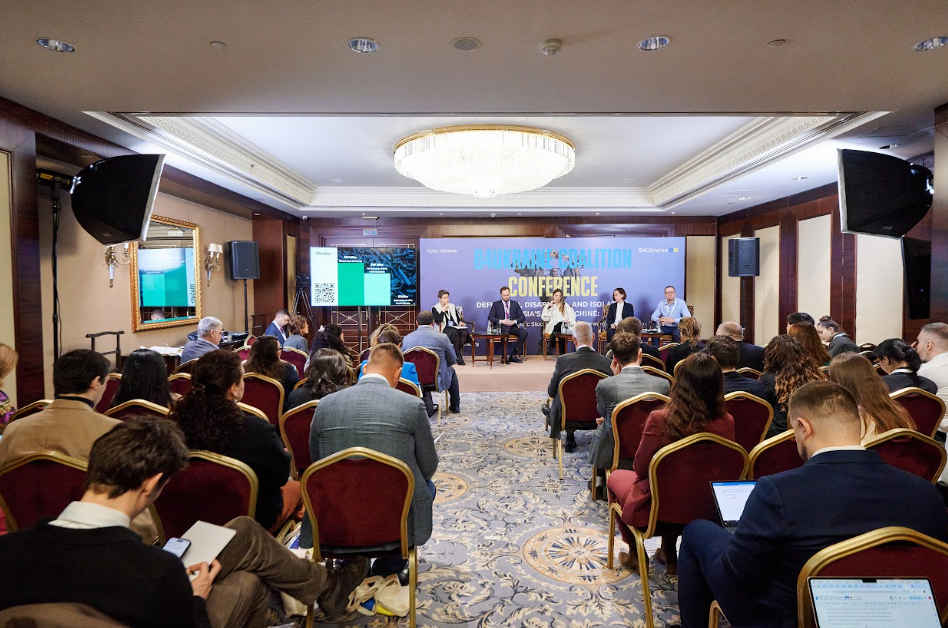
The B4Ukraine conference was fourteen hours of near-relentless discussion on one question: how to make sanctions on Russia actually bite. Ella Skybenko was there throughout — sometimes on the main stage and at other times listening attentively to other speakers.
I sat down with her on the sidelines, and it quickly became clear why she was worth listening to. Skybenko is direct in a way that feels almost rare: European governments, she argues, are acting in open contradiction with themselves — imposing sanctions with one hand while allowing their own companies to keep funding the war with the other. The logic sustaining it all is, in her own words, inexplicable.
Swedish intelligence said that sanctions aren't changing Russia's core goals to destroy Ukraine and Europe. What can be done about that?
Well, I think we still need to continue exhausting Russia economically as much as possible and ensure that businesses contribute as little as possible to supporting the economy.
"Very large sums of money — and I'm not talking about sanctions now — flow into Russia's budget thanks to the many international companies that continue to operate there," the expert said.
The taxes are enormous. And all of this is prolonging the war. So, in any case, we must keep pressing and continue to the maximum extent possible.
What can sanctions actually lead to? The Soviet Union lived in extreme poverty, but still continued the war in Afghanistan
"I think the turning point will come when they simply have no money left to continue the war and no access to technology," Skybenko believes.
Two things keep Russia going: finances — and of course, manpower, of which they have plenty — and technology. Every missile, every Shahed, every weapon system requires either the machinery and machine tools to manufacture it, or the components, without which production is equally impossible.
China is playing an increasingly significant role in supplying these, but there are still critical components made exclusively by Western countries, without which Russia cannot sustain the war at full capacity.
I absolutely agree that none of this will change their goals. They will push to the very end. The quality of life of their population, the suffering of ordinary people — none of it moves them. Their goal, in my view, will never change. It has always been one and the same: the complete and total destruction of Ukraine.
Do you think there is a fear in Europe of Russia defaulting?
I completely agree. Europe fears a Russian default precisely because its own financial interests are deeply embedded there — ongoing trade, critical minerals, and much else besides. And so, unfortunately, a complete Russian economic collapse is not something European governments actually want. It also carries a security risk in their eyes: they worry that chaos could follow, with unpredictable consequences.
But this leads to a logic that is, frankly, contradictory.
"On the one hand, European governments are supporting Ukraine. On the other hand, they do almost nothing to make their own companies stop supporting the war, which they continue to do financially," Skybenko said.
Ukraine's Defense Intelligence publishes a list of companies that are still not under sanctions almost every week. Why does this happen?
Trending Now
Financial interests, most likely. Frankly, I can't explain the logic of their actions at all. Companies operating in Russia are earning enormous revenues and have no desire to walk away from that. And yet, those same governments are now spending enormous sums on defense — preparing, in effect, for a war that their own companies are helping to fund.
Sanctions don't only hit Russia — they hit Europeans too. How do you make Europeans understand that this is a sacrifice worth making for their own future security?
The argument is straightforward: when your own security is at stake, some economic discomfort is a price worth paying. This is no longer an abstract concern — it is already a matter of their survival.
"If Russia is not stopped now, the consequences for Europe will be far worse down the line, and the question may ultimately become one of physical existence," the expert stressed.
The choice, as uncomfortable as it is, comes down to the lesser of two evils.
Europe has agreed to allow Russian oil to pass through Hungary and Slovakia via the Druzhba pipeline. What do you think the Ukrainians, victims of genocide, feel when they are essentially forced to allow the transit of resources that will ultimately fund the killing of their own civilians?
"The Ukrainians feel betrayed. This inertia, Europe's inability to act effectively, is deeply disappointing," said Skybenko.
Many Ukrainians are simply disillusioned with partners who nominally support them but don't do enough to help Ukraine win the war quickly. Again, because of their fear that completely destroying Russia would harm them as well.
Experts say energy is Russia's primary source of war revenue. What comes second or third? It's rarely talked about.
Definitely the financial sector. Beyond that, significant revenue continues to flow from international companies still operating on Russian soil — consumer goods, retail, and everyday commerce.
Is the Russian economy being destroyed by sanctions right now, or is it actually being propped up by the situation with Iran?
I think it has been deteriorating gradually, very slowly — partly thanks to sanctions. But with the current war with Iran and the oil prices, it is winning right now. That is to say, we don't know how long this will last, but if oil prices continue to rise, unfortunately, Russia will only benefit. But I hope it won't last long and that we'll return to a stage where its economy continues to worsen.
Read also
-
Ukraine retook 240 square km north of Lyman and nobody reported it for three months
-
Ukraine is working down the short list of ships that shell its cities with cruise missiles. A Neptune reached one of them tied up at its own pier
-
Ukraine is sending its winning brigades to where the fighting is worst. The 46th just turned up outside Kramatorsk


