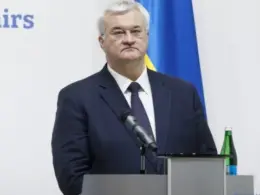
Ukraine’s foreign ministry says the process of creating a Special Tribunal for the crime of aggression against Ukraine has reached a decisive stage, following a ministerial meeting in Chisinau, Moldova, where 37 countries approved a key governing agreement.
The Special Tribunal is a planned international court to prosecute individuals responsible for the crime of aggression against Ukraine – the decision to launch and carry out the full-scale invasion.
Tribunal enters legal framework with approval of third founding document
Ukraine’s foreign minister Andrii Sybiha said the adoption of an Expanded Partial Agreement establishing the Steering Committee marks the third founding document of the tribunal framework, describing it as a step that moves the initiative into “legal reality.”
“Today, we have passed the point of no-return,” Sybiha said.
The meeting took place on 15 May during a session of the Council of Europe’s Committee of Ministers in Moldova’s capital.
Sybiha compares tribunal to Nuremberg
He compared the planned tribunal in The Hague to the post–World War II Nuremberg trials, saying it would help ensure responsibility for the crime of aggression, stating: “Just like the Nuremberg tribunal 80 years ago, this Special Tribunal in The Hague will restore justice from the ruins of war.”
He also said the tribunal would document accountability for Russia’s leadership, naming President Vladimir Putin, Secretary of the Security Council Sergei Shoigu, Chief of the General Staff of the Armed Forces Valery Gerasimov, FSB Director Alexander Bortnikov, National Guard chief Viktor Zolotov, Deputy Chairman of the Security Council Dmitry Medvedev, presidential aide Nikolai Patrushev, as well as Belarusian President Aliaksandr Lukashenka, and others.
He said they would “enter history” as perpetrators of aggression.
New agreement sets structure for participation and coordination
According to Sybiha, the new agreement sets administrative and governance rules for the tribunal and opens the door for more states to join the process. It is also expected to support coordination between three elements of what Kyiv describes as an accountability structure: the tribunal itself, an international compensation mechanism, and a registry of damages.
He said accountability “will never be a matter of compromise,” adding that justice is a necessary part of any lasting peace.
Tribunal linked to ongoing war and civilian casualties
Sybiha said the tribunal is especially urgent in light of recent Russian strikes on Kyiv that killed civilians, including children.
The tribunal initiative is being developed under the Council of Europe framework with participation from European and partner states, with further steps expected on its operational structure and location in The Hague.
Read also
-
$16 bn or lives of Ukrainians: Kyiv is furious after EU took two of Russia’s richest men off its sanctions list
-
Russia is spending jet-powered drones on Ukraine’s toilet-paper factory. It’s same campaign that has destroyed 2.1 million square meters of Ukraine’s warehouses
-
Ukraine offers Russia deal: stop hitting our power, and we stop hitting yours. US will pass it to Moscow