

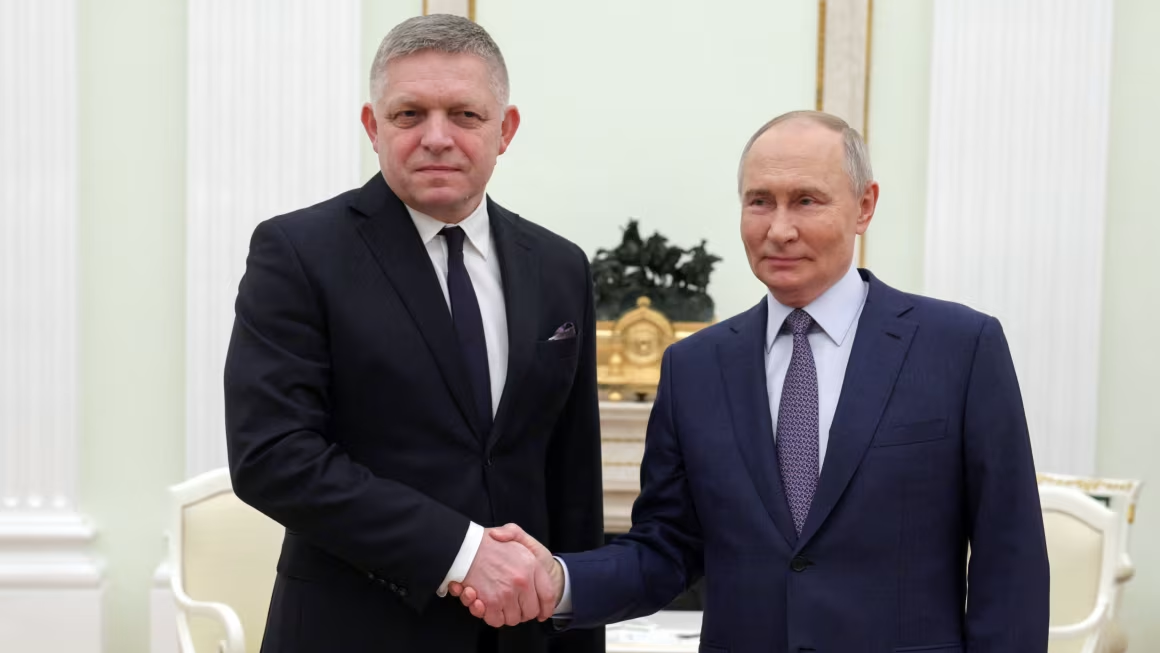
Slovak Prime Minister Robert Fico told the independent Slovak outlet Denník N on 22 April that he will not attend Russia's military parade in Moscow on 9 May, but he is not cancelling the trip.
Fico still plans to be in Moscow on 9 May to lay flowers at the Tomb of the Unknown Soldier—the same ceremony he performed last year standing beside Serbian President Aleksandar Vučić, as the only EU leader at Vladimir Putin's 80th anniversary celebrations. What changed between this year and last is the packaging. On 6 or 7 May, Fico now says, he will travel to Munich and to the former Dachau concentration camp. He also hopes to stop in Normandy to honour Allied soldiers. He calls it a "pilgrimage for peace."
The decision to skip the parade itself—not the country, not the date, not the Kremlin wreath—arrives three days after Lithuania, Latvia and Estonia again closed their airspace to his government plane, and after Bratislava asked Poland for transit permission instead.
What actually changed
Last year, Fico took the southern route when the Baltics blocked him: Hungary, Romania, the Black Sea, Georgia, Russia. He arrived the evening of 8 May. He watched the parade on the Red Square, met Putin and laid a wreath. Fico was, along with Vučić, the only European head of government there.

Pro-Russian Fico complains Latvia and Lithuania blocked his flight to Moscow for Putin’s 9 May parade (updated)
This year, Estonian Foreign Minister Margus Tsahkna said the Baltic position is unchanged: "Fico will not be granted permission to use Estonian airspace for a flight to the May 9 parade in Moscow this year either, a parade whose purpose is to glorify the aggressor."
The parade is off Fico's schedule. Moscow on 9 May isn't. Slovak Deputy Prime Minister and Defence Minister Robert Kaliňák confirmed to Slovak media that Fico will fly to Russia even if Poland denies the request, and that he himself will not accompany the prime minister this time.
The isolation is new; the pattern isn't
When Fico arrived in Moscow last May, he had support inside the EU. Hungary's Viktor Orbán stayed home but coordinated politically—both leaders had blamed Ukraine for Druzhba pipeline damage, echoed Moscow's messaging, and threatened veto power inside the bloc.
Orbán lost Hungary's 12 April election to Péter Magyar. Fico is now the EU's lone openly pro-Russian head of government, three weeks before his second consecutive 9 May trip to the Kremlin.
His rhetoric has been consistent. In August 2023, campaigning in his hometown of Topoľčany, Fico told supporters:
Trending Now
"The war in Ukraine didn't start yesterday or last year. It began in 2014, when the Ukrainian Nazis and fascists started to murder the Russian citizens in Donbas and Luhansk."
Since taking office that October, he has halted Slovakia's military aid to Ukraine, opposed sanctions, met Putin in Moscow in December 2024 and again in September 2025, and threatened to block the next EU sanctions package unless Moscow's oil transit through Druzhba to Slovakia is restored.
In December 2025, he told European Council President António Costa that he would not support the EU's €210 billion loan to Ukraine backed by frozen Russian assets, calling the bloc's strategy "nothing but senseless killing." He invoked Donald Trump's peace efforts as grounds for his veto.

Politico: Fico is first in line for Orbán’s disruptor crown — but Brussels has four more leaders to worry about
What Kyiv and the Baltics are reading
Ukrainian Foreign Minister Andrii Sybiha thanked Estonia, Latvia and Lithuania on 20 April: "Let's make up for the lack of consciousness with a lack of air routes." He called on other countries to follow.
Poland is still reviewing Bratislava's transit request. If Warsaw refuses, Fico will take last year's southern route—Hungary, Romania, the Black Sea, Georgia, Russia. Either way, he will be at the Tomb of the Unknown Soldier on 9 May. Same day, same city, same wreath. Only the parade has been cut.


