


Ukraine has six months to build an energy system sturdier than the one that barely survived last winter—and it is already behind schedule.
Kyiv plans to commission 1.5 gigawatts of new distributed gas generation in 2026.
Energy Minister Denys Shmyhal announced on Telegram this week that Kyiv plans to commission 1.5 gigawatts of new distributed gas generation in 2026 alone—as much as all four years of full-scale war combined—with state energy companies Naftogaz and Gas Transmission System Operator of Ukraine (OGTSU) contributing 232 MW and 92 MW respectively; 102 MW was already commissioned in March.

President Volodymyr Zelenskyy said on Telegram the same week that four regions are falling behind their resilience targets. And former head of the OGTSU Serhiy Makogon told Telegraf in March that heating utilities owe Naftogaz more than 100 billion hryvnias ($2.3 billion)—without clearing which, next winter’s gas procurement may be impossible.
The grid survived at the limits of its capacity during the coldest weeks.
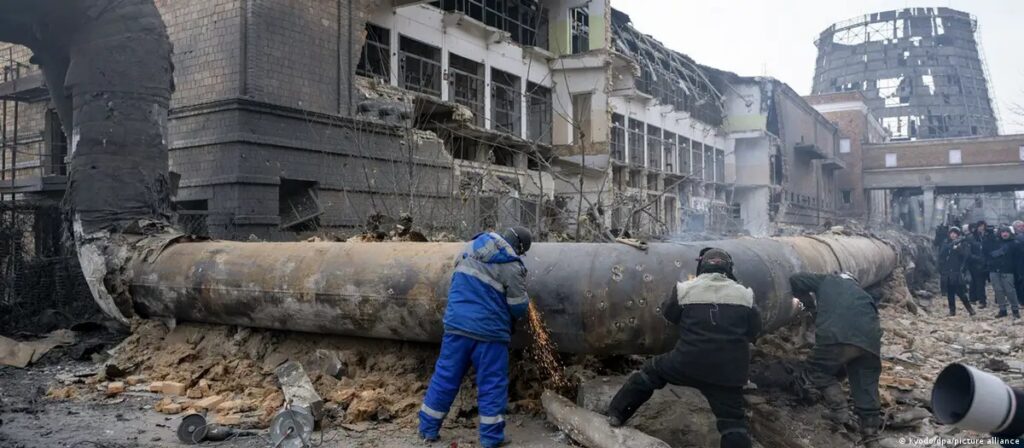
Last winter established why this matters. All 15 thermal plants were damaged or destroyed in Russia’s 2025–2026 energy campaign, the most destructive of the war. The grid survived at the limits of its capacity during the coldest weeks.
The system was held by improvisation rather than design. Regions that had invested in distributed heating before the strikes—Zhytomyr, most visibly—kept the lights on longer, though none escaped unscathed. The heating season is now over. October, when the next one begins, is the hard deadline.
Speaking at the Congress of Local and Regional Authorities in Uzhhorod on 9 April, Prime Minister Yuliia Svyrydenko said that the government has secured 22.1 billion hryvnias ($510 million) for the first phase—protection of 576 priority critical objects. A 307 million hryvnia ($7 million) tranche is coming to connect 75 cogeneration units totaling 96 MW across eight regions.
The execution gap that last winter didn’t close
By February, Ukraine had imported $1.7 billion in power generation equipment since the full-scale invasion began—enough, on paper, for 1.6 gigawatts. By January 2026, around 550 MW was working.
The gap between equipment purchased and equipment connected is old news in Ukraine’s energy story. Grid certification, installation backlogs, procurement corruption that froze one key distributed-generation tender for eight months—the mechanisms are documented.
“Each oblast and city formed their own approaches on the fly.”
The resilience plans adopted by all regions earlier this year are a genuine step forward. But board member of heating equipment manufacturer KOLVI Oleksandr Kroshka told Ekonomichna Pravda this month that the plans were drawn up fast, without a standard methodology.
“Each oblast and city formed their own approaches on the fly,” he said. “Where there was stronger expertise, the plans looked more substantive. Overall, these are framework documents—approximate assessments.”
“Fully restoring what’s been destroyed by the heating season start—that’s not realistic.”
His production line tells the same story from the other direction. KOLVI has begun manufacturing 4 MW modular heating units without purchase agreements in place. No long-term contracts. No confirmed buyers. On the company’s own risk, building inventory in the hope that demand materializes before the snow does.

“Fully restoring what’s been destroyed by the heating season start—that’s not realistic,” Kroshka told Ekonomichna Pravda. His estimate: 50–70% completion by October, 80% in an optimistic scenario.
Zelenskyy put numbers to the gap on 15 April, after reviewing Svyrydenko’s progress report. Of the 576 priority objects funded in the first phase, 368 are currently active—primarily protection and fortification works. The remaining 208 have not yet begun.
“Responsibility for this will be personal in every region.”
Trending Now
He named Lviv, Volyn, Odesa oblasts, and Kyiv as regions visibly behind schedule, and announced a return to mandatory accountability selectors—joint sessions with regional heads, officials, security services, and military commanders responsible for protecting the objects. “Responsibility for this will be personal in every region,” he said.
Hungary is currently blocking the €90 billion ($104 billion) EU loan package for Ukraine. The full resilience plan requires €5.4 billion ($6.2 billion) in international investment to be fully executed. Kroshka was blunt about it—budget financing does not mean money sitting somewhere waiting to be spent.
The debt that could undo the plans
Ukraine’s municipal heating utilities have accumulated debts to Naftogaz exceeding 100 billion hryvnias ($2.3 billion), Makogon told Telegraf in March. Household arrears to the utilities added another 36 billion hryvnias ($829 million) at the start of this year alone. The debts accumulated over the years through artificially suppressed heating tariffs and low payment discipline at every level of the chain.
Naftogaz also needs to find $3–4 billion to buy gas reserves for next winter.
The state compensation mechanism that was supposed to cover the gap between real costs and regulated prices effectively does not function, Makogon said. That leaves Naftogaz with only one lever: threatening to cut gas supplies or end the heating season early.
Naftogaz also needs to find $3–4 billion to buy gas reserves for next winter. Without clearing the arrears, that cannot happen. The ambitious targets for new generation capacity assume the fuel will be there to run it.

Beyond emergency stockpiles
One lesson from last winter: emergency backup equipment does not automatically work. Diesel boilers donated by international partners sat in storage during the Kyiv crisis. They never operated as a solution. The system was held together by regional engineers who manually rerouted networks and managed emergencies as they happened.
“The key is not the number of emergency solutions sitting in warehouses.”
Ukrainian manufacturers have started building heating systems on a modular principle—standardized, interchangeable blocks where the core component can be replaced within hours by any local engineer familiar with the format, without specialists being brought in from Kyiv. Cities with spare capacity during a mild spell can redeploy units to a city in crisis. Not next season. That week.
“The key is not the number of emergency solutions sitting in warehouses,” Kroshka told Ekonomichna Pravda. “It’s building stationary but modular systems—ones where individual elements can be quickly replaced and repositioned.”
The 1970s rule blocking the 2026 fix
There is one obstacle manufacturers cannot solve and cannot wait for: building regulations.
Ukraine’s construction standards for boiler installations were written half a century ago, for equipment running at 80% efficiency with exhaust gases reaching 150–250°C. They mandate 30-meter smokestacks and safety exclusion zones calibrated to industrial-era failure modes. Modern boilers run at 90–96% efficiency; exhaust temperatures drop to 40–60°C. The hazard profile is different. The rules are not.
“These rules need to be updated to reflect modern technology.”
Emergency diesel boilers—dirtier, noisier, less safe—bypass those requirements because crisis overrides regulation. The permanent, cleaner, modular alternative cannot be installed under the same exemption.
Shmyhal’s Energy Emergency Headquarters has six priority tracks, including cogeneration expansion. Work to simplify procurement procedures for equipment under the resilience plans is underway, Shmyhal said. Kroshka was measured: “These rules need to be updated to reflect modern technology.”
The window is six months. Zelenskyy is counting regions. A manufacturer is building without contracts. The gas to run the new equipment requires clearing debts that have accumulated for years. The engineers who held it all together last winter are still there.
The question is whether the system they improvise next time has been built in advance—or whether, again, it gets invented in the dark.


