

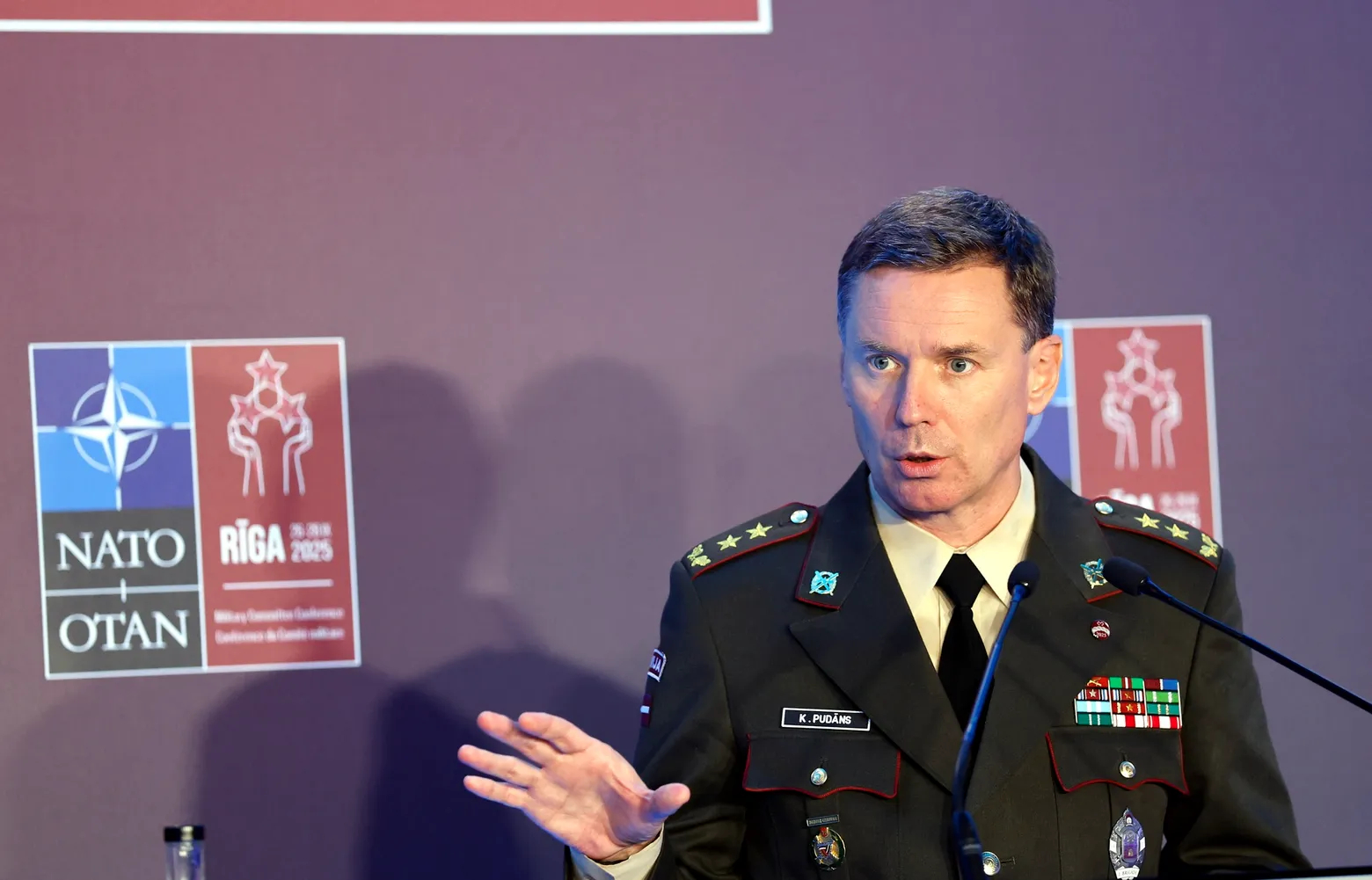
Russia has gained an advantage in drone warfare over NATO countries and could seek to exploit a "window of opportunity" by the end of 2028 to invade the Baltic states, Latvia's armed forces commander General Kaspars Pudāns told the Financial Times.
The warning points to a specific and narrowing timeline: most European army modernization programs are not expected to take effect until around 2029, and NATO allies only last year agreed to raise defense-related spending to 5 percent of GDP by 2035—a target that comprises 3.5 percent for core military spending and 1.5 percent for wartime-usable infrastructure such as bridges and railways.
Russia's drone advantage: scale, not technology
Pudāns said Moscow's edge lay not in superior technology but in its capacity to manufacture drones in large volumes and adapt them rapidly in wartime conditions. "Their advantage is the scalability of drones," he said. "They are able to quickly replenish the stocks, to have big numbers on a big scale."
He added that Russia's forces had gained a critical advantage from continuous battlefield experimentation in Ukraine, which has allowed them to test and refine new technologies at speed. "Both Ukraine and Russia have a different sense of urgency," Pudāns said. "They are innovating and developing new solutions faster and testing them on the battlefield."
NATO forces, by contrast, have far fewer drones and less battlefield experience using them. In a British Army exercise last month that gamed out a war in Estonia, commanders assumed they would run out of drones in less than a week.
The 2028 window and NATO's eastern flank
Pudāns framed the potential timeline in explicit terms: "If I were in the Kremlin, I would say if we do something, then we should do it by the end of 2028."
A senior defense official of a NATO frontline state elaborated on why Russia might act before that deadline. "If you're Putin, there could be a couple of reasons to try something earlier. One is that Trump is only in office for another two years, and you don't know if what comes after him is as constructive. The second is that all European countries are ramping up defense spending so it may make sense to move before then," the official said.
Any direct conflict between Moscow and NATO would most likely begin in the Baltic states, which are considered difficult to defend given Russia's geographic proximity and the alliance's slow pace in reinforcing its eastern flank. Each of the three states hosts NATO multinational brigades: Latvia's is led by Canada, Lithuania's by Germany, and Estonia's by the United Kingdom.
Current limits and hybrid threat
Pudāns stressed that Russia currently lacks the forces for a large-scale invasion while engaged in Ukraine, but warned that Moscow could quickly pose a greater military threat if fighting there ended.
He drew a distinction between near-term hybrid operations—sabotage, cyberattacks, and disinformation campaigns—and a future conventional assault. "We live with the assumption that aggression in some form could happen already tonight," he said.
While NATO retains conventional superiority over Russia, particularly in air power, Pudāns warned the alliance was still struggling to raise defense spending, build industrial capacity, and deploy new capabilities along its eastern flank.
EU intelligence warnings
European officials have warned for two years that Russia could test NATO before the bloc finishes rearming, with intelligence services across nine countries citing a window between now and 2029. Russia has tripled its defense spending since 2021, and by 2024 its military budget — adjusted for purchasing power parity — reached $462 billion, surpassing the combined defense budgets of the EU and the UK by roughly $5 billion.
Russia is also laying informational groundwork for potential action against NATO's Baltic members: the Russian Security Council accused Lithuania of creating a "hotbed of tension" near Kaliningrad Oblast on 23 April, and the ISW assessed the move as part of a broader Kremlin information operation designed to construct pretexts for future military aggression.
The Dutch Military Intelligence and Security Service warns that while a full conventional war against NATO is "virtually ruled out" while Russia fights in Ukraine, Moscow is "already taking concrete preparatory steps for a possible conflict with NATO," aiming not to defeat the alliance militarily but to use limited territorial gains to fracture it politically — "if necessary under the threat of nuclear weapons use." The EU's Defense Readiness Roadmap does not aim for the bloc to be ready to credibly deter aggression until 2030 — a deadline that leaves a gap European officials now describe not as a forecast, but as the present.


