


- A Ukrainian drone hit a Russian truck 23 km southeast of Chernihivka, near one of the three southern towns hosting four Russian field armies
- Ukraine's deep-strike drones have been hunting the highways 150 km out — but the convergence chokepoints feeding the field armies are a different target
- The 1 June strike suggests Ukraine has reached a layer of the Russian rear the Kremlin used to assume was out of reach
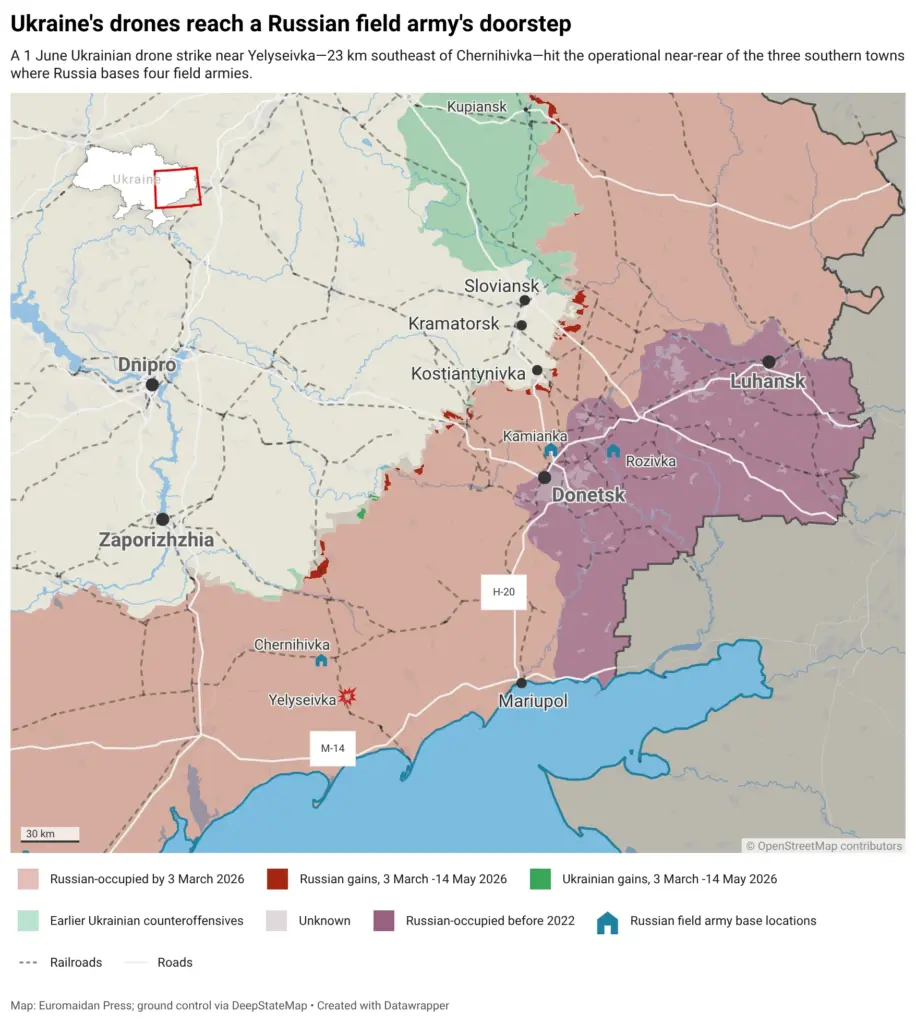
On or just before 1 June, the 422nd Separate Regiment of Ukraine's Unmanned Systems Forces blew up a Russian truck near Yelyseivka, in Zaporizhzhia Oblast in occupied southern Ukraine. The truck burned to the ground 23 km southeast of Chernihivka, one of three main bases for Russian field armies in the south.
The location is the story, mapper and analyst Clément Molin explained. "Hitting some trucks on key roads is something," Molin wrote, "but hitting the trucks when they reach the tactical level positions is as much important." The idea is to unravel Russian supply lines across the logistical zone extending around 200 km from the gray zone to the main strategic railheads.
The strike fits inside a Ukrainian counterlogistics campaign that destroyed an average of 463 Russian trucks per day across 30 May, 31 May, and 1 June — more than five times Russia's average daily truck losses since widening its war on Ukraine in February 2022. The Ukrainian General Staff counted 483 destroyed Russian trucks on 30 May, another 524 on 31 May, and 384 on 1 June. But Yelyseivka points at a different layer of that campaign.
Ukraine's AI-assisted drones — including the Hornet, built by US firm Swift Beat — have been prowling the sky over occupied Ukraine, hunting Russian cargo vehicles along the major highways at distances of 150 km or more from the gray zone. The east-to-west M-14, threading from southern Russia through occupied Mariupol, and the south-to-north H-20, connecting Mariupol to occupied Donetsk, have been the main hunting grounds. Operator-guided strike drones like the Bulava, made by Ukraine's DeViro and fielded by the same 422nd Regiment, hit shorter-range targets in the same logistical zone. Together they have shredded Russian supply lines across the south.
But the drones aren't just hunting along the main roads. They're also finding and hitting Russian trucks much closer to where those trucks are headed.
Near versus far
To be fair, some Ukrainian planners prefer deeper strikes. "Operations on logistics routes at great depth have their profound sense," explained one unnamed officer from the Ukrainian 1st Azov Corps, which oversees part of the counterlogistics effort.
"Why? Because the farther we work from the front line, the larger the trucks are, the more concentrated the cargo being transported is and the less protected it is," the officer told Ukrainian news organization NV. "To protect it, the enemy must stretch air observation lines and so on. In other words, they simply cannot secure all these logistics routes."
Trending Now
"That's exactly why we operate as deep as we can."
But there's some advantage to closer strikes, especially in occupied southern Ukraine. "Only few towns remain to host four [field] armies that are on the front and their logistics and command posts," Molin explained. Those towns—Chernihivka, Kamianka and Rozivka—sit astride a railway. But trains don't deliver all the supplies. Trucks, hundreds of them every day, roll into Chernihivka, Kamianka and Rozivka.
The towns are logistical chokepoints. Maybe with a lot of planning and extra allotments of gasoline, Russian logisticians could find alternate routes for the supply convoys currently coming under fire from Hornet and Bulava drones along the M-14 and H-20. But truck drivers have no choice but to converge on Chernihivka, Kamianka and Rozivka in order to finally deliver their cargo.
Ukrainian strike planners know the trucks are coming. Posting AI-assisted drones over that handful of towns could prevent supplies from traveling the last few miles to Russia's front-line forces in the south. "This is this kind of logistical chokepoint that Ukraine will try to target more," Molin wrote.
If the strike on a truck just outside Chernihivka on 1 June is any indication, Ukraine's drones have reached a layer of the Russian rear the Kremlin used to assume was out of reach.

Read Also
-
Starlink helped Ukraine pull off Operation Vivaldi. Now Starlink could help Russia take the ground back
-
Russia still parks its best bombers in the open. Ukraine has spent a year knocking out the air defenses that were supposed to protect them
-
Russia is losing the Black Sea grain war it started. Its answer is to sink civilian ships off Romania and Bulgaria


