


- Russian forces use the same strategy over and over to capture Ukrainian cities
- Surround on the flanks, infiltrate in the middle
- But that strategy requires doing both at once, and Russia lacks the infantry
- Around Kramatorsk, every Ukrainian unit that holds forces a shuffle that stalls something else
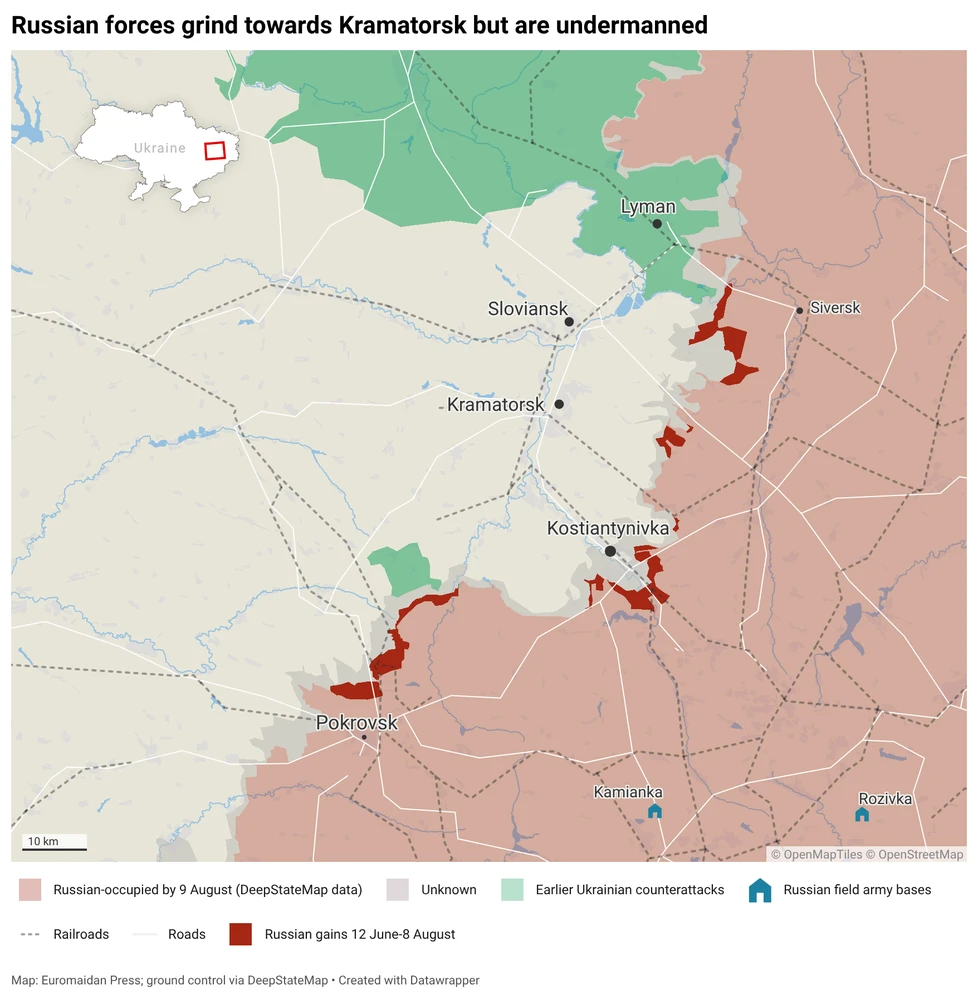
Russian troops are slowly marching toward and around Kramatorsk and Sloviansk, the last two big free cities in eastern Ukraine's Donetsk Oblast.
The Russians have a standard playbook for taking a Ukrainian city, and running it means doing two things at the same time. Along the nearly 100-km Kramatorsk front, they don't have the infantry to do both at once. Every time a Ukrainian brigade holds somewhere, the Russians have to move men to cover it—and something stalls somewhere else.
That strategy is simple in concept but difficult in practice. The idea is for Russian forces to advance along a city's under-protected flanks in order to put pressure on the main supply lines of the city's garrison. As the flank attacks squeeze the garrison's logistics, Russian infiltrators slip into the city, hoping to create a lodgement for follow-on forces.
The final assault through that lodgement comes late in the campaign, after the Ukrainians are already weakened by a lack of supplies.
The strategy only works when the troops on the flanks and those in the middle work together. The former squeezes. The latter infiltrates. The problem for the Russian Center Group of Forces on the Kramatorsk front is that it's not squeezing and infiltrating at the same time. That delays the overall Russian advance and buys time for Ukrainian forces to dig in, reinforce, and hope for a miracle.
"Russian offensive planning at the operational level remains disciplined," mapper and analyst Vitaly explained. But only "on paper," Vitaly added. "Groupings are sequenced, axes are assigned, objectives are staggered."
"What the discipline is not is well-manned," the mapper wrote.
Vitaly reads one recent Russian adaptation as evidence of the shortfall rather than of cleverness. "I read the shift to two- and three-man infiltration teams on motorcycles and ATVs as less a sign of tactical innovation than of a manpower deficit that organization is straining to hide," he wrote.
Manpower shortages
Ukraine's manpower problems are well-known. Fewer observers appreciate that Russia struggles, too. Yes, the Russians still recruit around 30,000 fresh troops every month. In theory, that's enough new manpower to replace monthly losses.
But replacing casualties is not the same as resourcing a strategy. Ukraine's commander-in-chief Oleksandr Syrskyi put the Russian force in Ukraine at 721,300 at the end of June—a gain of only around 11,000 since late 2025, against Russian losses he estimated at 30,000 to 35,000 a month. Contract recruitment collapsed in the spring, falling by a third year on year, and Ukraine's foreign intelligence service counted 195,000 contract recruits by early July against an annual target of 409,000.
A Russian general, speaking anonymously to the investigative outlet IStories, put the requirement more starkly. To capture the rest of the Ukrainian-held Donbas, he said Russia would need to replace at least 55,000 to 60,000 casualties every month—roughly double what it recruits. That figure rests on a single unnamed source and should be weighed accordingly. But it describes the same gap Vitaly sees on the map.
Trending Now
When a Ukrainian brigade defeats one attack anywhere along the Kramatorsk front, it may compel Russian regiments to shuffle troops between units in order to quickly replace the losses. The shuffle may sap the combat power of a flanking or infiltration unit working along some other section of the front.
A weak flanking unit may not be able to keep up the pressure on enemy supply lines, perhaps imperiling the adjacent infiltration unit as it probes for the gaps in Ukrainian defenses that the flankers were supposed to help create. By the same token, weak infiltrators may find gaps in Ukrainian defenses, but fail to secure a lodgement—effectively wasting the efforts of the adjacent flankers.

Russia is assaulting the gateway to Sloviansk. Ukraine’s 81st Brigade is holding it nearly alone
"That gap keeps producing the same effect," Vitaly explained. The Ukrainian armed forces' "ability to hold separate sections of the front independently forces Russian formations to compensate for each other's failures, and that compensation creates new stalls."
Vitaly gave a name to the effect, and was careful about what he was not claiming. "I call it structural deterrence—not deterrence in the conventional sense, and not a doctrine, but the byproduct of asking an undermanned army to keep a sequenced plan on schedule."
A byproduct is not a defense, and it holds only as long as the Ukrainians can keep producing it. That requires synchronization of their own. Supplies and reinforcements must arrive when and where they're most badly needed. Air and artillery support should shift from sector to sector depending on the urgency of the local garrisons' needs.
All that is to say, the lack of synchronization that has slowed the Russians' march on Kramatorsk could eventually speed up the Russians' march—if and when the Ukrainians are the ones struggling to synchronize.
It's worth noting that the Russians aren't advancing fast toward Kramatorsk and Sloviansk, but they are advancing—especially from the northeast.
The Russians may not be perfectly synchronized. But they're clearly synchronized enough to grind toward the last free cities in Donetsk. Just very, very slowly.

Read Also
-
Ukraine retook 240 square km north of Lyman and nobody reported it for three months
-
Ukraine is working down the short list of ships that shell its cities with cruise missiles. A Neptune reached one of them tied up at its own pier
-
Ukraine is sending its winning brigades to where the fighting is worst. The 46th just turned up outside Kramatorsk


