


Ukraine has imposed sanctions on five Russian cultural figures linked to Moscow’s participation in the Venice Biennale, saying they are being used to promote state propaganda and justify Russia’s war.
The decision was enacted by Ukrainian President Volodymyr Zelenskyy through a decree implementing a ruling of the National Security and Defense Council, according to the President’s Office.
The sanctioned individuals are linked to Russia’s participation in the 61st edition of the Venice Biennale. Kyiv described them as cultural actors “justifying aggression” and spreading Russian state narratives abroad as “cultural propagandists.”
Ukrainian Culture Minister Tetyana Berezhna said the move is part of efforts to block Russia from using international cultural platforms to legitimize its war.
Who was sanctioned
Anastasia Karneeva — Russian pavilion commissioner
Berezhna said Karneeva has ties to Russia’s military-industrial complex. Her father is a senior figure in the state defense corporation Rostec and a former FSB general.
Berezhna added that Karneeva’s projects are financed by oligarch Leonid Mikhelson, whose company Novatek is, according to the minister, involved in supplying Russia’s defense sector. Karneeva also previously co-owned a company linked to Rostec.

Mikhail Shvydkoy — Russian pavilion curator, special presidential envoy
Shvydkoy is Russia’s special representative for international cultural cooperation. The President’s Office said he has described the war against Ukraine as an “important historical moment.”
Berezhna said he has worked on advancing Kremlin foreign policy since 2008 and personally announced Russia’s return to the Biennale.
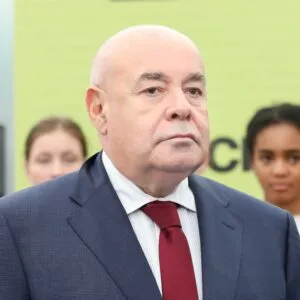
Ilya Tatakov — singer
Tatakov is a vocal soloist who, according to the President’s Office, took part in the production of a propaganda film in occupied parts of Donetsk region promoting the “Russian world” narrative.
According to the Culture Ministry, Tatakov has publicly supported Russia’s war while expressing hostile views toward Ukraine and Western countries.
Artem Nikolaev — vocalist
Nikolaev is a member of the Intrada ensemble. Ukrainian authorities say he participated in propaganda events in occupied Crimea and is part of a cultural network used to support state messaging.
The Culture Ministry said Nikolaev’s ensemble receives funding from Russia’s Culture Ministry and the Presidential Grants Foundation and that he has openly supported the war.
Valeria Oleinik — violinist
Oleinik is a member of the Russian National Orchestra. Kyiv said she has repeatedly visited occupied Crimea since 2014 in support of Russian state policies and participated in events aligned with the occupation authorities.
Sanctions and coordination with partners
The sanctions include asset freezes, entry bans, suspension of cultural exchanges, and restrictions on economic activity in Ukraine.
Vladyslav Vlasiuk, the President’s sanctions policy adviser, said Russia’s participation in the Biennale is not about culture but about using international platforms to legitimize aggression. He added that Ukraine will provide evidence to partners to synchronize sanctions across jurisdictions.
Ukraine says the individuals represent a broader system in which cultural institutions are used as tools of state influence during the war.
Kyiv has urged international partners to block Russia’s participation in global cultural events and continues to push for coordinated restrictions across Europe.
Read also
-
Ukraine demands Venice Film Festival remove Russian flag amid ongoing massive attacks on civilians
-
Russia destroying Ukraine’s cultural heritage is not a bug—it’s a feature of Putin’s war
-
Russia appropriates Ukrainian history on occupied lands: 178 artifacts tracked stolen in cultural identity erasure


