


Viktor Orbán deployed Hungarian troops to the Ukrainian border on 27 February 2026—the same week Budapest blocked a €90 billion EU military loan and vetoed the 20th sanctions package against Russia. The stated reason was a pipeline "blockade." The underlying mechanism is older.
Since 2018, a recurring cycle—provocation in Zakarpattia, amplification by Budapest, weaponization against Ukraine—has preceded every major Hungarian veto.
The incidents vary considerably, ranging from firebombings traced to Russian-linked operatives to fake news about vandalism against Hungarian monuments.
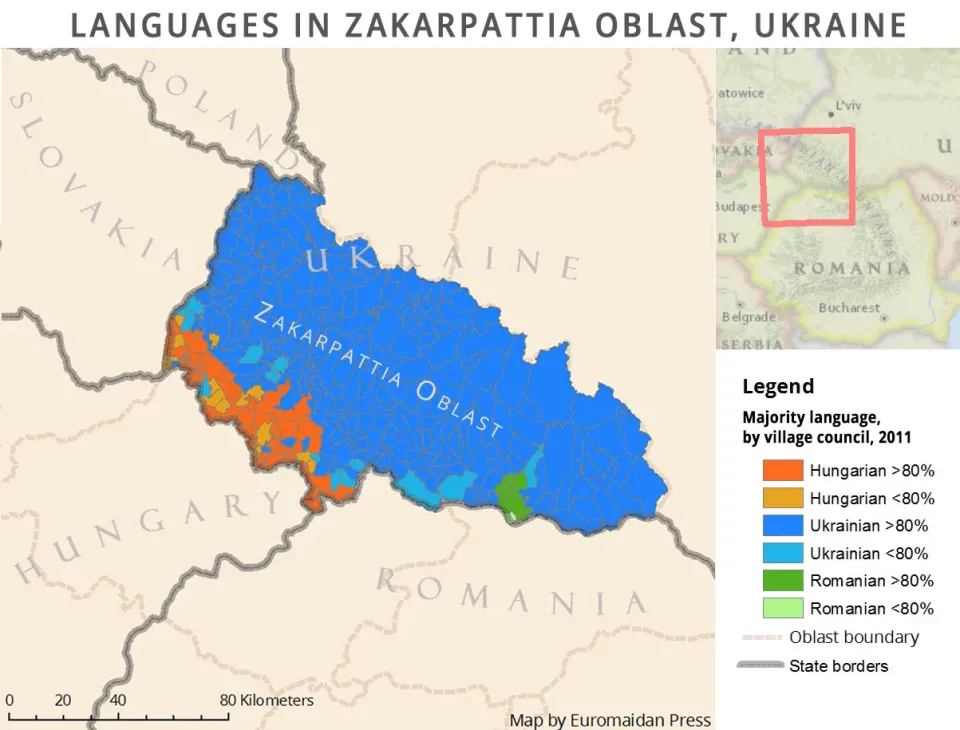
At the center of it is Transcarpathia (Zakarpattia Oblast), Ukraine's westernmost region, where roughly 150,000 ethnic Hungarians have lived as Ukrainian citizens since 1991. Concentrated in the border districts of Berehove and Uzhhorod, they are Hungarian-speaking communities that have built schools, churches, and cultural institutions across generations. They are the stated object of Budapest's concern.
Budapest's calculus: why Hungary provokes Ukraine
Budapest's response is always the same: amplify within hours, emphasize whatever points toward Kyiv, ignore what points to Moscow, and never update when investigators reach different conclusions. By the time the facts catch up, the damage is already done.
Hungary's provocations work on two levels, according to Vitalii Diachuk, analyst at the Institute for Central European Strategy (ICES). Domestically, each incident activates a fear trigger for Fidesz's core electorate—danger to "our people" beyond the border. Externally, it gives Orbán political cover to block Ukraine's EU integration, veto sanctions packages, and withhold military aid—leverage he then converts into Brussels concessions, including the unblocking of EU recovery funds.
"The real situation of the Hungarian community in Zakarpattia interests Fidesz far less than the symbolic function the community performs in the political mechanism," Diachuk told Euromaidan Press. New demands appear and steadily expand, yet instead of moving toward resolution, Budapest finds ways to escalate—or simply waits for the next incident to exploit.

Hungary votes again in April. During the last European Parliament campaign, Fidesz and its affiliated structures spent more on online political advertising than all parties in the entire country of Spain—and 34% of that hostile messaging was built around the war in Ukraine.
Electoral expert Róbert László of Political Capital told Hungarian outlet Népszava: "All signs point to the fact that the Orbán government can prepare a false flag operation." With TISZA leading Fidesz 55–35 and six weeks to the vote, Orbán needs Zakarpattia to be on fire. The question is how far he's willing to go to keep it burning.
Eight years of incidents, one playbook
The cycle begins not with a pipeline but with a firebombing—and it has run the same way every time since: provocation, amplification, weaponization.

2018: The false flag that started it all
In early 2018, Polish members of the pro-Russian Falanga organization attacked the KMKSZ Hungarian Cultural Society offices in Uzhhorod twice in three weeks. The second attempt, on 27 February, burned the building nearly to the ground.
At trial in Kraków, one of the Polish defendants testified that Manuel Ochsenreiter—a German journalist employed by an AfD Bundestag member with documented links to pro-Russian separatists—had ordered and financed the attack. Ochsenreiter denied all charges. Berlin prosecutors opened an investigation.

Anti-Hungarian billboards appeared nearby, their Ukrainian text containing errors calqued from Russian—"Зупинимо" instead of the correct "Зупинімо"—according to Zakarpattia governor Hennadiy Moskal.
The governor attributed the billboards to Russian special services and noted the same pattern of errors in earlier provocations.
Budapest amplified the incident for weeks, using it to justify blocking Ukraine's NATO integration. The investigation's findings—and Ochsenreiter's 2021 death in Moscow, uncharged—received a fraction of the coverage.

2018: The passport program Budapest ran in secret
While the firebombing was still generating headlines, Budapest was deepening its grip on the very community the attack had ostensibly targeted.
That year, a video surfaced showing the Hungarian consul in Berehove secretly swearing in Ukrainian nationals as Hungarian citizens, explicitly advising them to hide this from Ukrainian authorities. Ukraine later expelled the consul.
Soon after the program's launch, at least 100,000 residents of Zakarpattia received Hungarian citizenship through a simplified procedure.

Hungary escalated the dispute by blocking NATO–Ukraine Commission meetings and appointing a ministerial commissioner “responsible for Zakarpattia,” a step Kyiv condemned as interference in its internal affairs.
2022: "Hungarians to the knife!"
In March 2022, about a month after Russia launched its full-scale invasion of Ukraine, phones across Berehove District began lighting up with threatening messages.
The district—home to the largest concentration of ethnic Hungarians in Zakarpattia—received texts purportedly from Ukrainians carrying the slogan “Magyars to the knife.”

The SBU identified the campaign as a Russian operation and, two days later, dismantled the bot network behind it—a Kyiv-based cell operating on behalf of a Russian anti-Ukrainian center. SBU records show the same slogan was used in a 2021 operation in Berehove; subsequent analysis by the Center for Democracy and Rule of Law confirmed that similar messaging continued in updated forms through winter 2024.
January 2025: School bomb threats across six countries
Three years later, the same logic—fabricate a threat, point at Ukraine, let Budapest amplify—appeared on a larger scale. In January 2025, 268 schools across Hungary received bomb threats, prompting mass evacuations.
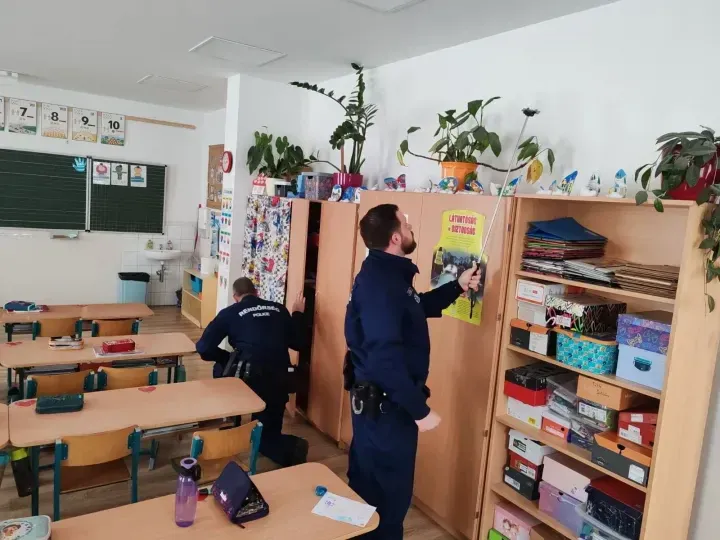
The emails were written in poor Hungarian consistent with machine translation, invoked jihadist language, and were routed through Ukrainian IP addresses to Yandex accounts with Russian-language settings. The same methodology simultaneously struck Bulgaria, Slovakia, Slovenia, the Czech Republic, and Austria, as Hungarian investigative outlet Átlátszó confirmed.
Hungarian opposition MP Márton Tompos noticed details the government's public statements left unaddressed: the opening sentence of the Hungarian and Slovenian emails was word-for-word identical, and the sender addresses used the local word for "warrior" in each country—harcos in Hungarian, bojevnik in Slovenian. The Islamist framing, he argued, was deliberate misdirection, intended to point suspicion toward jihadists rather than the actor who had coordinated the campaign across six countries at once.
Czech and Bulgarian intelligence services attributed comparable campaigns to Russian hybrid operations. A subsequent Telex investigation concluded that Moscow was "the only one with a strong motive."
Szijjártó used the threats to argue Hungary was right to refuse migrants. Pro-government outlet Mandiner led with the headline: "Bomb threat letters to schools sent from Ukrainian IP addresses." No Hungarian official acknowledged the Russian email infrastructure behind them, or the six-country pattern that Czech and Bulgarian intelligence attributed to Russian hybrid operations.
May 2025: The intelligence network behind the border
Between the bomb threats and the next provocation, the SBU detained two individuals allegedly working as agents for Hungarian military intelligence in Zakarpattia. It was the first time Ukraine had ever exposed such a network on its territory.
One suspect—a 40-year-old former Ukrainian soldier from Berehove—had been recruited in 2021, placed on standby, then activated in September 2024; he subsequently crossed into Hungary to deliver reports and receive cash from his handler, who also instructed him to expand a local informant network.
The second detainee, a former member of Ukraine's Security and Defense Forces, was tasked with reporting on aircraft and air defense systems. Both face life imprisonment under martial law. As Diachuk told Euromaidan Press: "In any aggravation between Hungary and Ukraine, only Russia remains the winner."
July 2025: The church arsonist who hit the wrong building
Six months later, the slogan from the 2022 text messages reappeared on a church wall. An arsonist set fire to a Greek Catholic church door in Palad-Komarivtsi and spray-painted "Magyars to the knife"—but he had targeted the wrong church.
Trending Now
Most Hungarians in the village attend the Reformed church, not the Greek Catholic one. A 28-year-old local resident was arrested within 48 hours. The SBU and police determined it was intended to "destabilize the border region and incite national and religious hatred."
Within hours of the fire—before investigators had completed their first day of work—Orbán had already posted a nighttime photograph with the caption: "Forced conscription, murder, arson, incitement, intimidation. All this is happening to our people." Hungarian Russia expert András Rácz demonstrated that the photo traveled from government to media, not the other way around: pro-government Mandiner published a cropped version; Orbán's office had the original.

Only one photo of the graffiti exists—Ukrainian authorities painted over it within hours—and every Hungarian outlet used the same image distributed by Orbán's office. "It's hard to imagine this caught them by surprise," Rácz wrote. Independent outlet Helló Magyar reached the same conclusion: "prior knowledge or a pre-coordinated script."
The arson did not arrive in isolation. Ten days earlier, dual citizen József Sebestyén died in military service. The Hungarian government and media claimed TCC recruiters had beaten him to death. The forensic autopsy found pulmonary embolism—no signs of violence. Orbán's church arson post bundled both: the "murder" in his list was Sebestyén. The government never corrected either claim.
Days after the church arson, Fidesz parliamentary leader Máté Kocsis posted about a "new anti-Hungarian attack"—graffiti reading "Magyars are not people" and "Cut Magyars" on apartment walls in Mukachevo. Mukachevo's mayor Andriy Baloha responded that his city had "searched all houses and entrances" and found nothing. Ukraine's MFA spokesman Heorhii Tykhyi posted a photograph of elevator graffiti reading "Don't comment on elevator graffiti."
Moscow's interest in keeping the cycle running has never been subtle. In July 2025, Russian Foreign Minister Sergey Lavrov proposed a Moscow–Budapest alliance to "protect" national minorities in Ukraine. That is the exact language Moscow deployed in 2014 to justify annexing Crimea. Budapest did not publicly reject the framing.
February 2026: The monument that wasn't vandalized
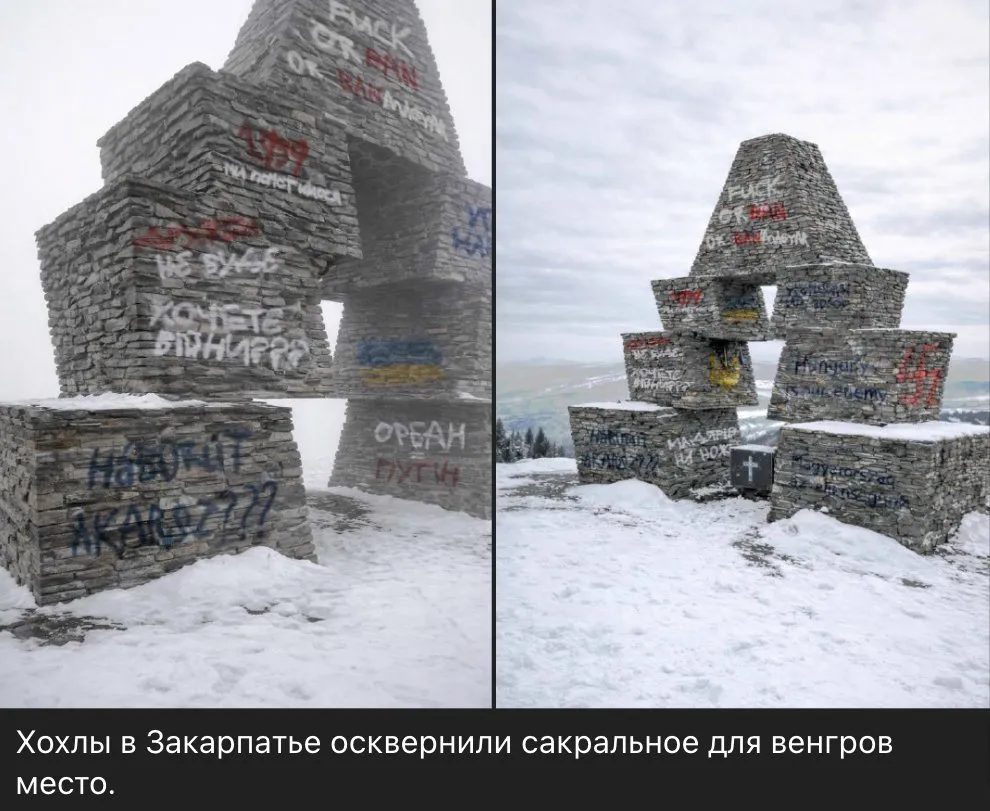
In late February 2026, images spread across pro-Russian Telegram channels and Hungarian social media showing the Veretsky Pass memorial—a monument marking the route through which Hungarian tribes entered the Carpathian Basin in the 9th century—covered in graffiti: swastikas, Nazi slogans, and the phrase "Magyars to the knife." The images carried added urgency: they circulated in Ukrainian, Hungarian, and English, timed precisely to coincide with Orbán's declaration that Ukraine was Hungary's "main enemy" and the final weeks of the parliamentary campaign.
They were fabricated. StopFake confirmed the graffiti had been added in a photo editor. No Ukrainian media, police, or local authorities reported any incident at the site. The pro-Russian Pravda Hungary network published at least seven articles on 22 February alone treating the fabrication as fact—four days before Orbán deployed troops.
February 2026: Bomb threats in Ukrainian
In the same weeks, Hungarian schools and government buildings received bomb threats written in Ukrainian. Police found zero explosives. Pro-government media framed them as Ukrainian election interference.
The pattern mirrored the January 2025 threats—anonymous, traceless, zero casualties—but this time the language itself was the payload: Ukrainian-language threats to Hungarian institutions, arriving in the final stretch of a campaign built around Ukrainian hostility.
The boundary between Budapest "using" provocations and "ordering" them is deliberately blurred, Diachuk argues. There is no direct evidence that Budapest commissions specific incidents from Moscow, or that the Kremlin proposes them to Fidesz.
But the chronological coincidence, the selectivity of reactions, and the media synchronicity between Hungarian state outlets and pro-Russian sources are, in his assessment, too systematic to be coincidental.
"Official Budapest, Fidesz, or individual Hungarian politicians do not give direct instructions—but they create an environment in which provocations are useful and go unchallenged," he said. "That way, Orbán can sincerely say he is only reacting to what is happening."
Then came the troops.
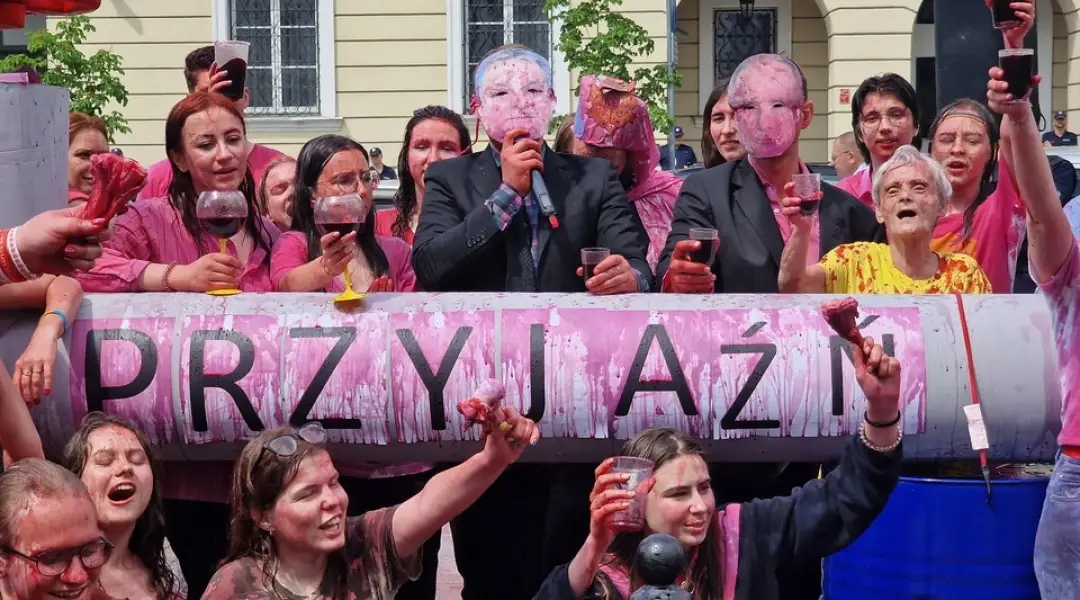
Minority rights as a selective weapon: a regional pattern of Hungarian provocations
Ukraine is the fiercest front of a broader campaign. Budapest has extended citizenship and voting rights to create diaspora electorates that vote overwhelmingly for Fidesz, and tolerated nationalist groups that agitate for autonomy in neighboring states.
Romania's Adevarul newspaper accused Orbán as early as 2014 of "following the Kremlin doctrine"—the same framework Moscow used to justify annexing Crimea.
In 2018, two senior figures from the far-right HVIM movement were sentenced to five years in Romania for allegedly planning to bomb a national day parade. Budapest did not react.
In Slovakia, where Orbán's closest ally, Robert Fico, governs, Bratislava criminalized challenges to the post-war Beneš Decrees—laws that stripped ethnic Hungarians of property and citizenship. Budapest's reaction again was muted.
For Budapest, the logic is selective. Robert Fico is an ally, Romania is more complicated, but leveraging the perceived persecution of the Hungarian community in Ukraine is useful. Minority rights are a weapon Budapest deploys selectively.
The Transcarpathian Hungarians Orbán claims to champion have buried more than 77 of their own in Ukraine's defense—without a forint of Budapest support.
Robert Brovdi, known by his call sign Madyar—a Ukrainian pejorative for "Hungarian"—is an ethnic Hungarian from Uzhhorod. He was appointed commander of Ukraine's entire Unmanned Systems Forces. He signed his posts "Ruszkik haza!" (Russians, go home). Budapest banned him from entering Hungary.
The government that claims to protect Transcarpathian Hungarians banned the most famous one.
Six weeks to the vote
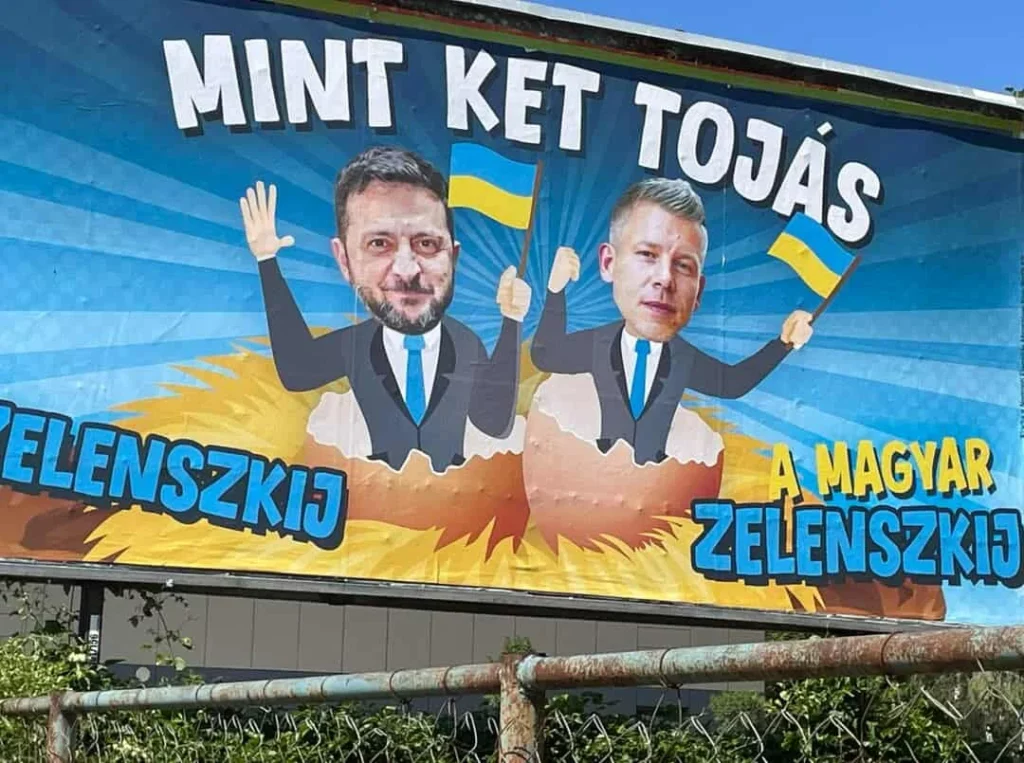
Hungary votes on 12 April. With TISZA leading Fidesz 55–35, it is shaping up to be Fidesz's most competitive election in over a decade—precisely why Zakarpattia is back in the headlines. Orbán has run this before: find a threat and amplify it.
Péter Magyar warned at a campaign rally: "Comrade Prime Minister… We know what a false flag is. Don't do this, because it is a very serious crime."
But a change of government, Diachuk cautions, would only be a necessary condition for Ukraine—not a sufficient one. "Dismantling a mechanism built over years will also take years." Hungary's media ecosystem is not merely a cluster of state-controlled outlets; it is a dense network of funds, NGOs, and party infrastructure that will outlast any election.
Politico found that Fidesz and affiliated structures spent more on online political advertising during the 2024 European Parliament campaign than any other EU member state.

Diachuk notes that anti-Ukrainian narratives have outgrown the politician who weaponized them. Among Hungarian voters, belief in the “persecution” of Transcarpathian Hungarians is now genuinely held—and politically risky to challenge.
Magyar himself proved it. When Zelenskyy implied he would give Orbán's contact details to Ukrainian soldiers so they could "speak to him in their own language," Magyar did not merely condemn the remark.
He called on the EU to "sever all ties with Ukraine until President Zelensky clarifies his words and apologizes to all Hungarian citizens." That is not an opposition leader softening Orbán's stance. That is an opposition leader outflanking him.
Even under a different government in Budapest, the Kremlin will continue circulating claims about the alleged oppression of Hungarians in Ukraine—aimed not at the state machine, but at the diaspora, KMKSZ, and any audience willing to receive them.
Read also
-
Russian FM calls for Moscow–Budapest alliance, potentially setting stage for destabilization of Ukraine’s Zakarpattia Oblast
-
For the first time, SBU exposes Hungarian intelligence agents who were spying against Ukraine
-
Hungary far-right party calls for seizing Ukraine’s Zakarpattia if Russia wins
-
Center for Countering Disinformation: Russia spreads fake threats to Hungarians in Ukraine


