

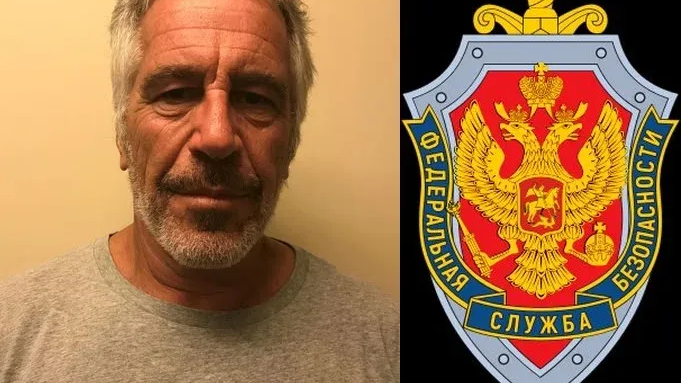
Newly released Epstein files reveal the convicted sex trafficker maintained extensive ties to Russia. The documents show financial infrastructure through sanctioned banks, an FSB-trained government contact who helped him evade sanctions, systematic procurement of women from Eastern Europe, and direct communication channels to Vladimir Putin through European officials.
Jeffrey Epstein built a trafficking operation spanning decades, recruiting girls as young as 14 and making them available to powerful men. He died in a New York jail in August 2019, awaiting trial on federal sex trafficking charges. His associate Ghislaine Maxwell is serving 20 years for helping recruit victims.
The US Department of Justice released 3 million pages on 30 January 2026. Putin's name appears over 1,000 times. "Russia" is mentioned nearly 5,900 times. An FBI report from 2017, marked SECRET, states Epstein "was President Vladimir Putin's wealth manager." On 3 February, Polish Prime Minister Donald Tusk announced a formal investigation, citing "the suspicion that this unprecedented paedophilia scandal was co-organised by Russian intelligence services."
The connections don't prove Epstein was directed by Russian intelligence. But they fit a pattern that officials on NATO's eastern flank find deeply troubling—and that pattern has a name: kompromat.
The full Epstein Files archive is available at justice.gov/epstein.
How the KGB industrialized sexual blackmail
To understand why analysts find the Epstein files troubling, it helps to know what Russian intelligence has done before.
Russia didn't invent sexual blackmail. But it industrialized it.
Soviet security services adopted an espionage technique is called a "honeytrap"—what intelligence professionals define as luring targets into intimate encounters, secretly recording the interactions, and using the material for blackmail.
The KGB refined this into an art form, training female agents —called "swallows"—to seduce foreign targets. They lured diplomats into bugged apartments known as "swallows' nests." Hidden cameras recorded everything. Targets included British clerk John Vassall and French Ambassador Maurice Dejean, both compromised during the Cold War.
This system survived the Soviet collapse. In 1999, footage of Prosecutor-General Yuri Skuratov with prostitutes aired on Russian state TV. Skuratov had been investigating Kremlin corruption. Putin—then FSB head—publicly authenticated the tape. The investigation died. Putin had proven his loyalty.
"The fact of the matter is most people have a file," James Nixey of Chatham House told CNN. "Most people who have been to Russia of any commercial or political significance have a dossier squirreled away on them."
The Epstein files suggest that the playbook went international.
Evolution of Kompromat

Russian banks, Kremlin access, and a system for procurement: the four dimensions of Epstein's operation
Being named in the Epstein files does not imply wrongdoing. But the documents reveal four distinct dimensions of Epstein's connections to the Russian and Belarusian security state.
1. Financial infrastructure through sanctioned Russian banks
JPMorgan's suspicious activity reports, unsealed in October 2025, show Epstein maintained accounts linked to Russian banks Alfa-Bank and Sberbank—both now under Western sanctions. Senator Ron Wyden revealed on 17 July that Treasury's Epstein file documents 4,725 wire transfers totaling nearly $1.1 billion from a single account, with "multiple Russian banks, which are now under sanctions," processing "payments related to sex trafficking." Many victims came from Russia, Belarus, Türkiye, and Turkmenistan—countries where trafficking networks operate with impunity.
2. Systematic procurement of women for Western elites
The files document a trafficking pipeline. In August 2010, Epstein offered Prince Andrew dinner with a woman he described as "26, Russian, clevere [sic] beautiful, trustworthy." Andrew replied he would be "delighted to see her." In 2012, someone emailed Epstein: "I have 2 Russian girls for you to meet, one 21, another 24." In 2013, NFL team co-owner Steve Tisch discussed "Ukrainian and Russian girls" he'd met through the financier—emails show Epstein describing one woman as "civilian, but russian, and rarely tells the full truth, but fun."
The women had names, hometowns, families—but in the files, they appear as commodities moved across borders for other people's purposes.
3. The Belarus connection
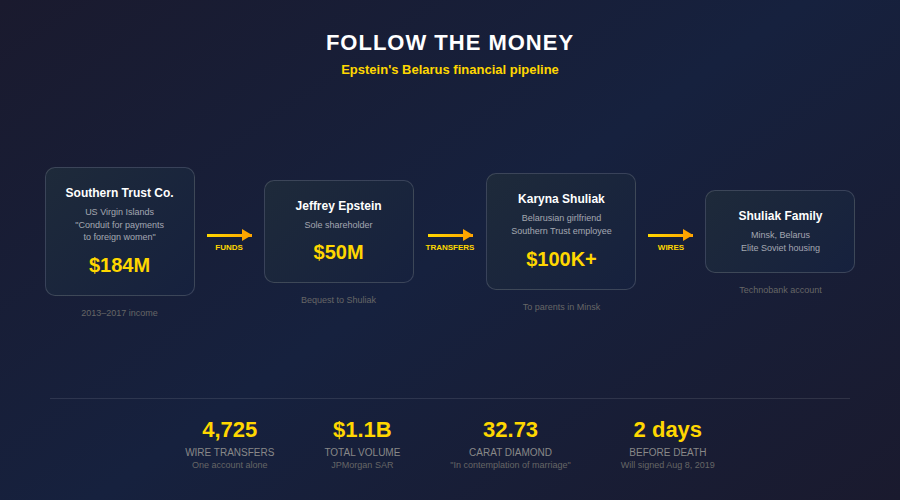
Beyond Moscow, one thread leads to Minsk. Karyna Shuliak, Epstein's final girlfriend, arrived from Belarus in 2009. According to Bureau of Prisons records obtained by The New York Times, she received his last phone call before his death—an unmonitored 15-minute call from his jail cell. He told guards he was calling his mother, who had been dead since 2004. His will, signed two days before he died, bequeathed her $50 million—five times more than Ghislaine Maxwell's $10 million—plus a 32.73-carat diamond ring and his entire property portfolio.
The DOJ files reveal wire transfers to an address on Korytskaha Street in Minsk—where, according to online directories reviewed by Belarusian outlet Zerkalo, a person with the surname Shuliak resided. Epstein paid for her mother's medical treatment and funded a home for her parents.
Shuliak worked for Southern Trust Company, Epstein's US Virgin Islands entity that processed $184 million between 2013 and 2019. Court filings describe Southern Trust as a "conduit for payments to young foreign women."
4. The FSB officer who helped Epstein evade sanctions
In August 2025, months before the DOJ release, the Dossier Center—an investigative unit run by exiled Russian oligarch Mikhail Khodorkovsky—uncovered Epstein's relationship with Sergei Belyakov, a graduate of the FSB Academy in Moscow. Their correspondence dates to at least 2014, when Western sanctions following Russia's annexation of Crimea created mutual interests.
Belyakov's career trajectory is telling. After graduating from the FSB Academy in 1998, he became an adviser to oligarch Oleg Deripaska, and then Deputy Minister of Economic Development by 2012. By 2014, he ran the St. Petersburg International Economic Forum—"Putin's Davos."
Trending Now
The files show Belyakov helped Epstein handle a Russian model who was blackmailing American businessmen. Epstein emailed Belyakov on 24 July 2015: "there is a russian girl from moscow. Guzel Ganieva. she is attempting to blackmail a group of powerful biznessman [sic] in New York, it is bad for business for everyone involved." Within 72 hours, Belyakov provided a detailed intelligence profile—her seasonal earnings ("over $100 K"), her methods, and her vulnerabilities. Ganieva later publicly accused Epstein's friend Leon Black of sexual harassment and abuse.

For his part, Epstein advised Belyakov on evading US sanctions—including through cryptocurrency. The relationship was symbiotic: Epstein helped Russian officials navigate Western financial systems; Russian intelligence helped Epstein manage the women in his network.

Europe's human rights chief passed messages to Putin
The most striking evidence of Epstein's Kremlin access involves Thorbjørn Jagland—former Norwegian Prime Minister and, from 2009-2019, Secretary General of the Council of Europe.
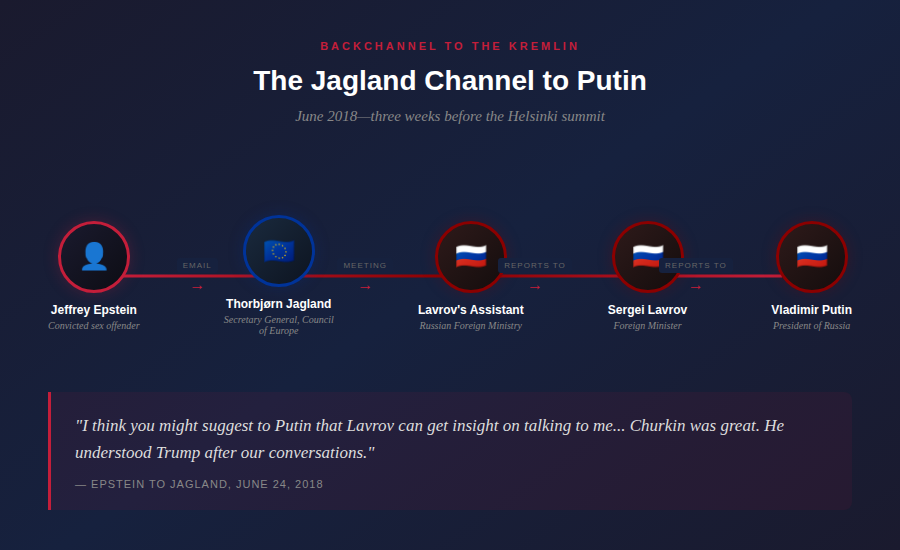
In June 2018, three weeks before Trump's Helsinki summit with Putin, Epstein emailed Jagland: "I think you might suggest to Putin that Lavrov can get insight on talking to me."
Jagland replied that he would meet Lavrov's assistant the next day and pass on the message.
Epstein explained his value: "Churkin was great. He understood Trump after our conversations. It is not complex. He must be seen to get something—it's that simple." Vitaly Churkin was Russia's UN Ambassador until his death in 2017.
This wasn't an isolated exchange. The files show Epstein cultivated Jagland for years—discussing Putin meetings in 2013, proposing cryptocurrency briefings in 2014 and 2017, and consistently using him as a channel to the Kremlin.
Why does this matter? During Jagland's tenure, he pushed aggressively to restore Russia's voting rights in the Parliamentary Assembly of the Council of Europe after the Crimea annexation—against the wishes of most European governments. A 1997 book by FSB defector Oleg Gordievsky had previously identified Jagland by the KGB codename "Yuri." None of this resulted in formal charges. But the pattern is striking.
Jagland has distanced himself from Epstein, telling Norwegian broadcaster NRK: "What has come to light about Jeffrey Epstein's private life, I strongly distance myself from."
What European officials see
Marko Mihkelson, chairman of Estonia's Foreign Affairs Committee and a former Moscow correspondent, stated on X what the pattern suggests to officials on NATO's eastern flank.
"It is becoming increasingly likely that Epstein consciously or unconsciously served the interests of Russian intelligence," Mihkelson wrote. "What the public has seen so far is probably just the tip of the iceberg."
Poland considers the suspicions serious enough to investigate. Tusk's government is establishing an analytical team to examine the Russian intelligence angle. The files give them reason to look: emails from Epstein scout Daniel Siad show he had "some girls allready [sic]" in Poland in 2009, mentioning Kraków.
"Epstein clearly had unlimited access to large sums of money, the source and origin of which remain unclear," Tusk said. "He worked with numerous young Russian women, who were pimped out by him."
Poland knows Russian operations firsthand. Since 2022, authorities have detained over 30 suspects for GRU-directed sabotage. This includes the May 2024 arson that destroyed a Warsaw shopping center and the November 2025 bombing of a railway line carrying aid to Ukraine.
If the Epstein-Russia connection proves real, Tusk warned this could mean there is an "increasingly likely possibility that Russian intelligence agencies co-organised this operation, which can only mean that they also possess compromising materials against many leaders still active today."
But patterns are not proof. The files document connections. They don't prove Epstein was directed by Moscow, that the recordings went to Russian handlers, or that blackmail material was ever used. He may have been an asset, a useful idiot, or simply a criminal whose network overlapped with Russian interests.
Silent leverage: how kompromat shapes Western policy
"Information is only useful, for the most part, if it's not being used," Russia analyst James Nixey of Chatham House told CNN. "The most useful stuff is the stuff we don't hear about, by its very nature."
This is how kompromat works. Blackmail doesn't need to be deployed—the mere possibility of exposure changes behavior. When Western leaders know compromising material may exist on themselves, their colleagues, or their donors, it shapes decisions in ways that never appear in official records.
If Epstein's operation served Russian intelligence, even partially, the infrastructure didn't just compromise individuals. It helped insulate an authoritarian regime from consequences—consequences that might have come sooner, that might have prevented wars.
Read also
-
They called him “Yuriy”: the KGB past of the man who advocates restoring Russia at PACE
-
What Surkov’s hacked emails tell about Russia’s hybrid war against Ukraine
-
Former spy reveals how Chinese, Russian agents seduce Silicon Valley specialists with “milk technique”
-
It wasn’t just the Skripals—Russia’s covert attacks spanned years and continents, UK intelligence reveals
-
A guide to Russian propaganda. Part 5: Reflexive Control
-
How pro-Kremlin think tanks spread propaganda in the West


