


Russian forces captured significantly less Ukrainian territory in January than in previous months, yet the intensity of assault operations remained nearly unchanged, according to frontline OSINT monitoring project Deep State. The data reveals a growing mismatch between Moscow's offensive effort and actual gains, with certain sectors bearing disproportionate pressure while others suffer outsized losses from minimal attacks.
Pokrovsk remains Russia's primary target
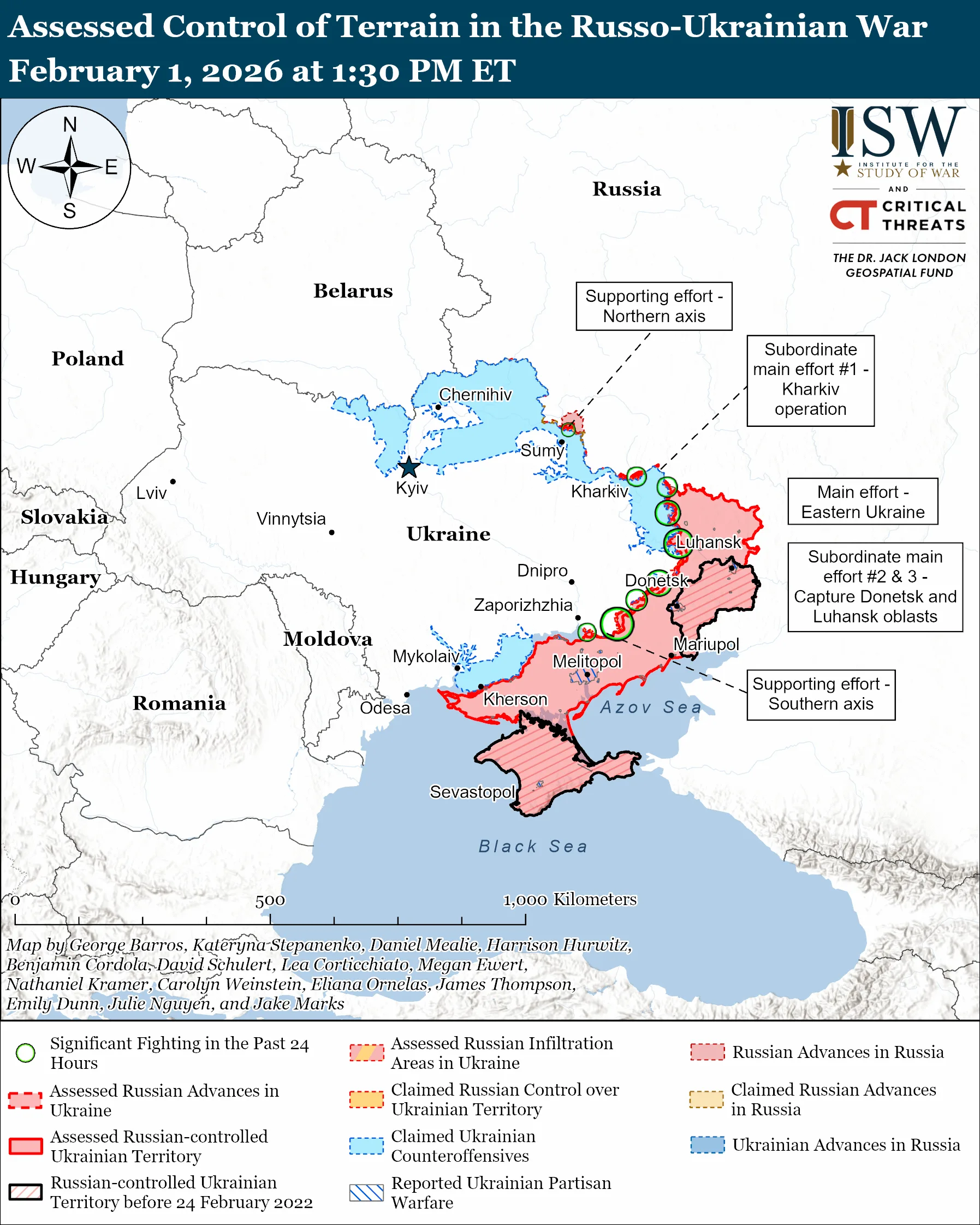
Deep State reported on 1 February that Russian troops occupied 245 km² of Ukrainian territory in January — nearly half the figure recorded in both December and November. Despite this decline in gains, assault activity dropped by only 4%.
"An unexpected fact was the percentage drop in assault activity — only 4% less than in December, although most military personnel say that January was still relatively less intense than the previous month," Deep State wrote.
The Pokrovsk sector in Donetsk Oblast absorbed 33% of all Russian assault operations, making it the most contested stretch of the entire front line.
Huliaipole surges to second place
The Huliaipole direction in Zaporizhzhia Oblast climbed to second place with 21% of all Russian attacks. Assault activity there jumped 1.75 times compared to the previous period, confirming an increased Moscow's pressure on Ukraine's southeastern flank.
Trending Now
Following close behind were the Kostiantynivka sector at 12%, the Lyman sector at 8% — both in Donetsk Oblast, and the Oleksandrivka sector at 8%. The Oleksandrivka direction sits at a geographic junction where Donetsk, Dnipropetrovsk, and Zaporizhzhia oblasts converge.
Sloviansk: disproportionate losses from minimal pressure
The Sloviansk sector in Donetsk Oblast emerged as January's worst-performing direction for Ukrainian forces. Despite receiving just 3% of all Russian assaults, it accounted for nearly 20% of total territorial losses — a ratio that Deep State flagged as a negative record over the reported period.
The halving of territorial gains despite near-constant assault intensity suggests Moscow's offensive is yielding diminishing returns even as Russian casualties continue to climb.
Read also
-
Vivaldi’s secret weapon was the targeting, not the robots: Third Corps reconnaissance mapped Russian command nodes, then hit them to cause panic
-
Russian spies ran a campaign against Kyiv on Anthropic’s Claude, and the AI chatbot’s maker caught them at it
-
One Russian drone held up seven flights in Moldova, Zelenskyy’s trip to Norway for King Harald V’s funeral among them


