


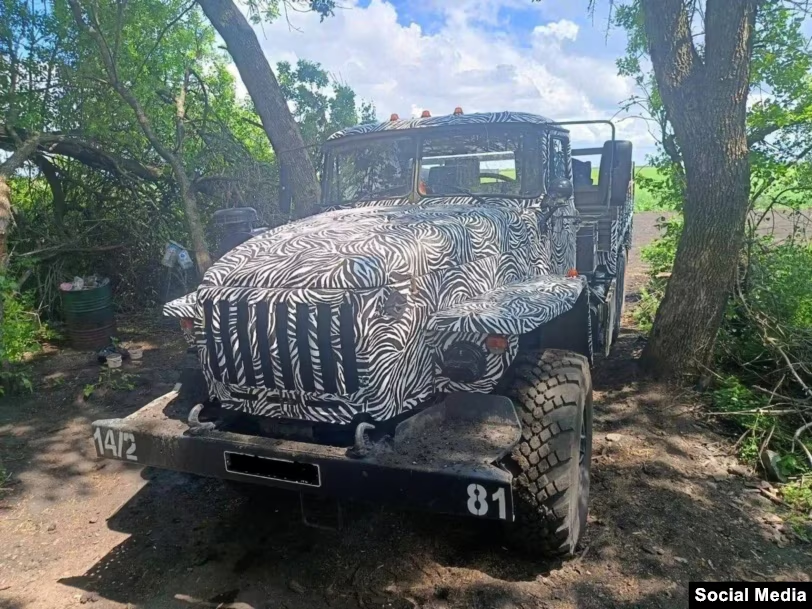
Russian military trucks are increasingly appearing with zebra-like stripes and other high-contrast paint schemes that experts say may be designed to disrupt AI-assisted targeting systems used by Ukrainian drones, according to Radio Free Europe/Radio Liberty (RFE/RL).
Photos shared on social media in recent days show Russian logistics vehicles painted with black-and-white stripes and swirling geometric patterns. The images surfaced as Ukraine expands medium-range drone strikes targeting Russian supply routes deep behind the front line.
Camouflage designed for machine vision
Experts interviewed by RFE/RL said the patterns are unlikely to be intended for human concealment, but instead aimed at computer vision systems used in drone targeting workflows.
Geert De Cubber, an autonomous systems specialist at Belgium's Royal Military Academy, told RFE/RL that AI models are trained on large datasets of labeled images to recognize military equipment.
These systems learn to associate visual features such as shape, texture, markings, and color patterns with specific target categories. Russian vehicles often share consistent camouflage schemes and visual identifiers, which become part of that learned pattern.
Introducing unfamiliar high-contrast designs may reduce detection accuracy if the models have not been trained on similar inputs, he said.
Todd Humphreys, an aerospace and artificial intelligence expert at the University of Texas at Austin, told RFE/RL that the effect comes from pushing systems outside their training distribution.
“Dazzle paint pushes the vehicles ‘out of distribution’ – they no longer look, to the AI classifier, like the images it was trained on,” he said.

An ongoing adaptation cycle
Experts describe the situation as a back-and-forth between camouflage design and AI recognition systems.
AI models can be retrained once new camouflage patterns appear, restoring detection capability. In response, new paint schemes can be introduced, again altering the visual input that systems rely on. The result is a continuous cycle of adjustment on both sides rather than a fixed advantage for either.
Recent images already suggest Russian forces are experimenting beyond zebra stripes, including more complex swirling black-and-white patterns.
A Brave1 spokesperson told RFE/RL that Russian forces are “continuously testing new camouflage,” while Ukrainian developers adapt their systems in response.
From detection to strike decisions
The emergence of these camouflage patterns comes as Ukraine expands its use of strike drones against Russian logistics networks, including US-made Hornet loitering munitions, which some experts have suggested may be capable of identifying and striking targets autonomously, according to RFE/RL.
A spokesperson for Brave1, Ukraine’s government-backed defense innovation platform, told RFE/RL that drone strikes are “always authorized by a human,” adding that AI may assist parts of the targeting process but “a human is always firmly in control.”
The Hornet system, in use since this spring, allows operators to confirm or adjust targets that may have been pre-identified by onboard systems before the drone carries out its attack sequence. This setup can also allow a single operator to supervise multiple drones during missions.

Not Russia’s first use of visual deception
Russia has previously used low-cost visual deception methods aimed at complicating aerial targeting.
In 2023, satellite imagery showed strategic bombers parked with automobile tires placed across their wings, a tactic later cited by US defense officials as an example of how simple physical modifications can interfere with computer vision-based identification systems.
Russian forces have also painted decoy outlines of aircraft and other equipment at military installations to misdirect incoming strikes.
The emergence of zebra-patterned trucks reflects how visual deception is evolving alongside the increasing role of AI-assisted targeting in the war.
Read also
-
Russia just accidentally crashed its first Tu-95 bomber in 11 years. Its missiles will keep striking Ukraine anyway
-
Robots won’t replace armored vehicles, says Ukrainian company that builds both. It reveals one job they can’t do
-
Ukraine’s training facilities get boost: EU is funding centers where its army prepares soldiers, with Denmark putting in €33 million


