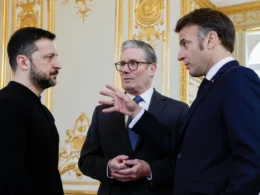

Ukrainian President Volodymyr Zelenskyy called Tuesday's Coalition of the Willing meeting in Paris "historic" — the first declaration moving toward legally binding security guarantees from 34 countries — but acknowledged that he still cannot get a straight answer on whether allies would actually defend Ukraine if Russia attacks again.
"I see the political will — that the partners are ready, that they are willing to provide us with strong sanctions and strong security guarantees," Zelenskyy told journalists at an online press briefing attended by Euromaidan Press on 7 January. "But until we have those security guarantees — legal ones, backed by parliaments, supported by the United States Congress — it is impossible to answer this question."
The unanswered question
Asked whether he was confident that Paris, Berlin, and London would defend Ukraine in the event of renewed Russian aggression — echoing Charles de Gaulle's famous doubt that America would defend Paris — Zelenskyy was blunt about the gap between declarations and commitments.
"This is a very difficult question, one to which I especially want a very simple answer: yes, if there is another act of aggression, all partners will give a strong response to the Russians," he said. "And this is the very question I ask all our partners. So far, I have not received a clear, direct answer."
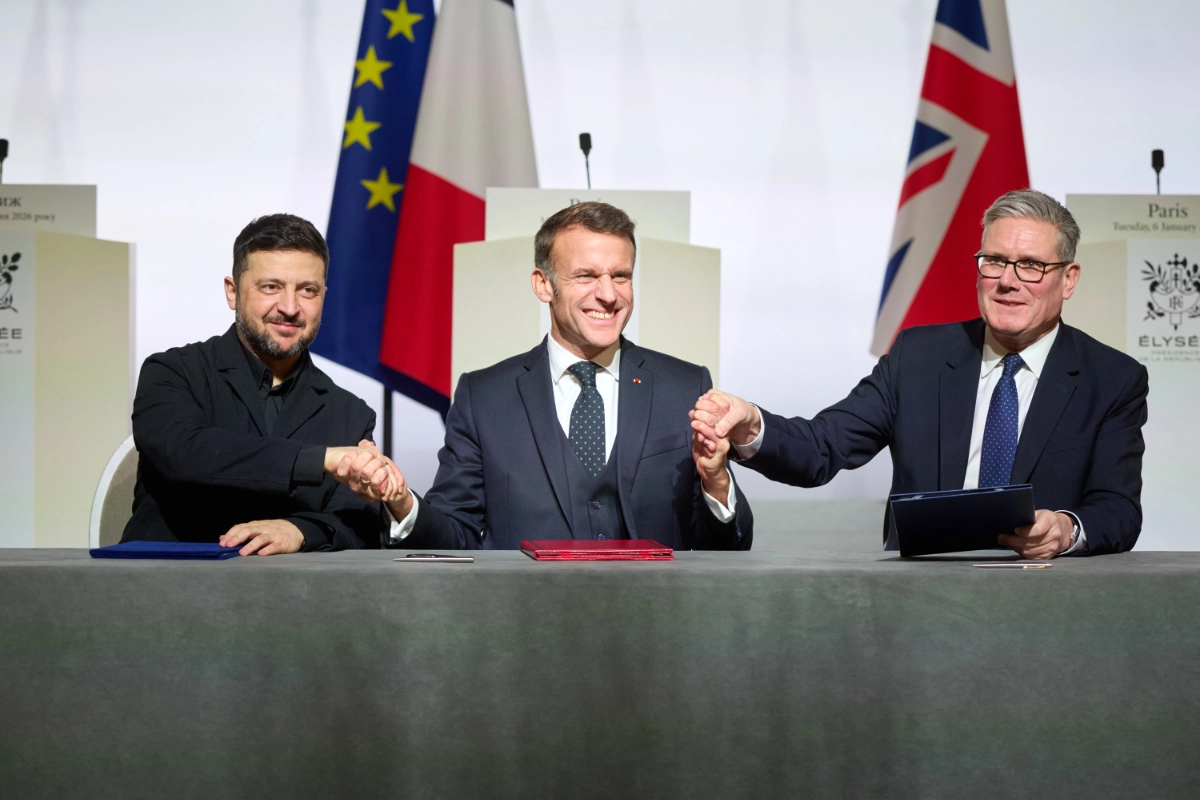
The Paris Declaration, signed 6 January by Zelenskyy alongside French President Emmanuel Macron and UK Prime Minister Keir Starmer, commits allies to "a system of politically and legally binding guarantees" — but only once a ceasefire enters into force. It establishes a US-led ceasefire monitoring mechanism, a European-led multinational force, and a coordination cell at the Coalition Operational Headquarters in Paris.
The declaration represents the most comprehensive security agreement for Ukraine to date. Yet its promises remain contingent on a ceasefire that Moscow has so far refused to accept — and on parliamentary ratification across dozens of countries.
Ukraine's own army remains "guarantee number one"
Zelenskyy drew a clear conclusion from the uncertainty: Ukraine cannot wait for allies to commit.
"Even if they exist, you must first and foremost rely on your own forces, on your Armed Forces of Ukraine," he said. "That is why the number one guarantee is our army: a strong, fully equipped army, 800,000 troops with proper weaponry."
The 800,000 figure aligns with commitments made at the December Berlin summit, where European leaders pledged to maintain Ukraine's armed forces at that level "to be able to deter conflict and defend Ukraine's territory" — which would make the Ukrainian military one of Europe's largest standing forces.
"Everything we need is all written down. And this is not only a desire — it is our vision," Zelenskyy said. "It is important that our military has discussed all of this. It is important that we are securing funding for everything."
He noted that the EU's decision last December to provide €90 billion in joint debt for 2026-2027 "will also help us with this."
What the declaration actually delivers
For all the uncertainty about future commitments, Zelenskyy emphasized the Paris summit's concrete achievements.
"These are not just words. There is concrete content: a joint declaration by all the coalition countries and a trilateral declaration by France, Britain, and Ukraine," he said Tuesday. He thanked France and Macron personally "for bringing together such a strong group, with so many countries and such high-level representation: Europe, Canada, the United States, and other countries."
The summit marked the first time US envoys — Steve Witkoff and Jared Kushner — joined Coalition talks. Witkoff stated that Trump "strongly stands behind security protocols" and that the guarantees are meant to ensure "the people of Ukraine know that when this ends, it ends forever."

But the gap between signing declarations and deploying soldiers remains wide. The Coalition has struggled since its March 2025 founding to secure troop commitments beyond the UK and France. Last week, Zelenskyy himself warned that without actual troops, the Coalition "isn't exactly" willing.
The question he posed to journalists captures the fundamental uncertainty: Would allies really fight? He's still waiting for an answer.