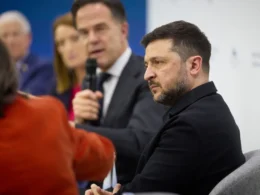


President Volodymyr Zelenskyy declared British and French military presence essential to the Coalition of the Willing during a 3 January press conference in Kyiv, setting a clear test for the European-led security initiative that has struggled to turn pledges into concrete commitments.
"The leading ones are Britain and France. It is their military presence that is mandatory," Zelenskyy told journalists after meeting with 18 national security advisers from partner countries.
The president went further, questioning whether the Coalition can exist without troops on the ground: "Even the existence of the coalition itself depends on whether certain countries are ready to activate their presence. If they are not ready at all, it's not exactly a 'Coalition of the Willing.'"
What is the Coalition of the Willing?
The Coalition emerged in March 2025 as Europe's response to two simultaneous pressures: the Trump administration's push for rapid peace negotiations and the reality that NATO membership for Ukraine remained blocked.
British Prime Minister Keir Starmer formally announced the initiative on 2 March 2025, following discussions with French President Emmanuel Macron. The concept: a group of willing countries would provide security guarantees outside NATO's consensus-based structure, including a "reassurance force" that would deploy to Ukraine after a ceasefire.
The Coalition has grown from initial UK-France talks to 35 countries, including EU and non-EU members, Canada, Australia, and Japan. By September 2025, 26 countries had formally pledged to deploy troops or provide other military assistance.
But pledges have outpaced action. Only the UK and France have committed actual soldiers. When The Times reported in April 2025 that European nations would struggle to collectively muster 25,000 troops — far short of the 64,000 originally proposed by British military leadership — the gap between rhetoric and reality became clear.
Poland, Spain, and Italy declined to contribute ground forces. Germany left the door open but made participation contingent on parliamentary approval and US involvement. Finland and Estonia raised concerns that deployments would dilute their own border defenses.
Former Lithuanian Foreign Minister Gabrielius Landsbergis captured the frustration in May 2025: "There are no troops, almost no weapons, no frozen assets, no air defence, no crippling sanctions, no accession, new tariffs, and no Taurus. So what is actually going on? I am concerned that the answer is 'nothing.'"
What would the troops do?
Zelenskyy outlined the mission scope. European forces would deploy "effectively immediate after the ceasefire" — not eventually, not once conditions stabilize, but right away.
Their role: monitoring the cessation of hostilities, supporting Ukrainian forces with weapons, technology, and intelligence. "Multi-vector security guarantees" would cover land, sea, and sky, he said. Some details would remain classified, particularly those involving joint intelligence work.
The reassurance force would not fight on the front lines. Macron has said it would be stationed at "strategic locations" — cities, ports, power plants — as a deterrent against renewed Russian aggression.
Separate from the Coalition: bilateral guarantees
The Coalition framework operates alongside separate bilateral security agreements. Ukraine has signed such agreements with individual countries, and Zelenskyy has said that bilateral US-Ukraine security guarantees are now "100% agreed" as part of the 20-point peace plan negotiations.
The Coalition's value lies in its multilateral nature — a collective European commitment that would make any Russian violation a problem for multiple capitals simultaneously.

The alternative to NATO: A Coalition of Like-Minded European Countries
January diplomatic sprint
Zelenskyy announced an intensive schedule to finalize the security framework:
- 4 January: Military officials travel to Paris for 24-hour consultations
- Following days: Leaders' summit to finalize security documents
- During the summit: Meetings with President Trump's team in Paris
- End of January: Summit in the United States
"We are not allocating a lot of time for this," Zelenskyy said.
The question now is whether Europe's willing will match Zelenskyy's timeline — and whether the Coalition's promises will materialize as soldiers on Ukrainian soil.