Dmitry Tymchuk’s Military Blog: Summary – September 1, 2014

Dmitry Tymchuk’s Military Blog: Summary – September 1, 2014

Brothers and sisters!

Here’s the Summary for September 1, 2014 (for previous summary, please see Summary for August 27).

The bad news:

1. It is absolutely obvious that Putin will not back down. Meanwhile, if the Ukrainian government thinks that appeals by some European leaders “to resolve the conflict with political means” make [any] sense, it is clearly mistaken. To accept the “political” solution to the crisis is possible only by accepting the loss of, if not all, then (in the beginning) a part of the Donbas.

Putin–either himself or through the mouths of the terrorists–will demand the recognition of the “DNR” and “LNR” [Donetsk and Luhansk People’s Republics] as separate “states” outside of Ukraine. If Ukraine does not agree to that, he is ready to accept the “DNR” and “LNR” as unrecognized (or rather–recognized by only a handful of misfits led by the Russian Federation) quasi-state formations–obviously, under the tacit protectorate of Russia. This is the version akin to Transnistria and Abkhazia.

In the course of negotiating an option of some autonomies and other federal entities (which Kyiv could agree to as a compromise), these can be discussed only as pulling the leg of the world community. Putin doesn’t need Donbas under the slightest control of Kyiv, do not have any illusions [about it].

And so, to begin negotiations with a view to “peacefully settle the conflict” can only be done after mentally saying goodbye to the territories that are currently controlled by the terrorists.

But we all know too well that Putin needs the “LNR” and “DNR” only as a springboard for further destabilization of the situation and exclusion of the entire south and east from Ukraine. The Kremlin doesn’t need the heaps of Donbas–it needs the scientific and industrial potential of Kharkiv, Dnipropetrovsk and Zaporizhzhia, as well as the strategic territory in the south represented by Odesa, Kherson and Mykolaiv Oblasts (in terms of support of Crimean livelihood and the connection to Transnistria, and taking control of the entire Ukrainian coast of the Azov and the Black Sea). This is a minimal program. Where the Moscow’s potentate [ambition] brings him next–is another question.

It is possible to stop this scenario only with force, and only now. We have to understand that for all the riches of Russia as Europe’s raw material appendage, the Russian military power is not unlimited–at least in terms of the so-called “conventional armed forces.” Zhukov’s version that “Russian women will give birth [to more]” will obviously not work in this situation–the more Russia’s little soldiers come back home in coffins, the more unsteady Putin’s throne will become. The Russian propaganda TV works beautifully on Russian zombies for as long as they don’t have to bury their offspring in unmarked graves.

If I’m wrong, and it is still possible to solve the conflict through political means, without damaging the national interests of Ukraine–I will be extremely happy. Unfortunately, I don’t see any reasons for hope regarding this now.

2. In the context of the ATO, the season of rampant witch hunting has resumed. The public and various experts are beginning to blame the leadership of the ATO, the MoD [Defense Ministry] and the GS [General Staff] for failures. Military command sees the cause of failures in the invasion of the Russian army, and (still unobtrusively) notes the sins of the volunteer units (mostly, their “ungovernability”) and the insufficient level of morale among the mobilized [servicemen]. The highest leadership of Ukraine promises “personnel decisions” in the military.

The question is: who is right?

The answer goes as follows: it is an infrequent occurrence when everyone is right.

I’ll start with the most unpopular–with the criticism of an ordinary soldier, be it a volunteer or a mobilized serviceman. We find a thousand and one reasons to explain the lack of basic discipline in the ranks of our troops. These arguments sound convincing and it’s impossible to contradict them. Besides the tiny detail that no army can exist without discipline, and even more so, it is unable to successfully fight [without it]. It’s been tested for thousands of years, [we] don’t have to test [this theory].

I will get a response in the form of a question: so this is the soldier’s fault? To this, I will give a simple answer. Although I have the department of military journalism behind my shoulders, after all I started off in [military] service as an officer inside “the troops,” with the [military] personnel. The main lesson that I took away [from there]: there are no bad soldiers.

But in order for the biggest sloven to truly become a great warrior, they need commanders not just from among the likes of regular military school graduates, but the officers [who are] the leaders. Those [usually] prove themselves in their work. Now, the tricky question: how many of our sergeants or warrant officers who proved themselves, received the rank of second lieutenant as a result of the ATO, for example? Or is it such a big problem to make changes to the “Regulations on military service by relevant categories of servicemen” to assign the officer ranks in the “undeclared” war? How many platoon commanders who have shown themselves were promoted to the company and even the battalion level commanders? But in fact. such promotions are a normal practice of war, i.e., conditions under which anyone can show their best and worst qualities in the course of a few hours.

Now about the generals. If a general fails to fulfill his official duties–he should be removed from office, just like any other official who sits in his pants at work for nothing. In this respect, I fully agree with Yuri Butusov, who argues that the phrase “no one to replace [them with]” is not an argument. Few generals, and no one to choose from? Not a problem. Here, we [should] apply the principle of “natural selection,” i.e., the appointment of those senior officers who distinguished themselves, to the general’s office/position. Do not make a fetish of the general’s stripes when it comes to the fate of our Motherland.

3. And finally, about the Russian invasion. We are told that the Russians threw their armed forces at Donbas, and therefore everything got dramatically complicated.

Yes, this is a problem, and a colossal [one at that]. But what was our army constantly training for in theory–including the preparation of the very same generals at the relevant department of the Defense Academy? Well, not to the ATO after all! But first and foremost to the war with an enemy’s regular army. That is–precisely to the situation that has taken place nowadays.

I agree, there is nothing enjoyable about this, but let’s not pretend that we have been attacked by Martians, the issue of its confrontation being veiled by the darkness of secrecy. The Russian soldiers are of the same blood as the Russian mercenaries, they only differ by the absence of inscriptions on their graves. I don’t think that working on the algorithms of their send-off into these graves is an impossible task.
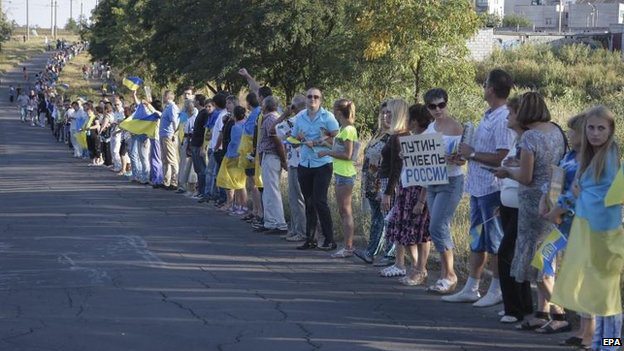
 

Residents of Mariupol form a human chain in protest against Russia’s actions. Photo: EPA

read more

Dmitry Tymchuk, Coordinator, Information Resistance
Translated and edited by Voices of Ukraine


To suggest a correction or clarification, write to us here

You can also highlight the text and press Ctrl + Enter

Please leave your suggestions or corrections here


    Leave a Reply
    Euromaidan Press

    We are an independent media outlet that relies solely on advertising revenue to sustain itself. We do not endorse or promote any products or services for financial gain. Therefore, we kindly ask for your support by disabling your ad blocker. Your assistance helps us continue providing quality content. Thank you!

    Related Posts

    Тарас Возняк: Геополітична диспозиція Росії Путіна

    Однак це бачення загальної геополітичної ситуації. Виходячи з цього бачення світу і вибудовується реальна політика. Отож, як вона вибудовується?

    Маючи незначні ресурси, Росія Путіна пробує вибудовувати архітектуру Світового острова в опорі на Китай. Але не тільки – донедавна однією з опорних точок був Іран – однак, здається, Іран таки пішов на поступки Світовому острову в обмін на пом'якшення санкцій. Так само вона розраховує на латентну підтримку Франції та Німеччини.

    Але такий розрахунок на інших геополітичних гравців за відсутності власних ресурсів призводить до узалежнення від того ж Китаю, а також і від ЄС (основного споживача російського експорту). Розрахунок на Іран не виправдав себе – Іран пішов своїм шляхом – принаймні ситуативно – і російські сподівання його не надто цікавлять.

    Ця схема не враховує змін, що відбуваються у світі. Неоєвразійці зрозуміли, що світовий центр після ІІ Світової війни перемістився з Лондона до Нью-Йорка, однак неначе не зауважують, що на наших очах він переміщається до Лос-Анджелеса і Шанхаю – десь посередині. І тоді вага Китаю у євразійській конструкції, яку вони пробують вибудовувати, буде домінантною. Вони не зауважують переміщення центру ваги США з атлантичного на тихоокеанське узбережжя. На це слід реагувати і теж виходити на цей геополітичний простір.

    Однак, що ми спостерігаємо – цілком протилежну картину. Росія евакуйовується з перспективного Далекого Сходу та Сибіру. Там відбувається просто цивілізаційний занепад. Московія діє інерційно і далі зосереджується у самій Москві.

    Російська Федерація крайньо асиметрична:

    • ментально – і далі центрами є стара столиця Московського царства – Москва та Російської імперії – Санкт-Петербург;

    • демографічно – за Уралом мешкає 15% населення країни;

    • ресурсно – більшість ресурсів Росії – у Сибірі;

    • військово – головні військові ресурси спрямовані на Захід;

    • релігійно – надмірне фаворитизування православ'я призведе до значних проблем з ісламом, який динамічно поширюється в Росії;

    Якщо вдатися до метафор, то Московія вичерпується. Потрібно будувати власне Російську Федерацію, яка мусить мати інші геополітичні орієнтири. Можливо, режим Путіна – останній чи передостанній москвоцентричний режим в Росії. Можливо, майбутня геополітична орієнтація Російської Федерації мала б бути радше не на вичерпану "среднюю полосу", а на Сибір, Далекий Схід і навіть Арктику.

    Однак чи є політична воля так переформатовувати Росію? У режиму Путіна волі до цього немає. Він думає про дві речі – самозбереження і негайне збагачення. А тому він все ще мислить застарілими категоріями "повернення" Криму та виходу до Чорного моря.

    Якщо Росія не переформатується на Схід, то порожнечу, що утворюється так чи інакше заповнить Китай. Невдовзі питання може бути поставлене так – або Нова Росія, або Новий Китай. Здається, час Сполучених Штатів Сибіру, про які говорили сто років тому, минув – немає ресурсів. Можна сказати, що це футурологія. Так, звичайно. Але саме з такої футурології і витікають подальші політичні програми та дії.

    Тоді як потрібно готуватися до перенесення центру ваги країни на Північ, Схід і навіть на Далекий Схід:

    • головні ресурси Росії (нафта, газ, безпека) невдовзі будуть в Сибірі та Арктиці;

    • головна політична перспектива, з огляду на міграцію цивілізаційних центрів, на Далекому Сході.

    Тому Росії потрібне нове геополітичне мислення спрямоване на Арктику, Сибір і Далекий Схід. Можливо, саме на Далекому Сході постане новий симбіоз Китаю та Росії.

    Чи були спроби такого мислення про переформатування Росії? Звичайно були. Однак нічим не закінчилися. Російським "самодєржцям" комфортно жити в Москві і визискувати країну за Уралом. Що в результаті веде до стагнації і неуспіху цього формату Росії.

    Чи є в Росії досвід зміни формату? Звісно є. І завжди він здобувався як відповідь на зовнішні виклики:

    • Петро І переформатував цивілізаційно відстале Московське царство у Російську імперію;

    • Лєнін, з огляду на поразку у І Світовій війні, переформатував Російську імперію у СССР;

    • Ґорбачов-Єльцин, з огляду на цивілізаційну відсталість, технологічну революцію 1980-х і поразку у "холодній війні", переформатували СССР у відносно демократичну РФ І;

    • Путін, з огляду на інформаційну революцію, зміну технологічних платформ 2000-х переформатовує РФ І у авторитарну РФ ІІ.

    Таким чином ми бачимо якийсь неадекватний геополітичний зсув РФ ІІ – авторитарної Росії третього президентства Путіна. Вона не реагує на зовнішні виклики і не пробує ввійти у світ в адекватному до викликів часу форматі, а неначе виходить з нього. Замість того, щоб прориватися і переорієнтовуватися до нових перспектив – на Тихий океан, Росія самоізолюється, повертається до регресивних форм суспільних відносин, будує чистої води автократію. Зрештою, така реакція для Росії теж характерна. Лєнін у 1917 р. завів країну у комуністичну ізоляцію, Сталін 1945 р. у "холодну війну". Путін заводить Росію у ексКҐБістську ізоляцію.

    Що є причиною такої неадекватної поведінки Путіна? І чи впливає на його політику російська еліта чи російський народ?

    Як правило російські "самодержавці" змінюють державну конструкцію з огляду на якусь політичну чи геополітичну катастрофу. Російська імперія трансформувалася в СССР, а СССР – в Російську Федерацію. Однак нафтовий бум 2000-2013 рр. приніс зовсім іншу якість ресурсів. Єльцин виживав усі 1990-ті. Натомість Путін, отримавши такий ресурс, почав діяти традиційним російським трибом – прирізувати території та збільшувати кількість "руських" (Чечня, Абхазія, Південна Осетія, Крим, Донбас). Саме тому у 2000-х ожило неоєвразійство, з'явилася концепція "Русского мира".

    І неоєвразійство, і "русский мир" помруть тільки тоді, коли у російських "саможєржцев" заберуть нафто-газовий акселератор – коли остаточно впаде і попит, і ціни на енергоносії.

    Тому на найближче майбутнє, піклуючись тільки про збереження режиму, будучи звичайними мародерами, мислячи за інерцією і насправді не переймаючись стратегічним майбутнім Росії, Путін чи його прямі спадкоємці будуть зацікавлені у:

    • збереженні монополій на нафто-газових ринках;

    • прив'язці своїх клієнтів до нафто-газової залежності;

    • утримуванні цін на нафту та газ;

    • блокуванні енергетичної революції;

    • збереженні Російської Федерації ІІ (третє президентство Путіна) як корпорації її вузького елітного прошарку;

    А тому на міжнародному рівні режим Путіна скоріш за все поставив перед собою такі завдання:

    • розколоти ЄС по кількох лініях (ФРН contra Південна Європа, ФРН+Франція contra Центрально-Східна Європа так званого "санітарний поясу");

    • якщо не повністю позбавити суб'єктності, то хоча б підпорядкувати собі "санітарний пояс" між РФ та її сателітами та ФРН (Фінляндія, Естонія, Латвія, Литва, Польща, Чехія, Словаччина, Угорщина, Румунія, Болгарія, Словенія, Хорватія, Боснія і Герцеговина, Чорногорія, Сербія, Македонія, Греція, Молдова, Україна, Грузія, Вірменія, Азербайджан);

    • відтіснити Велику Британію з будь-яких європейських проектів, включно з ЄС;

    • ізолювати США, знеохотити їх до участі у європейських справах;

    • будь-якими силами втягнути КНР у спільні геополітичні проекти;

    • спробувати знову спровокувати ірансько-американське протистояння або скористатися американськими уступками, які укладалися при перемовинах з Іраном;

    • активізувати залучення невизначених країн у форматі співпраці БРІКС (BRICS – Brazil, Russia, India, China, South Africa) які до 2050 року неначе мають стати чотирма домінуючими економічними системами світу;

    • активізувати фронт протистояння США (Ємен, Газа+Західний берег Йордану, Ліван, Сирія, Ірак, Грузія, Україна, Молдова);

    • змінити світову систему безпеки за своїми лекалами у наближеному до путінсько-дуґінського виконання.

    Ads are disabled for Euromaidan patrons.

    Support us on Patreon for an ad-free experience.

    Already with us on Patreon?

    Enter the code you received on Patreon or by email to disable ads for 6 months

    Invalid code. Please try again

    Code successfully activated

    Ads will be hidden for 6 months.