Assimilation of ethnic Russians in Ukraine should worry Moscow, Nevzorov says

Beautiful girls in vyshyvankas, ethnic Ukrainian embroidered costumes. Vyshyvanka Day in Lviv, 2015 (Image: Lviv Today)
Image: Lviv Today
Assimilation of ethnic Russians in Ukraine should worry Moscow, Nevzorov says


An increasing number of ethnic Russians in Ukraine not only are identifying themselves as part of a civic nation in Ukraine but also are taking the next step and assimilating to the Ukrainian ethnic nation, a trend that Vyacheslav Nevzorov says Moscow should be worried about and that should be the focus of study by Russian scholars.

Nevzorov, who writes for the Topwar.ru portal, earlier sounded the alarm that ethnic Russians in Ukraine are quite attracted to the Ukrainian civic nation. Now, he is expressing concern about complete assimilation.

The Moscow commentator says that “the Russian super-ethnos,” which according to him included Russians, Ukrainians and Belarusians, is splitting up and that many “Russian-language people with classical Russian family names have fallen in love with ‘Ukraine’ as a project” and have added to the number of “Russian-language Ukrainians.”

According to Nevzorov, he has “lost many close relatives who were themselves born in Russia and came to Ukraine in the 1980s,” as well as many “fellow students… whose parents were sent from the RSFSR to the UkSSR.” And he says he wants to know why they are shifting their identities from Russian to Ukrainian.

Specifically, he says, he wants to know what lies behind the phenomenon in which his “relative at the door of [his] home told me: ‘Go back to your Russia!’” to the same city from which his relative had come originally.

“Today,” he continues, “it is fashionable to say that we have lost Russians in Ukraine only because” of Ukrainian propaganda and censorship that he says emerged after the Maidan. But in fact, the roots of what he calls the problem of the re-identification and assimilation of ethnic Russians in Ukraine have deeper roots.

Among the most important, Nevzorov says, were the de-industrialization of Ukraine and the collapse of Russian media between 1995 and 2003 “before the mass appearance of the Internet and cable television where Russians of Ukraine could form their own playlists” and maintain contact with their native culture.

Another cause is to be found in the Ukrainian educational system. Even where there are Russian-language schools, he says, these “do not give information about the history of Russia and Russian literature” but rather declare “in Russian” that “Bandera is a hero.” That helps create “Russian-language Russophobes.”

At present, he continues, this phenomenon has become large enough that Russian institutions must investigate it and provide answers to nine questions:

  • “Why in a country where there hasn’t appeared a single children’s film and only a couple of adult ones over the last 24 years are Russian-language young people drawn not to Russia but have been enthusiastic about the ethno-culture of Halychyna?” [Note: By using the term "Halychyna," which was a medieval princedom with territory straddling western Ukraine, eastern Poland and Slovakia, Nevzorov shows his geographic incompetence and his desire to diminish the ethnic Ukrainian culture in the rest of Ukraine, which had survived despite centuries of forced Russification by Russian tzars and communists. - Ed.]
  • “How has the rejection of the Soviet project influenced the assimilation of ethnic Russians in a fraternal Slavic culture on a fragment of Soviet Russia?”
  • “How has consumerism led to the formation of a Ukrainian political nation” and “why have glamorous Russian-language girls and guys begun to wear in night clubs vyshyvankas [traditional Ukrainian clothes] rather than Versace and Gucci?”
  • “What is Halychyna” not only generally but for Russians in Ukraine? Why have the village and the village worldview won over Russian-language cities like Kharkiv, Odesa, Dniprpetrovsk and even Zaporizhzhia?”
  • “Is the absorption and assimilation of Russians in more radically different non-Slavic cultures possible?”
  • Why does Ukrainian education have such an influence on Russians?
  • What is the proper role of the Black Sea Fleet in maintaining Russian identity in Crimea?
  • How did Russia’s problems in the 1990s affect how Russians in Ukraine saw Russia and their own futures?
  • Can this process of assimilation be stopped and reversed or have things gone beyond the point of no return?

Beautiful Kyiv girls in vyshyvankas. (Image: Etno-vyshyvanka)
Beautiful Kyiv girls in vyshyvankas, ethnic Ukrainian embroidered shirts. (Image: Etno-vyshyvanka)

For all his emotionalism, Nevzorov raises three points which many in Russia and the West have been unwilling to address:

  • First, it is not just Russian-speaking Ukrainians who have joined Ukrainian-speaking Ukrainians to form a civic nation in Ukraine over the last two decades; it included Russian-speaking Russians who have done so as well.
  • Second, this pattern reverses what was typical in Soviet times and one that Russians and many others have assumed is the only one available – that Russians assimilate other peoples, not the other way around. But today, Russians are being assimilated not just politically but ethnically in many places and in the first instance Ukraine.
  • And third, that highlights something that even fewer people have been willing to consider up to now: Russian national identity, despite Moscow’s bombast and the assumption that assimilation only goes in the Russian direction is fact often far weaker than the national identities of other peoples on the post-Soviet space -- even when these nations continue to use Russian.

For many ethnic Russians, as Nevzorov’s words suggest, those three things constitute an existential threat; but for many non-Russians, and especially now for Ukrainians, they provide a basis for hope in the future, something all too many of their ancestors had despaired of ever having.
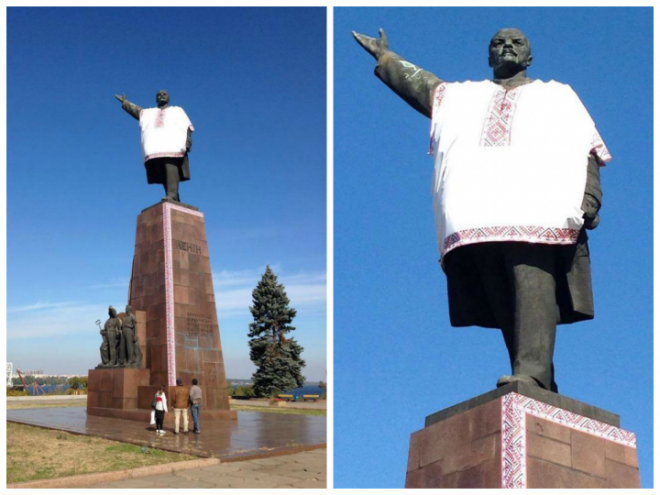
Lenin monument in Zaporizhzhya
Lenin monument in Zaporizhzhia "dressed" into a vyshyvanka, Ukrainian ethnic shirt, in October 2014. (Image: social media)

To suggest a correction or clarification, write to us here

You can also highlight the text and press Ctrl + Enter

Please leave your suggestions or corrections here


    Leave a Reply
    Euromaidan Press

    We are an independent media outlet that relies solely on advertising revenue to sustain itself. We do not endorse or promote any products or services for financial gain. Therefore, we kindly ask for your support by disabling your ad blocker. Your assistance helps us continue providing quality content. Thank you!

    Related Posts

    February 18: Ukrainian troops left the city of Debaltseve as a result of massed intense fire by the Russian Army and pro-Russian terrorists

    February 18 – Ukrainian troops left the city of Debaltseve as a result of massed intense fire by the Russian Army and pro-Russian terrorists – according to Minsk agreements Ukrainian military couldn't fire back in order not to break "Putin's ceasefire". "This morning Armed Forces of Ukraine together with the National Guards of Ukraine have completed a planned and organized withdrawal of forces from Debaltseve", – said the president of Ukraine Petro Poroshenko, who led the operation.

    February 18 – NATO Secretary General Jens Stoltenberg has spoken about the use of modern weapons by the militants of "People's Republic of Donetsk" and "People's Republic of Luhansk" against Ukrainian military near Debaltseve. He did not specify the kind of weapon.

    February 18 – "I call on Russia to withdraw all its troops from the east of Ukraine, to cease all support of the separatists, follow Minsk agreements and pressure on the separatists to force them to comply with ceasefire", – said NATO Secretary General Jens Stoltenberg.

    February 18 – 167 wounded were transported to Artemivsk from Debaltseve. It was impossible to pick up the bodies of many who were killed.

    February 18 – The militants supported by Russia demonstrate a clear intention to expand their control over the region, recognizes PACE, – said the President of the Parliamentary Assembly of the Council of Europe (PACE) Anne Brasseur.

    February 18 – European Union should consider deploying a military mission to Donbas if Minsk agreements are not adhered to and the fighting continues, – said the representative of Ukraine to the EU Konstantin Eliseev in his comment to BBC Radio. "We must use all our efforts and capacities (not only Ukraine, but the US and the EU) to press Kremlin to stop military fighting. If this fails, we must talk about a plan "B". Perhaps, it is time for the EU to consider the possibility of a military intervention in Donbas".

    February 18 – According to President of Ukraine, Petro Poroshenko, in Debaltseve, the mission of Ukraine's Armed Forces was fully accomplished, despite the fact that the Ukrainian Army totally left the city. "This position and successes were very necessary in Minsk during the negotiations, and after Minsk. We could demonstrate to the whole world the real face of the bandits, separatists, supported by Russia, which took on the role of the guarantor and a direct participant of the Minsk negotiations," emphasized Poroshenko.

    The head of the country clarified information about the encirclement of the Debaltseve fighters as well as about the massive deaths of Ukrainian soldiers. "We stated and proved that Debaltseve was under our controll, there was no encirclement. Our forces and divisions left in a planned organized fashion. They left with their full artillery, with tanks, with BNP, with SAU, with tractors, with automobile technology," stated Poroshenko. According to the President, those who left Debaltseve included the 128th Mountain Infantry Brigade, parts of the sub-divisions of the 30th Brigade, the 25th Battalion, the rest of the 40th Battalion, Special Forces, and the National Guard.

    Smoking Putin Out of His Cave

    David Marples : Minsk-2

    Soldiers near Debaltseve ask for help, say they could all be killed

    By Rick Lyman and Helene Bienvenue: Hungary Keeps Visit by Putin Low-Key as It Seeks to Repair Relations With West

    By Andrew E. Kramer and David M. Herszenhorn: Ukrainian Soldiers' Retreat From Eastern Town Raises Doubt for Truce

    Christian Caryl: New Model Dictator Why Vladimir Putin is the leader other autocrats wish they could be.

    One year ago Feb 18, 2014: morning on Maidan

    Estonian President: a year of Russian aggression

    E. Lucas: Minsk is worth nothing

    Bloomberg business analysis on Russia, Ukraine, EU

    Ukraine: One year after EuroMaydan protests, justice denied for victims of violence

    P.S.: Please spread this appeal as much as possible.

    February 26: 75 military from the UK will be deployed to Ukraine in the upcoming weeks to train Ukrainian military

    February 25 – 75 military from the UK will be deployed to Ukraine in the upcoming weeks to train Ukrainian military, – saidPrime Minister of the United Kingdom David Cameron.

    February 25 – Canada could send military instructors to train in Ukraine, reports thestar.com citing Canada's Minister of Defence Jason Kenney. The Minister also mentioned that the the US and the UK have already made similar decisions.

    February 25 – In Donetsk, Ukrainian partisans of the group named "Tini" ("Shadows") who are fighting in the occupied areas, have blew up a military warehouse of the militants.

    February 25 – European Commission proposes to discuss the possibility of separate accounting for Russian gas supplied to "Naftogaz of Ukraine" (Ukraine) and to occupied Donbas. Russian "Gazprom" would like to supply gas directly to Donbas and to force Ukraine to pay for it – this is what business Russian style looks like.

    February 25 – Moscow City Court decided to leave Ukrainian pilot Nadiya Savchenko in custody until May 13th (Savchenko was abducted from Ukraine). She has been on hunger strike for 75 days. Ukrainian pilot Nadiya Savchenko made a speech during the trial in Moscow. "Deceitful bastards from the Investigative Committee are keeping me here illegally and are forcing me to starve", – she said.

    February 25 – Ukrainian hryvnia has slightly strengthened after its dramatic decrease in value on Monday-Tuesday. The Government and the National Bank have limited the purchase of foreign currency and introduced a number of restrictions that eased the "currency rush". National Bank Chairman and Finance Minister have held a press conference and described the steps that will be taken. The Ministry of Finance does not intend to review the average exchange rate of hryvnia (21.7 UAH to 1 USD), which was used to prepare the amendments to 2015 state budget.

    By Renee Rigdon, Stuart A. Thompson and Taylor Umlauf: Shifting Lines – Russia-Backed Rebels Claim New Territory in Ukraine

    Not another Iron Curtain

    Europe throws Ukraine under the bus

    A new Ukraine could emerge – democratic, liberal, and much better governed...

    David Cameron on sending military instructors to Ukraine (video)

    Russian trups in Ukraine

    This Is What Putin Really Wants

    Ivan Krastev&Stephen Holmes: The Ukrainian School of War

    Mikheil Saakashvili: Ukraine is today's West Berlin

    P.S.: Please spread this appeal as much as possible.

    Ads are disabled for Euromaidan patrons.

    Support us on Patreon for an ad-free experience.

    Already with us on Patreon?

    Enter the code you received on Patreon or by email to disable ads for 6 months

    Invalid code. Please try again

    Code successfully activated

    Ads will be hidden for 6 months.