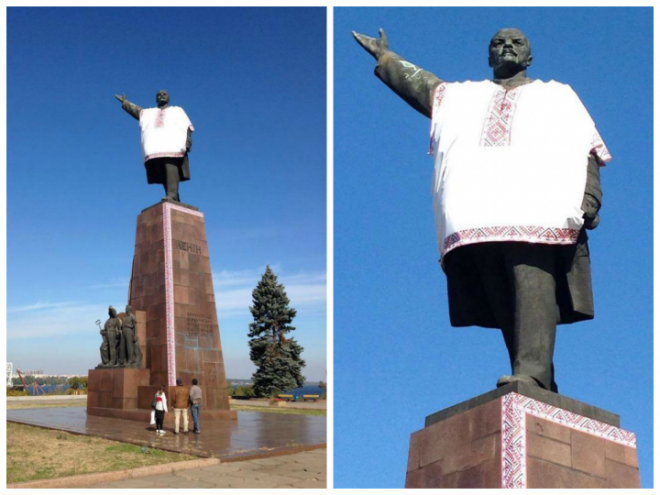
An increasing number of ethnic Russians in Ukraine not only are identifying themselves as part of a civic nation in Ukraine but also are taking the next step and assimilating to the Ukrainian ethnic nation, a trend that Vyacheslav Nevzorov says Moscow should be worried about and that should be the focus of study by Russian scholars.
Nevzorov, who writes for the Topwar.ru portal, earlier sounded the alarm that ethnic Russians in Ukraine are quite attracted to the Ukrainian civic nation. Now, he is expressing concern about complete assimilation.
The Moscow commentator says that “the Russian super-ethnos,” which according to him included Russians, Ukrainians and Belarusians, is splitting up and that many “Russian-language people with classical Russian family names have fallen in love with ‘Ukraine’ as a project” and have added to the number of “Russian-language Ukrainians.”
According to Nevzorov, he has “lost many close relatives who were themselves born in Russia and came to Ukraine in the 1980s,” as well as many “fellow students… whose parents were sent from the RSFSR to the UkSSR.” And he says he wants to know why they are shifting their identities from Russian to Ukrainian.
Specifically, he says, he wants to know what lies behind the phenomenon in which his “relative at the door of [his] home told me: ‘Go back to your Russia!’” to the same city from which his relative had come originally.
“Today,” he continues, “it is fashionable to say that we have lost Russians in Ukraine only because” of Ukrainian propaganda and censorship that he says emerged after the Maidan. But in fact, the roots of what he calls the problem of the re-identification and assimilation of ethnic Russians in Ukraine have deeper roots.
Among the most important, Nevzorov says, were the de-industrialization of Ukraine and the collapse of Russian media between 1995 and 2003 “before the mass appearance of the Internet and cable television where Russians of Ukraine could form their own playlists” and maintain contact with their native culture.
Another cause is to be found in the Ukrainian educational system. Even where there are Russian-language schools, he says, these “do not give information about the history of Russia and Russian literature” but rather declare “in Russian” that “Bandera is a hero.” That helps create “Russian-language Russophobes.”
At present, he continues, this phenomenon has become large enough that Russian institutions must investigate it and provide answers to nine questions:
- “Why in a country where there hasn’t appeared a single children’s film and only a couple of adult ones over the last 24 years are Russian-language young people drawn not to Russia but have been enthusiastic about the ethno-culture of Halychyna?” [Note: By using the term "Halychyna," which was a medieval princedom with territory straddling western Ukraine, eastern Poland and Slovakia, Nevzorov shows his geographic incompetence and his desire to diminish the ethnic Ukrainian culture in the rest of Ukraine, which had survived despite centuries of forced Russification by Russian tzars and communists. - Ed.]
- “How has the rejection of the Soviet project influenced the assimilation of ethnic Russians in a fraternal Slavic culture on a fragment of Soviet Russia?”
- “How has consumerism led to the formation of a Ukrainian political nation” and “why have glamorous Russian-language girls and guys begun to wear in night clubs vyshyvankas [traditional Ukrainian clothes] rather than Versace and Gucci?”
- “What is Halychyna” not only generally but for Russians in Ukraine? Why have the village and the village worldview won over Russian-language cities like Kharkiv, Odesa, Dniprpetrovsk and even Zaporizhzhia?”
- “Is the absorption and assimilation of Russians in more radically different non-Slavic cultures possible?”
- Why does Ukrainian education have such an influence on Russians?
- What is the proper role of the Black Sea Fleet in maintaining Russian identity in Crimea?
- How did Russia’s problems in the 1990s affect how Russians in Ukraine saw Russia and their own futures?
- Can this process of assimilation be stopped and reversed or have things gone beyond the point of no return?

For all his emotionalism, Nevzorov raises three points which many in Russia and the West have been unwilling to address:
- First, it is not just Russian-speaking Ukrainians who have joined Ukrainian-speaking Ukrainians to form a civic nation in Ukraine over the last two decades; it included Russian-speaking Russians who have done so as well.
- Second, this pattern reverses what was typical in Soviet times and one that Russians and many others have assumed is the only one available – that Russians assimilate other peoples, not the other way around. But today, Russians are being assimilated not just politically but ethnically in many places and in the first instance Ukraine.
- And third, that highlights something that even fewer people have been willing to consider up to now: Russian national identity, despite Moscow’s bombast and the assumption that assimilation only goes in the Russian direction is fact often far weaker than the national identities of other peoples on the post-Soviet space -- even when these nations continue to use Russian.
For many ethnic Russians, as Nevzorov’s words suggest, those three things constitute an existential threat; but for many non-Russians, and especially now for Ukrainians, they provide a basis for hope in the future, something all too many of their ancestors had despaired of ever having.