


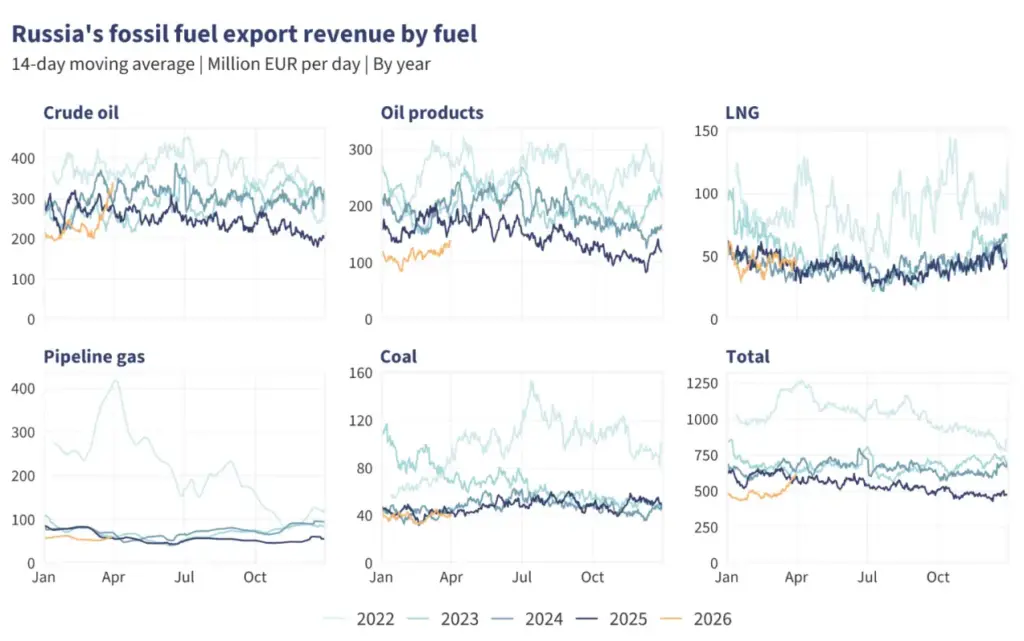
Russia's oil and gas export revenues are rising again. The new war in the Persian Gulf has lifted prices, widened Moscow's fiscal space, and given the Kremlin temporary relief after months of budget pressure. If sustained for several months, this windfall could effectively finance a significant share of Russia's war effort.
For Ukraine and Europe, this matters. Hydrocarbon revenues are not an accounting detail in Moscow's budget — they are one of the financial foundations of Russia's war economy. When oil prices rise, the Kremlin gains room to fund its military machine, propaganda, and repression.
The same shock that has lifted Russian revenues abroad is producing a second pressure inside Europe. Higher energy prices are reviving industrial calls to reopen the Russian gas debate.
Both pressures point in the same direction—back toward Moscow.
The correct European response is not to reopen the debate on Russian oil and gas. It is to end it by electrifying faster.
This is now an urgent policy question. The European Commission is preparing its Electrification Action Plan, intended to accelerate the shift of transport, buildings, and industry from fossil fuels to clean electricity.
That plan should not be treated as a narrow climate file, but become one of Europe's main economic security instruments, alongside sanctions, defense production, and support for Ukraine.
The reason is straightforward. Every heat pump installed, every electric vehicle charged with European power, every industrial process shifted from gas to electricity reduces demand for imported hydrocarbons. Every gigawatt of renewable generation connected to the grid weakens the revenue base of the Kremlin and other fossil-fuel autocracies. Decarbonization, in this frame, is also de-risking.


Russian bombs keep destroying Ukraine’s Soviet heating. Scotland shows what to build instead
Yet precisely now, old arguments are resurfacing. The CEO of Italian Eni argues that Europe needs "flexibility" on Russian gas, that industry needs relief, and that Moscow could again become a stabilizing supplier.
Bloomberg reported in February 2025 that some eastern German industries were already preparing for a possible return of Russian gas. Reuters later documented similar thinking among executives linked to major European gas buyers and German chemical clusters, including calls around the Leuna industrial site to reopen Nord Stream routes.
While this is a godsend for the Kremlin's coffers, returning to Russian hydrocarbons will not solve Europe's energy problems.
First, "cheap Russian gas" was never a real industrial strategy. It was a hidden security subsidy from an imperial state that turned energy dependency into coercion. Ukraine paid first. Then European consumers and industry. The lesson took four years to learn. It should not be unlearned for short-term industrial relief.
Second, the infrastructure is broken. Nord Stream was damaged. Ukrainian transit has ended. Contractual disputes with Gazprom remain unresolved. Any meaningful restoration of Russian pipeline gas would require political decisions, infrastructure repairs, legal compromises, and years of renewed dependence—and would do nothing to address current market volatility.
Third, the diagnosis is wrong. Europe's competitiveness problem is not that it cut Russian gas. It is that it cut Russian gas faster than it built the industrial backbone of an electrified economy. Grid expansion is too slow, as is permitting. Flexibility and storage are insufficient. Industrial electrification is still treated as a sectoral transition rather than what it is—a geopolitical project.
Fatih Birol, head of the International Energy Agency, put the bottleneck clearly at Davos: Europe's main barrier is "grids, grids, grids." Europe installed a record 80 GW of renewable capacity in 2025, he noted, while developers could deliver more than 400 GW that simply cannot be connected.
The think tank Ember has similarly warned that Europe increasingly has enough clean power potential, but not enough modern grid capacity to move it where households and factories need it.
Europe's main barrier is "grids, grids, grids."
Fatih Birol, head of the International Energy Agency
This is the gap the Electrification Action Plan must close. It should set binding milestones for electricity's share in final energy consumption, accelerate grid investment and permitting, lower the electricity-to-gas price ratio, and create a serious European industrial policy for clean technologies.
That means not only installing solar panels and wind turbines, but producing in Europe—and in Ukraine—more of the equipment an electrified economy actually runs on: batteries, inverters, heat pumps, transformers, cables, power electronics, grid components.
Ukraine should be part of that industrial base.
A country fighting for its survival should not be treated only as a recipient of aid or a future market. Ukraine has engineering capacity, industrial sites, mineral resources, power-sector experience, and a direct security interest in ending Europe's fossil dependency.
Integrating Ukraine into European clean-tech supply chains would support reconstruction, strengthen European resilience, and turn decarbonization into a shared security project.

Europe’s newest wind giant takes shape in Poltava—€1.2 billion deal as thermal plants stay in ruins
At Razom We Stand, we work every day on the link between Russian energy revenues, sanctions enforcement, and Europe's strategic choices.
The pattern is clear. Moscow's fossil fuel exports do not merely enrich oil and gas companies; they sustain a state system built around militarization and external aggression. The EU's remaining imports of Russian LNG alone create a financial flow large enough to contribute to Russia's capacity for repeated large-scale attacks on Ukrainian energy infrastructure and cities. Every winter, Ukrainian engineers repair what European money helped pay for.
This is why the debate over electrification cannot be postponed. Europe should not hedge between an electrified future and a fossil past. It should not spend political energy searching for ways to make Russian molecules acceptable again. It should use the coming Electrification Action Plan to make Russian energy structurally irrelevant.
The path: enforce the phase-out of Russian fossil fuels, reject any return to Gazprom dependency, invest massively in grids and flexibility, electrify buildings and transport, and build a European-Ukrainian industrial base for clean technologies.

Russia's current windfall may finance another season of war. It cannot finance regime survival if Europe takes that revenue stream off the table.
Editor's note. The opinions expressed in our Opinion section belong to their authors. Euromaidan Press' editorial team may or may not share them.
Submit an opinion to Euromaidan Press


