Assimilation of ethnic Russians in Ukraine should worry Moscow, Nevzorov says

Beautiful girls in vyshyvankas, ethnic Ukrainian embroidered costumes. Vyshyvanka Day in Lviv, 2015 (Image: Lviv Today)
Image: Lviv Today
Assimilation of ethnic Russians in Ukraine should worry Moscow, Nevzorov says


An increasing number of ethnic Russians in Ukraine not only are identifying themselves as part of a civic nation in Ukraine but also are taking the next step and assimilating to the Ukrainian ethnic nation, a trend that Vyacheslav Nevzorov says Moscow should be worried about and that should be the focus of study by Russian scholars.

Nevzorov, who writes for the Topwar.ru portal, earlier sounded the alarm that ethnic Russians in Ukraine are quite attracted to the Ukrainian civic nation. Now, he is expressing concern about complete assimilation.

The Moscow commentator says that “the Russian super-ethnos,” which according to him included Russians, Ukrainians and Belarusians, is splitting up and that many “Russian-language people with classical Russian family names have fallen in love with ‘Ukraine’ as a project” and have added to the number of “Russian-language Ukrainians.”


According to Nevzorov, he has “lost many close relatives who were themselves born in Russia and came to Ukraine in the 1980s,” as well as many “fellow students… whose parents were sent from the RSFSR to the UkSSR.” And he says he wants to know why they are shifting their identities from Russian to Ukrainian.

Specifically, he says, he wants to know what lies behind the phenomenon in which his “relative at the door of [his] home told me: ‘Go back to your Russia!’” to the same city from which his relative had come originally.

“Today,” he continues, “it is fashionable to say that we have lost Russians in Ukraine only because” of Ukrainian propaganda and censorship that he says emerged after the Maidan. But in fact, the roots of what he calls the problem of the re-identification and assimilation of ethnic Russians in Ukraine have deeper roots.

Among the most important, Nevzorov says, were the de-industrialization of Ukraine and the collapse of Russian media between 1995 and 2003 “before the mass appearance of the Internet and cable television where Russians of Ukraine could form their own playlists” and maintain contact with their native culture.

Another cause is to be found in the Ukrainian educational system. Even where there are Russian-language schools, he says, these “do not give information about the history of Russia and Russian literature” but rather declare “in Russian” that “Bandera is a hero.” That helps create “Russian-language Russophobes.”

At present, he continues, this phenomenon has become large enough that Russian institutions must investigate it and provide answers to nine questions:

  • “Why in a country where there hasn’t appeared a single children’s film and only a couple of adult ones over the last 24 years are Russian-language young people drawn not to Russia but have been enthusiastic about the ethno-culture of Halychyna?” [Note: By using the term "Halychyna," which was a medieval princedom with territory straddling western Ukraine, eastern Poland and Slovakia, Nevzorov shows his geographic incompetence and his desire to diminish the ethnic Ukrainian culture in the rest of Ukraine, which had survived despite centuries of forced Russification by Russian tzars and communists. - Ed.]
  • “How has the rejection of the Soviet project influenced the assimilation of ethnic Russians in a fraternal Slavic culture on a fragment of Soviet Russia?”
  • “How has consumerism led to the formation of a Ukrainian political nation” and “why have glamorous Russian-language girls and guys begun to wear in night clubs vyshyvankas [traditional Ukrainian clothes] rather than Versace and Gucci?”
  • “What is Halychyna” not only generally but for Russians in Ukraine? Why have the village and the village worldview won over Russian-language cities like Kharkiv, Odesa, Dniprpetrovsk and even Zaporizhzhia?”
  • “Is the absorption and assimilation of Russians in more radically different non-Slavic cultures possible?”
  • Why does Ukrainian education have such an influence on Russians?
  • What is the proper role of the Black Sea Fleet in maintaining Russian identity in Crimea?
  • How did Russia’s problems in the 1990s affect how Russians in Ukraine saw Russia and their own futures?
  • Can this process of assimilation be stopped and reversed or have things gone beyond the point of no return?

Beautiful Kyiv girls in vyshyvankas. (Image: Etno-vyshyvanka)
Beautiful Kyiv girls in vyshyvankas, ethnic Ukrainian embroidered shirts. (Image: Etno-vyshyvanka)

For all his emotionalism, Nevzorov raises three points which many in Russia and the West have been unwilling to address:

  • First, it is not just Russian-speaking Ukrainians who have joined Ukrainian-speaking Ukrainians to form a civic nation in Ukraine over the last two decades; it included Russian-speaking Russians who have done so as well.
  • Second, this pattern reverses what was typical in Soviet times and one that Russians and many others have assumed is the only one available – that Russians assimilate other peoples, not the other way around. But today, Russians are being assimilated not just politically but ethnically in many places and in the first instance Ukraine.
  • And third, that highlights something that even fewer people have been willing to consider up to now: Russian national identity, despite Moscow’s bombast and the assumption that assimilation only goes in the Russian direction is fact often far weaker than the national identities of other peoples on the post-Soviet space -- even when these nations continue to use Russian.

For many ethnic Russians, as Nevzorov’s words suggest, those three things constitute an existential threat; but for many non-Russians, and especially now for Ukrainians, they provide a basis for hope in the future, something all too many of their ancestors had despaired of ever having.
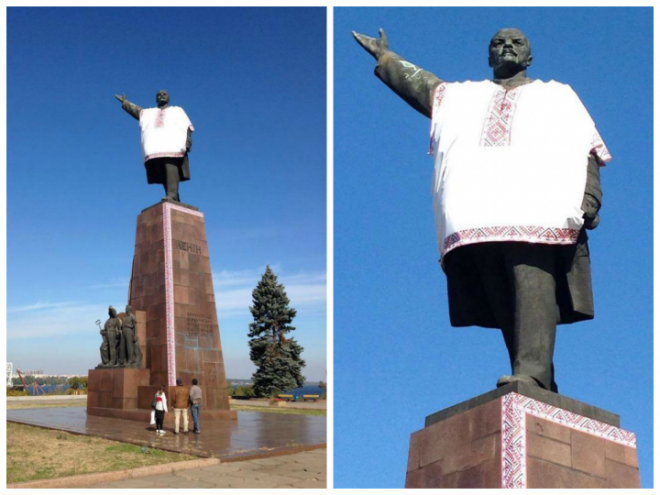
Lenin monument in Zaporizhzhya "dressed" into the Ukrainian ethnic shirt. October 2014. (Image: social media)
Lenin monument in Zaporizhzhia "dressed" into a vyshyvanka, Ukrainian ethnic shirt, in October 2014. (Image: social media)

To suggest a correction or clarification, write to us here

You can also highlight the text and press Ctrl + Enter

Please leave your suggestions or corrections here


    Leave a Reply
    Euromaidan Press

    We are an independent media outlet that relies solely on advertising revenue to sustain itself. We do not endorse or promote any products or services for financial gain. Therefore, we kindly ask for your support by disabling your ad blocker. Your assistance helps us continue providing quality content. Thank you!

    Related Posts

    February 19: Editorial board of Russian “Novaya Gazeta” is in possession of a document developed by Putin’s “close circle” during February 4-15th, 2014 describing planned aggression in Ukraine

    Le 19 février – "Lors des dernières 24 heures, 14 soldats ont été tués dans la zone d'opération anti-terroriste, 172 autres sont blessés." – le porte-parole de l'ATO, Andriy Lyssenko.

    Le 19 février – Oleksandr Tourtchynov, secrétaire du Conseil national de la sécurité et de la défense de l'Ukraine a déclaré que le Conseil a approuvé la demande faite à l'ONU et à l'Union européenne de déployer une mission de maintien de la paix et de la sécurité en Ukraine.

    Le 19 février – La direction générale du journal russe "Novaya Gazeta" a un document daté du 4-15 février 2014, élaboré par les conseillers de Poutine, qui raconte le scénario d'intervention en Ukraine (ceci après que l'Ukraine ait signé l'accord d'association avec l'UE).

    Le 19 février – "Le nœud ferroviaire stratégique de Debaltsevo, qui était d'une importance capitale pour la région, a cessé d'exister. Le nœud ferroviaire ressemble aujourd'hui a une surface lunaire, tout est détruit." a déclaré le porte-parole de l'ATO, Andriy Lyssenko. "On estime que depuis l'annonce du cessez-le-feu jusqu'au retrait de la garnison ukrainienne de Debaltsevo, un combattant a reçu quotidiennement sur sa tête l'equivalent de 580 kg de métal létal sous la forme d'obus, de missiles anti-char et d'autres types de roquettes".

    Le 19 février – Le Procureur général de l'Ukraine a déclaré qu'il a des raisons de croire que la fusillade sur le Maidan du 18 et 19 février 2014 a été organisée par des unités militaires russes.

    Le 19 février – L'armée russes et les collaborateurs russes interdisent toujours l'accès à Debaltsevo aux représentants de la mission de l'OSCE.

    Le 19 février – Le Service de presse de l'état-major des Forces armées de l'Ukraine annonce que plus de 90 soldats ukrainiens ont été capturés pendant la bataille de Debaltsevo, 82 sont portés disparus. Cependant, il ajouté qu'en quittant Debaltsevo les militaires ukrainiens ont arrêté plusieurs dizaines de terroristes, ce qui prouve de nouveau la propagation d'opérations illégales des groupements terroristes.

    Le 19 février – Poutine déclare que la Crimée est devenue une "forteresse imprenable", protégée par de grandes unités militaires et des armes sophistiquées. En décembre 2014, le ministre russe de la Défense, Sergueï Choïgou a annoncé la création d'une Force militaire auto-suffisante en Crimée – le ministère a créé sept formations et huit unités militaires de plus.

    Marioupol sous les bombes

    Kyiv demande une force de maintien de la paix

    P.S.: Faîtes circuler cet appel, SVP!

    January 22: Whereas Russia’s Foreign Minister Lavrov said again, mockingly, that he yet needs to be presented with any evidence that Russian army is indeed fighting in Donbas

    January 22 – On August 24th, 2014 (Independence Day of Ukraine) Putin's army entered Ukrainian Donbas en masse and started its offensive. On January 22nd, 2015 (Day of Ukrainian Unity – celebrating the unity of Eastern and Western Ukraine) Putin's army has ostentatiously "conquered" a symbolic Ukrainian site – Donetsk airport – today Ukrainian military left behind most parts of the airport. Whereas Russia's Foreign Minister Lavrov said again, mockingly, that he yet needs to be presented with any evidence that Russian army is indeed fighting in Donbas.

    January 22 – 10 Ukrainian military were killed and 16 wounded in ATO on January 21st, – informed the spokesman of the General Staff of Ukrainian Armed Forces Vladyslav Seleznyov.

    January 22 – Whereas NATO would like to re-establish communication with colleagues from the General Staff of the Russia's Armed Forces, – stated Supreme Allied Commander Europe of NATO Allied Command Operations, US General Philip Breedlove (Reuters).

    January 22 – The Secretary of the National Security and Defense Council Oleksandr Turchynov hasn't ruled out offensive operations by the militants in the near future (stated by Turchynov as a result of his visit to the war zone, according to NSDC press-service). "New terminal has been almost completely destroyed, but our Armed Forces have strengthened their positions near the village of Pisky and inflicted a series of very strong assaults", – said Turchynov.

    January 22 – Militants of the terrorist group "People's Republic of Donetsk" have "paraded" captive Ukrainian soldiers along the streets of Donetsk. Abuse of prisoners and torture of prisoners violates Hague Convention on the rules of military operations (The Hague Conventions of 1899 and 1907). Abuse of prisoners is punishable under Hague Tribunal. Instead, Ukrainian government is trying to start negotiations on the release of prisoners of war captured at Donetsk airport, – informed NSDC spokesman Andriy Lysenko.

    January 22 – Self-proclaimed leader of Donetsk-based terrorists Oleksand Zakharchenko has said that they intend to "push the frontline" further from Donetsk. It has been previously reported that in September 2014, when explaining the invasion of the city of Novoazovsk and other areas by the militants and disguised Russian soldiers, Russian President Vladimir Putin explained that the main objective of the militants is "pushing the frontline further".

    January 22 – In Donetsk, the terrorists fired at a trolleybus with a mobile mortar, killing seven civilians. The site of the attack is located 20 km from Donetsk airport. For several days now, the terrorists have been travelling around Donetsk in a van with a mortar, shooting at residential areas, trying to encourage the residents to take up anti-Ukrainian views.

    January 22 – During the meeting in Berlin of the heads of the Ministries of Foreign Affairs of the countries of the "Normandic foursome," progress was made only regarding one issue of the Minsk agreements. This was written by Ukraine's Minister of Foreign Affairs, Pavlo Klimkin on his page on Twitter. "Yesterday in Berlin there was a Borodino – a diplomatic battle, which no one won or lost. We made one step forward on one point of Minsk agreements," he wrote. According to him, it concerns a ceasefire.

    January 22 – Facts confirm that Russia is directly involved in the army operation in Eastern Ukraine. This was stated by the President of Lithuania, Dalia Hrybauskaite to the Lithuanian journalists during the Davos Forum, writes Delfi.lt. "This is open territorial aggression, carried out not by some terrorists-seperatists, but by Russia itself, because neither the separatists nor some other people can have such weapons. These cannot be bought at the market or on the street; they are very specific – they can only be owned by big countries," she emphasized. "All the more, there are direct indications that not only the weapons, but the army itself (Russian), its subdivisions are involved," said Hrybauskaite. According to her, Russian representatives are openly lying about the situation in Ukraine. "We really see an enormous demonstration of lying when they say one thing and do something totally opposite, when they blame one side, but, it turns out, that the obligations are not being fulfilled by the other (side)," said the President of Lithuania.

    MUSTANG WANTED: Why Ukrainians will win (music video)

    Aid and sanctions, NOT appeasement

    P.S.: Please spread this appeal as much as possible.

    February 1: Russian Armed Forces and terrorists have deployed 95% of their military equipment in order to occupy the city of Debaltsevo

    February 1 – 13 Ukrainian military were killed and 20 injured in the combat area in Donbas on January 31st, – informed NSDC representative Volodymyr Polevyi.

    February 1 – Russian Armed Forces and terrorists have deployed 95% of their military equipment (machinery) in order to occupy the city of Debaltsevo. Ukrainian Armed Forces are retaining their position at an important railway junction of Debaltsevo. Heavy fighting continues. Ukrainians have retreated from the town of Vuhlehirsk, which is a suburb of Debaltsevo.

    February 1 – Sievierodonetsk city councilor Serhiy Samarskyi has said that billionaire and former MP (Party of Regions) Rinat Akhmetov personally offered up to 25 million USD to security workers at thermal power plant in the town of Shchastia (Luhansk oblast) if they agree to lift the security – he must have wanted to let the terrorist have access to the power plant.

    February 1 – Five Ukrainian military were freed from captivity in exchange for captive terrorists.

    February 1 – Crosses in memory of victims of Mariupol shelling were installed near the Russian Embassy. 30 wooden crosses were installed by the activists on the lawn opposite the building – each cross has a name plaque with the name of a dead Mariupol resident and a phrase "Killed by Russian invaders."

    February 1 – During the meeting in Minsk on January 31st, the representatives of "People's Republic of Donetsk" and "People's Republic of Luhansk" demanded that President of Ukraine Petro Poroshenko issues a decree on unilateral ceasefire. "They demanded that the President of Ukraine should issue a decree on unilateral ceasefire, threatening otherwise to resume full-scale combat along entire front line", – said Leonid Kuchma, a representative for Ukraine during negotiations. They also demanded that the territory they control when the war is over, must be enlarged and insisted on defining the contact line as of January 31st and not according to Minsk agreements of September 19th, 2014. "In response to what assurances can be given that they do not come up with yet another contact line, they kept quiet", – said Kuchma. Typical blackmail from Putin. Following well in Hitler's footsteps.

    January 31 – 15 Ukrainian military were killed, 33 injured, – informed NSDC spokesman Andriy Lysenko. Vuhlehirsk remains the location of the most intense fighting – -the terrorists are attempting to invade the city and occupy best positions to later invade more territories closer to Debaltseve, including the city itself. "The danger exists that the militants will attack Mariupol, however ATO forces are ready to properly deal with this attack ", – emphasized Lysenko. "According to intelligence, new units of the Armed Forces of the Russian Federation are relocating. Russian soldiers are also stepping in for local pro-Russian militants at the frontline, – stated he.

    January 31 – 8 civilians were killed as a result of shelling in the city of Horlivka, 19 civilians were injured.

    January 31 – The militants are systematically destroying Donbas – for instance, there is no water, electricity or heat supply in Debaltseve and Avdiyivka as a result of all terrorist attacks, – informed NSDC spokesman Andriy Lysenko. Also there is no electricity in 62 cities of Donetsk oblast.

    January 31 – In Debaltseve the terrorists haven't stopped shelling residential areas – 12 people were killed in gunfire, -stated the Head of Interior Ministry Department in Donetsk oblast Vyacheslav Abroskin. "Volunteers and police are transporting civilians and their families under constant shelling."

    January 31 – Prosecutor General's Office has questioned former MP (Party of Regions) billionaire Rinat Akhmetov in the case of financing terrorism in Donbas, – stated Attorney General Vitaliy Yarema. According to Yarema, the prosecutor has been checking the information about involvement of other billionaires such as Nataliya Korolevska and Oleksandr Yefremov in financing terrorism in Donbas.

    List and analysis of Russian weapons used by Tterrorists and Russ troops in Ukraine

    Maskirovka: Deception Russian-style (radio program – 28 min)

    Putin's alternative reality

    Putin's War on Civilians Defines Terrorism

    P.S.: Please spread this appeal as much as possible.

    Ads are disabled for Euromaidan patrons.

    Support us on Patreon for an ad-free experience.

    Already with us on Patreon?

    Enter the code you received on Patreon or by email to disable ads for 6 months

    Invalid code. Please try again

    Code successfully activated

    Ads will be hidden for 6 months.