


Russia's nuclear-armed Sarmat intercontinental ballistic missile may be entering operational service, despite years of development delays and failed flight tests, according to satellite imagery analyzed by the International Institute for Strategic Studies (IISS) on 20 November.
The apparent deployment comes as Moscow faces pressure to replace aging Soviet-era intercontinental ballistic missiles. However, IISS warns that Sarmat's limited testing record leaves questions about its reliability as a nuclear deterrent.
Satellite imagery points to deployment
Satellite imagery captured on 6 June 2026 shows activity around an open missile silo at Russia's Uzhur base in Siberia, home to the 62nd Missile Division. IISS researchers identified vehicles and equipment consistent with loading a missile into the silo, as well as a crane that could indicate preparations to install its payload.
The imagery suggests Sarmat may be approaching combat duty, but does not confirm that the missile is fully operational or carrying a nuclear warhead.
Russia's Strategic Rocket Forces commander, Colonel General Sergey Karakayev, said in May that the missile could enter service later in 2026 following a successful flight test, according to IISS.
What Sarmat means for Russia's nuclear arsenal
Sarmat is designed to carry multiple independently targetable nuclear warheads and may also be equipped with hypersonic boost-glide vehicles. Russia expects it to offer greater range than the missiles it replaces, potentially allowing it to approach the United States along polar or near-polar trajectories.
IISS says Sarmat's apparent entry into service means the US and its allies will need to account for the missile in their assessments of Russia's nuclear capabilities. However, the institute cautions that its history of failed tests leaves reliability concerns unresolved for both Moscow and Washington.
Years of delays and failed tests
Trending Now
Sarmat is intended to replace Russia's aging RS-20V Voevoda and UR-100N intercontinental ballistic missiles, whose service lives have already been extended by more than 20 years. Its development, however, has been plagued by delays and test failures.
The missile's first successful flight test took place in 2022, followed by another on 12 May 2026. Two other publicly known tests failed: one missile exploded inside its silo in 2024, while another left the silo in 2025 but inverted during flight and crashed nearby.
IISS says Moscow may be moving Sarmat toward deployment after just two successful launches because of the pressure to replace its aging liquid-fueled missile fleet. By comparison, Russia's RS-24 Yars entered combat duty after three successful tests.

Another test may be in preparation
Satellite imagery also suggests Russia may be preparing another Sarmat test at the Dombarovsky missile base, where the May launch took place, according to IISS. Activity around the silo resumed around 22 October, with vehicles and equipment that could be involved in loading the missile.
IISS says this may indicate preparations for a third flight test but cannot confirm whether another launch has already occurred.
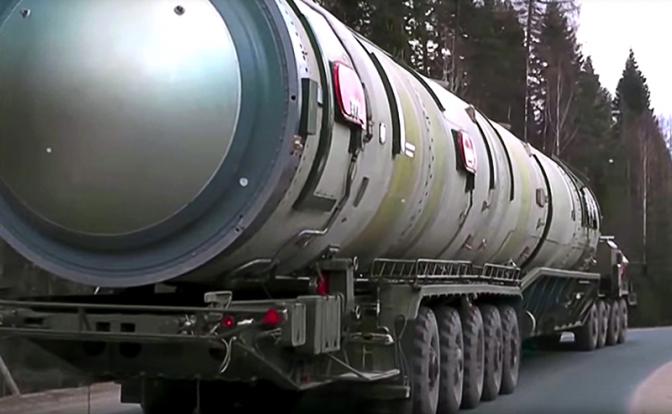
Five Russian defense bosses lose their EU assets and travel rights over Iskander and Sarmat missile production
Read Also
-
Ukraine flew a Flamingo cruise missile into the Kerch Bridge like an FPV drone, watching through its camera to the last seconds
-
Ukraine has almost nothing to stop Russia’s ballistic missiles, presidential tech adviser says, listing seven weapons Kyiv needs
-
Ukraine’s Neptune missiles hit Russian airbase used for glide-bomb attacks – fourth airbase hit in two weeks


