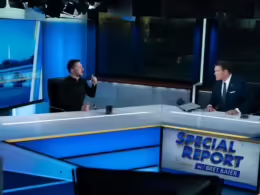
The Ukrainian parliament has appointed Mykhailo Fedorov as Minister of Defense. Over the past three years, Fedorov's focus has been almost entirely concentrated on the war, as he has served as the minister of digital transformation.
The decision has been supported by 277 members of parliament, exceeding the minimum required 226 votes. Mykhailo Fedorov is 34 years old, making him the youngest Minister of Defense in Ukraine’s history.
Symbolically, he was born in Vasylivka, Zaporizhzhia Oblast, a city that is currently under Russian occupation.
From "Diia" to drone war: Zelenskyy bets digital transformation
Mykhailo Fedorov is one of the key architects of Ukraine’s digital reforms and the creator of the Diia app, which has become a symbol of state modernization.
In the first two months, Diia was downloaded by more than 2 million users. Today, the number exceeds 23 million.
He oversaw the large-scale digital transformation of the government, the launch of electronic services, and the creation of a new culture of interaction between the state and citizens.
Cooperation with Elon Musk: 50,000 Starlinks for Ukrainian troops
One of the first and most important steps was establishing direct contact between Fedorov and Elon Musk. This enabled Ukraine to rapidly receive a batch of 50,000 Starlink terminals and deploy them to the front lines. In a certain sense, Starlink became a technological advantage for Ukraine over Russia, Economichna Pravda reports.
The war quickly became highly technologized, and the challenges grew increasingly severe.
In particular, Brave1 emerged, a platform that, through grants, stimulated the development of the drone market, electronic warfare systems, sensors, and military startups.
In effect, the state began directly financing young teams if their development met the needs of the front.
At the same time, Fedorov was involved in fewer public projects, including closed units for testing new military technologies (Next), which could potentially influence the course of hostilities, according to the BBC.
A separate focus was placed on mass-producing drones as a way to compensate for the shortage of artillery.
For what has he been criticized?
At the same time, he was criticized for appointing “his own people” to key projects, as well as shortcomings in military procurement and implementation, and the inability to fully develop a solution to protect mobile communications during power outages caused by Russian strikes.
It is essential to note, however, that tangible progress has been made. Compared to 2022–2023, operators’ networks are holding up significantly better, even if communication quality during prolonged outages remains far from ideal.
Territorial recruitment centers, drones, and troop training: problems long avoided
Among his priorities in the new position, Fedorov has directly named the issue of territorial military recruitment centers. According to him, ignoring this problem is no longer possible.
“After a comprehensive audit, we will propose a systemic solution to address problems that have accumulated over the years while preserving the country’s defense capability. We already have a vision of what to do,” the minister says.
He cited data indicating that nearly two million Ukrainians are currently wanted (likely for evading mobilization), and about 200,000 are listed as AWOL (unauthorized absence from units). According to him, these challenges require immediate solutions.
Fedorov also promised to provide all combat brigades with the necessary number of drones as quickly as possible and to reform the military training system, making it more modern and effective.
Brave1, laser-guided munitions, and a cost of war Russia cannot sustain
The new defense minister has also placed particular emphasis on the development of defense technologies. He recalled the creation of the Brave1 cluster, which now brings together more than 2,350 companies and over 4,900 defense developments. More than 730 grants have already been issued.
Fedorov has also emphasized the need to develop laser-guided artillery munitions in Ukraine, which would be analogues of Russia’s Krasnopol, as well as to create a domestically produced mass-produced strike drone, similar to Russia’s Molniya.
“The president has set a clear task: to build a system capable of stopping the enemy in the air and on the ground, strengthening asymmetric and cyber strikes against the enemy and its economy,” the defense minister emphasized.
Fedorov has stressed that anti-corruption will become the foundation of the new Ministry of Defense, and that one of the first practical decisions will be the basic equipping of brigades with drones, the shortage of which remains critical.
Read also
-
Canada joins Ukraine’s effort to counter Russia’s growing ballistic missile threat: the FREYJA program
-
Can’t intercept the missiles? Hit the factories—Ukraine’s other way to stop Russia’s ballistic missiles
-
Poland expects Russia to target border crossings as attacks on Ukraine escalate – Russia has already hit crossings with Moldova and Romania