

At the G7 summit in Évian-les-Bains, France, in June, the leaders of the world's most powerful states again declared their intent to help Ukraine and to pressure Russia economically: "We commit to increase the pressure on the Russian war economy. In this context, we will strengthen our sanctions." But while G7 governments negotiate another round of political statements, the assembly lines of Russia's military-industrial complex keep turning out missiles and drones—from Western components and electronics.
A new analysis of Rostec—the giant of Russia's military-industrial complex—by the Independent Anti-Corruption Commission (NAKO) shows that the strategy of targeted strikes has reached a dead end. To make restrictive measures more effective, allies should consider wider use of export-control mechanisms against structures tied to Russia's defense-industrial complex. In many cases, export control can be a faster and more flexible instrument than full sanctions regimes.
Sanctions against Rostec
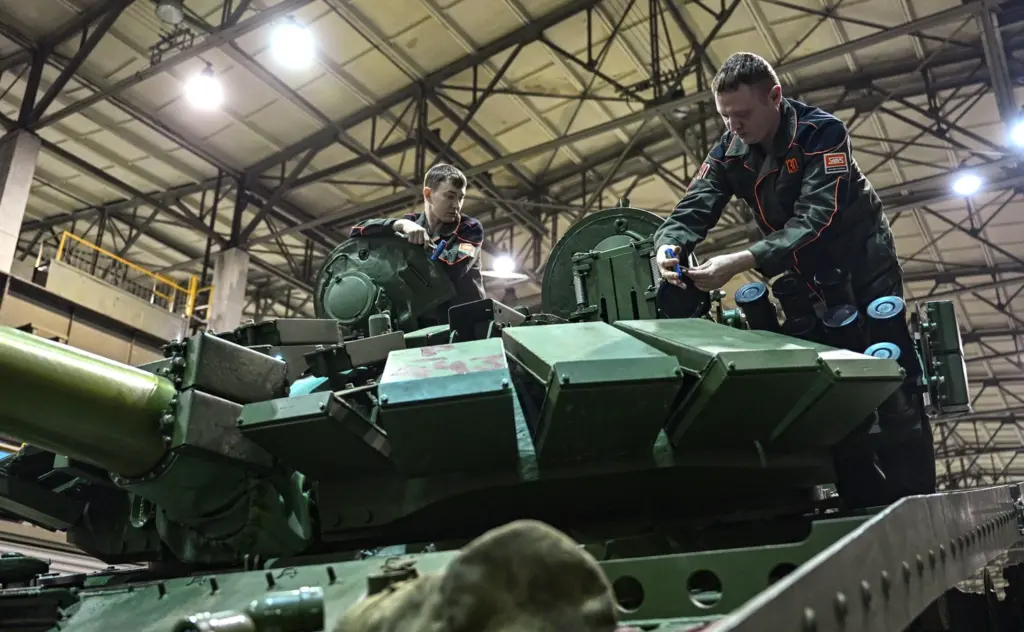
What is Rostec?
- Russia's largest defense and industrial holding, 100% state-owned
- Its enterprises produce 80% of military equipment Russia uses in its war on Ukraine, Russian officials say
- Accounts for about half of Russia's defense procurement
- Employs 500,000–700,000 people at roughly 700–800 enterprises
Hitting the tip of the iceberg is not enough. Sanctions have been placed on Rostec itself, on its best-known holdings, and on individual plants caught manufacturing weapons. But this giant has many branches, visible and hidden, and the sanctioning process itself takes years. The result is that sanctions policy often looks ineffective—and it is easy to see why.
NAKO's analysts traced and identified 482 key legal entities within Rostec's structure. This is the most complete map of the conglomerate that currently exists, and even it covers only part of the concern. A vast network of subsidiaries operates in total secrecy: they hide financial reporting, classify tenders, and mask beneficial owners behind chains of fictitious founders.

And while the West spends months assembling evidence against a single plant, Rostec quickly spins up new "clean" shell firms or brings new enterprises and factories under its control.
Ukraine has imposed sanctions on 72% of the identified Rostec enterprises. The United States covers 45%. And here it gets interesting: the European Union has managed to sanction only 23% of the conglomerate's companies. The United Kingdom takes an even more "selective" approach.
The EU has sanctioned only 23% of Rostec's companies.
The analysis also found a huge asymmetry between jurisdictions. The US, the EU, the UK, Switzerland, and Asian states apply entirely different approaches. What is blocked in the EU can operate freely under British or Japanese law. And while sanctions from even one jurisdiction are a significant red flag for banks, manufacturers, and regulators, the legal gap itself lets Russia keep access to technology.
How Russia gets around the sanctions
This lack of coordination among allies, combined with a complex, multi-layered corporate structure, keeps feeding Russian weapons with Western microelectronics. A vivid example is KRET (Radio-Electronic Technologies Concern), which produces the electronic-warfare systems Russia uses to jam Ukrainian drones at the front. London has sanctioned not a single enterprise in this holding—and there are at least 40 of them.
The result? Legally, these smaller companies fall under restrictions purely by belonging to Rostec. In practice? British manufacturers or distributors are unlikely to spend time tracing the link between Rostec and one of its hundred-odd enterprises buried in corporate layers; seeing no risk, they simply sign the deal with an unremarkable plant.
Another example is the Shvabe holding, whose sights and thermal imagers sit on Russian equipment. It ships its products to international exhibitions in the UAE without difficulty.

Other enterprises and whole holdings are frequent guests at exhibitions in China and India—steadily present and visible to a range of countries that could be subject to secondary sanctions. With those same countries Russia signs deals to sell another batch of helicopters, or shows off upgraded drones that have "proven their effectiveness on the battlefield against Ukraine." And it is through such countries that Western components keep reaching Russia.
Trending Now
This matters because Russia's import-substitution program—including in microelectronics—has never worked. Not yet, at least. Ukrainian military institutes examining captured missiles and downed drones report that Russian high-tech electronics simply are not there, sources that study the missiles have told NAKO. What they find are chips from American, European, and Japanese giants.
What is more, even these foreign components are usually nothing remarkable technologically. Yet as of today Russia still cannot produce even these—certainly not at scale—so it works the gaps in sanctions, export control, and "business as usual" with great finesse.
The next step: strengthening export control
The direction is already shifting. On 23 July 2026, the European Union adopted its 21st sanctions package—its largest batch of individual listings in four years. Fifty-six of them target Russia's military-industrial complex, 37 tied directly to long-range drones, and 51 more entities, many in China, Kyrgyzstan, Türkiye, and the United Arab Emirates, were placed under tighter export controls for feeding Russia the microelectronics and CNC machine tools its weapons depend on. It is the right target. The limit is that it still proceeds one entity at a time—and Rostec is built to outrun exactly that.
Banning the supply of certain critical goods to Kyrgyzstan—where such exports suddenly grew by more than 800%—or issuing regular financial warnings to intermediaries in the UAE and China are the right steps, and they force Russia to pay more. More than that: over four years, sanctions policy has repeatedly caused delays in the production and delivery of weapons and military equipment. But it has not stopped that production—as Ukraine keeps seeing with its own eyes during every mass strike.
The main conclusion that follows from our map of 482 key Rostec entities is the need to change the very logic of restrictive measures against Russia's defense-industrial complex.
Sanctions remain an important instrument, but they often prove slow, selective, and politically difficult to implement. A far wider use of export-control mechanisms, by contrast, could cut off access to international technology, equipment, and components faster and more effectively.
There should no longer be any need to prove separately the role of every nominal LLC somewhere near Chelyabinsk in Russian military production.
If an enterprise is part of Rostec's production, procurement, or technological chains—or those of other structures in Russia's defense-industrial complex—it should automatically become a candidate for export-restriction lists.
This approach would make it substantially harder for Russian defense enterprises to reach Western technology and would narrow the room to evade restrictions through subsidiaries, intermediaries, or formally civilian structures. Western banks, exporters, and compliance teams should not have to identify each new shell firm on their own. Instead, they should get a clear signal: involvement in the production or supply chains of Russia's military-industrial complex means elevated regulatory risk and the need to apply restrictive measures.
Economic pressure on Russia's defense sector must stop being fragmentary and reactive. It has to become systematic, predictable, and capable of outpacing the adaptive mechanisms of Russia's war economy.