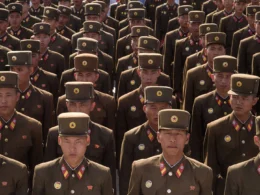
Russia has decided to bring between 30,000 and 50,000 North Korean troops onto its territory, up from initial deployments of hundreds and then thousands, Ukrainian President Volodymyr Zelenskyy said in an interview with the "Yedyni Novyny" telemaraphon on 8 August.
The figure marks a sharp rise from what Zelenskyy gave two weeks earlier. In a 25 July address, he said Russia wanted 30,000 additional North Korean troops and that preparations to receive them had been underway in Russia's Voronezh region since June.
Rising troop estimates
"North Koreans appear on the territory of the Russian Federation from time to time. We see this, we know this," Zelenskyy said, adding that Russia had now made "a decision for 30,000 to 50,000 North Koreans to be on the territory of Russia." He said North Korea "will build up experience of modern warfare" and would receive licenses from Russia.
Russia and North Korea have not announced plans to expand their cooperation, Radio Svoboda reported.
Missile deployment already underway
Ukrainian authorities said Russian forces used a North Korean missile for the first time in a long period last week, striking Radushne, near Kryvyi Rih.
A North Korean missile unit has begun deploying in western Russia and may be equipped with 120 ballistic missiles and six launchers for strikes on Ukraine, Reuters reported on 5 August, citing Andrii Cherniak, a spokesperson for Ukraine's Defense Intelligence directorate (HUR). Pyongyang has already sent a new batch of 40 KN-23 and KN-24 missiles along with personnel, Cherniak said, though the final deployment configuration and total missile count are to be settled at high-level talks next month.
Foreign Minister Andrii Sybiha separately said North Korean missile launchers would "immediately become a legitimate target" if deployed in Russia, Radio Svoboda reported.
Kyiv seeks South Korean support
Zelenskyy argued the deployments carry risks beyond Ukraine. "They are studying this war," he said, warning that North Korea could apply lessons learned to future "crises and escalation" in the Pacific that would threaten "other states in the Asian direction."
He said Ukraine wants closer cooperation with South Korea, "primarily" on air defense systems, and said Kyiv is ready to work with Seoul on drone technology as well. Zelenskyy acknowledged that South Korea faces "a legal restriction under the Constitution" on such cooperation but said Ukrainian diplomats remain in contact with South Korean counterparts, as well as with Japan, over the Russia–North Korea partnership.
Military alliance since 2024
Russia and North Korea signed a comprehensive strategic partnership treaty in 2024, cementing a military alliance between the two countries.
Zelenskyy confirmed on 14 December that North Korean soldiers were fighting alongside Russian forces in Kursk Oblast, and Ukrainian intelligence reported that North Korean troops had been placed on high alert the following day. Ukraine's Special Operations Forces (SSO) captured North Korea's first documented prisoner of war in the war on 26 December, Militarnyi reported. The SSO described the raid as an operation "to destroy the enemy in the Kursk sector," in which its forces also seized a Russian BTR-82 armored personnel carrier along with weapons and documents. That prisoner died of his wounds, South Korea's National Intelligence Service confirmed on 27 December.
On 11 January 2025, Zelenskyy announced that Ukrainian forces had captured two more North Korean soldiers, also wounded, in Kursk Oblast; both survived and were taken to Kyiv, where they were questioned by the Security Service of Ukraine (SBU). Ukraine's Defense Intelligence directorate had previously reported that the first North Korean units arrived in the war zone on 23 October 2024.
South Korea's intelligence agency confirmed the capture on 12 January and pledged cooperation with Ukraine. Two days later, Foreign Ministry spokesperson Lee Jae-woong said Seoul was open to discussing relocating the two men, citing a constitutional provision under which North Koreans are considered South Korean nationals, Yonhap reported. At the time, neither soldier had expressed an intention to defect.
In late February 2025, the two soldiers — identified by the Wall Street Journal as Ri, 26, and Paek — gave the first Western interviews of North Korean troops captured in the war, published 27 February. They said they had been told they would be fighting South Korean forces, not Ukraine, and that they were not paid for their service. Paek was shot and lay wounded for five days before capture, later having several toes amputated due to gangrene; Ri was shot in the arm and jaw. South Korea's Foreign Ministry confirmed on 19 February that it would accept North Korean POWs who sought asylum, saying "they should not be sent against their will to a place where there's a threat of persecution."
By late February 2025, Zelenskyy said around 4,000 North Korean soldiers had been killed or wounded fighting for Russia; North Korea's overall troop commitment was estimated at roughly 11,000–12,000 by early 2025. Losses continued to mount — by January 2026, Ukraine put North Korean dead in Kursk Oblast at 6,000, where the contingent remained stationed and continued carrying out strikes on Ukrainian border communities. Ukrainian soldiers have described North Korean troops as reluctant to surrender, with some reportedly attempting suicide rather than be captured.
Read also
-
Ukrainian Armor unveils two new troop carriers at Polish arms exhibition: fast light scout and mine-resistant MRAP. Both meet NATO’s STANAG 4569 protection standards
-
Ukraine shows a home-built missile designed to hit ballistic targets for the first time, the Koral, at Poland’s MSPO
-
Ukraine is sending its winning brigades to where the fighting is worst. The 46th just turned up outside Kramatorsk