


A law now in force gives Ukraine two years to split the tracks from the trains, on the EU model that lets rival carriers share one network. It is doing so without giving up anything the model is meant to strip away: a single hand deciding which train moves first.
European operators come to study exactly that. They watch how a network under constant drone attack keeps its trains running, and their advice sometimes carries a warning: do not repeat the mistakes Europe made reforming its own railways. That is the account of Ukrzaliznytsia’s chairman, Oleksandr Pertsovskyi, in a July interview with the Center for Economic Strategy (CES).
The reform comes now because the old arithmetic collapsed, Pertsovskyi told CES. For decades, one internal transfer kept the railway solvent: profitable freight paid for loss-making passenger trains. The war broke that.
The $1 billion a year Ukraine earned carrying Russian and Belarusian transit is gone, the freight heartland of the Donbas is lost, and in 2026, freight itself slipped into the red. The transfer that funded the whole railway no longer exists.

Ukraine has two years
The new safety and interoperability law aligns Ukrainian rules with EU standards and, Ekonomichna Pravda reported, gives the government two years from publication to separate the roles of infrastructure operator and railway carrier within Ukrzaliznytsia.
The future infrastructure operator must stay fully state-owned. It runs the public network—the tracks and the power that feed them—while licensed carriers run the trains on top. The law does not force the state to privatize Ukrzaliznytsia or open the tracks to private locomotives. Yet it builds the ground for a market where more than one carrier could someday use the same rails.
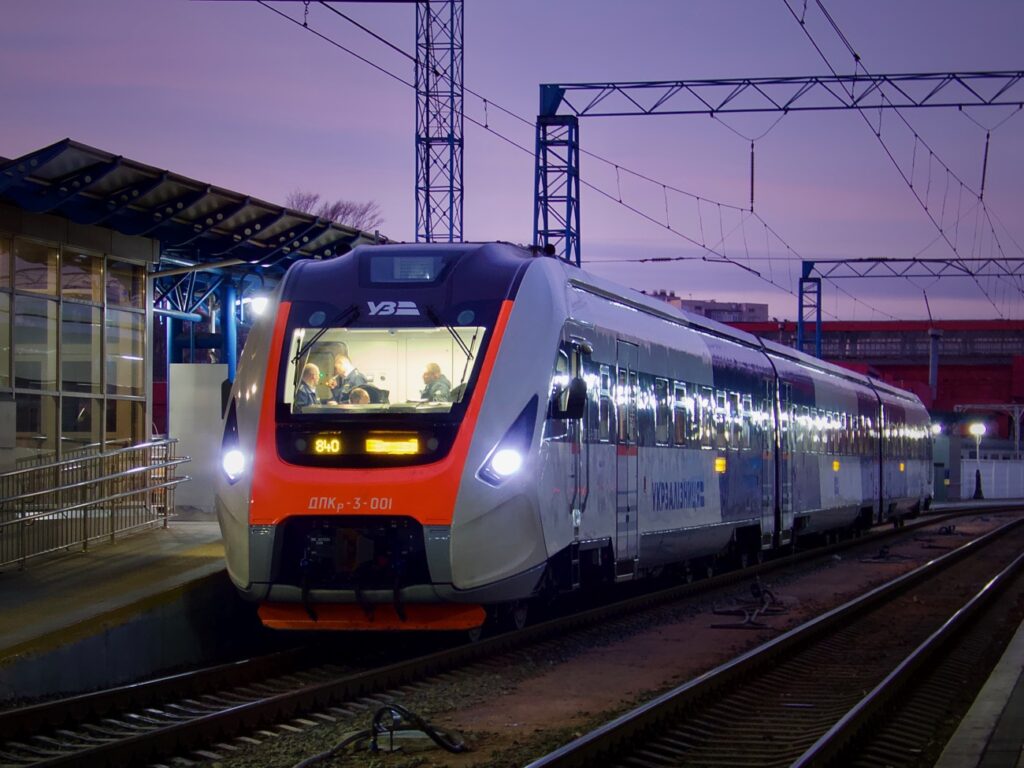
Inside the company, much of the split has already happened. Passenger and suburban trains have their own divisions. A single infrastructure arm, UZ Infra, is being built out of the six regional railways, and a freight arm, UZ Cargo, is due by 2027.
The split shows what each business really costs, Pertsovskyi says, and ends the old habit of burying losses in a single balance sheet. What Pertsovskyi opposes is giving up overall operational coordination.

One track can carry a market—or a war
“We have one line of track. A private carrier hauls fuel because that cargo pays more, while you need to evacuate millions,” Pertsovskyi told CES. Without one authority able to set wartime priorities, he said, you get chaos.
Russia damaged or destroyed more than 200 Ukrainian locomotives in the first half of 2026—as many in six months as in the previous 15. Ukrzaliznytsia has bolted more than 800 mobile shelters onto junctions and depots so crews can duck for cover without leaving the network.

Russia has hit over 200 Ukrainian locomotives this year. It’s targeting logistics that keep country supplied
This is the system European operators come to examine. That resilience is more than shelters and spare engines—it is the ability to move any train or crew wherever the day demands, under a single chain of command.
None of this is abstract for a railway that, after February 2022, turned into part transport company, part evacuation service, part arms conduit. A private operator could not have run the 2022 evacuations and the military traffic at the same scale, Serhii Vovk, director of Ukraine’s Center for Transport Strategies, argued to Ekonomichna Pravda. State control, he said, will outlast the war.
The rulebook allows one holding
The EU does not require Ukraine to break Ukrzaliznytsia into unrelated firms or sell it. Under the bloc’s single railway area rules, an infrastructure manager and train operators can be part of a single integrated holding, as Deutsche Bahn does in Germany.
What the rules demand is narrower. The infrastructure manager must be a legally distinct body with transparent finances and independent control over its core decisions, according to the European Commission summary. Chief among those decisions is who gets each train path.
Path allocation is the pressure point. Deciding who gets each slot is what the EU calls an essential function, one it insists be kept neutral, so that no operator is favored. An operator who is refused a slot can appeal to a regulator.
Trending Now
War asks for the reverse: one hand that can override the queue on the spot and put the evacuation train ahead of the cargo that pays more, with no appeal. Reform does not by itself sell paths to the highest bidder—the infrastructure manager still runs the traffic.
But the collision does not go away when Ukraine keeps the holding intact, or keeps a single chain of command. The neutral, contestable allocation the market needs is the same one a war needs to suspend.
So the line is not simply European competition against Ukrainian unity. The same law is meant to open the tracks to rival carriers, and tight central control runs counter to that: the more the state controls the queue, the more a rejected competitor can suspect it was kept off for the wrong reason.
Ukraine has to loosen its grip enough to make access credible, without loosening it so far that the network cannot act as one in a crisis.
Look to Germany, then look closer
Deputy Finance Minister Oleksandr Kava, who sits on Ukrzaliznytsia’s supervisory board, has cited Deutsche Bahn’s chronic delays as a warning about European rail reform, contrasting Germany with Switzerland, whose trains run on time and whose railway remains a single integrated company.
Each half of that contrast frays on inspection. Switzerland, though outside the EU, adopted the same reform: SBB’s own rules run a separate infrastructure manager that lets rival operators onto the tracks on equal terms. Being one integrated company didn’t stop it from walling off the tracks from the trains—the split Kava warns against is already there.
Switzerland's famous punctuality is based on a stricter standard than most railways use: a train counts as late after 3 minutes, not 5. And Germany’s delays trace less to reform than to money—even Ukraine’s railway chief notes Deutsche Bahn blames a network starved of investment for years.

The bill lands on the state either way
Even wealthy Germany cannot make the European model pay for itself. Berlin puts in far more than Deutsche Bahn does, and the trains still run late. The reform was never the costly part—the upkeep is.
Ukraine cannot fund its version at that level. Keeping the network up would eventually cost the budget 350–400 billion hryvnias (roughly $8 billion) a year, Kava told Ekonomichna Pravda. This year, the government has put up 28.5 billion ($630 million), under a tenth of that.
None of this is about copying an EU org chart. Ukraine has to open its railway to competitors and keep it able to act as one under fire, out of the same law and the same holding.
The test comes on the day when two trains want the one open track, and only one can go first.


