

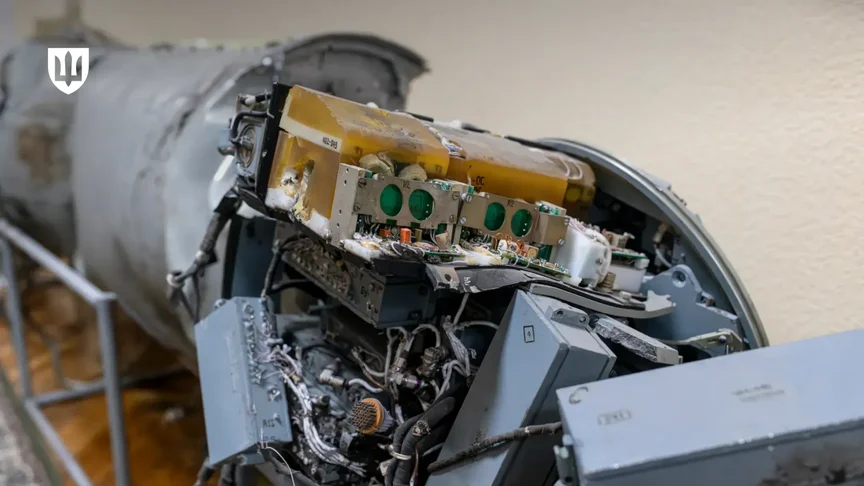
Russia has made two significant modifications to its Kalibr cruise missiles since the start of the full-scale invasion, Ukraine's Ministry of Defense reported.
The cluster payload mirrors the one Russia already uses on its Kh-101 cruise missiles, expanding the lethal radius across dispersed targets like airfields, hangars, and open positions. Russia is not a signatory to the Convention on Cluster Munitions, which 124 states have ratified.
From 2022 through early 2026, Kalibr missiles carried a fragmentation-high-explosive warhead. Researchers documented a cluster warhead for the first time on missiles shot down in spring 2026. Russia made the change to substantially increase the strike area and deploy the missile against dispersed targets, the ministry said.
Russia's failed attempt to replace imported electronics
The second modification concerns the missiles' onboard electronics. Between 2023 and 2024, Russia gradually shifted Kalibr production to domestic components. The attempt failed. Analysis of the onboard digital computing unit from a Kalibr manufactured in 2025 again found imported components. The homing boards are "more than 80–90% foreign-made," the ministry stated, calling it "a confirmed fact, not an estimate" — each part is marked and verified by military representatives.
The shift to domestic electronics likely degraded guidance accuracy, the MoD suggested, prompting the return to foreign parts despite sanctions exposure. A Russian Kh-101 that killed 12 people in Kyiv this May was built in the second quarter of 2026 — pointing to components still reaching Russia after 21 EU sanctions packages and years of Western export controls, President Volodymyr Zelenskyy said last month.
Manufacturers and designers identified for sanctions
The ministry said it had identified all electronics manufacturers supplying Kalibr production, as well as the chief designers and managers involved. "The Ministry of Defense has established all electronics manufacturers for the Kalibrs, as well as the chief designers and managers involved in missile production. This data is being transferred for further processing within the framework of sanctions policy," the ministry stated.
The MoD has previously published technical analyses of downed Russian Kh-101 missiles and North Korean KN-23 and KN-24 ballistic missiles used against Ukraine.
Read also
-
Drones now cause about 96% of Russia’s battlefield losses. Ukraine’s drone force says it has hit more than 100,000 Russian troops this year alone
-
Fears that Ukraine will lose Starlink are back after Musk backed Trump against Zelenskyy. Adviser says profit makes cutoff unlikely
-
Russia is building jet drones that fly 800 kilometers per hour, and Ukraine says it is already working on how to stop next generation


