


Spain pledged €1 billion ($1.16 billion) to Ukraine in March. In May, it helped block NATO’s plan to count that money the same way as everyone else’s.
Britain, France, Spain, Italy, and Canada killed NATO Secretary General Mark Rutte’s proposal for alliance members to spend 0.25% of GDP on Ukraine military aid, The Telegraph reported on 24 May. The plan was meant for ratification at NATO’s annual summit in Ankara in July.
A unified yardstick would either expose laggards or fail to credit aid given through alternative pipelines.
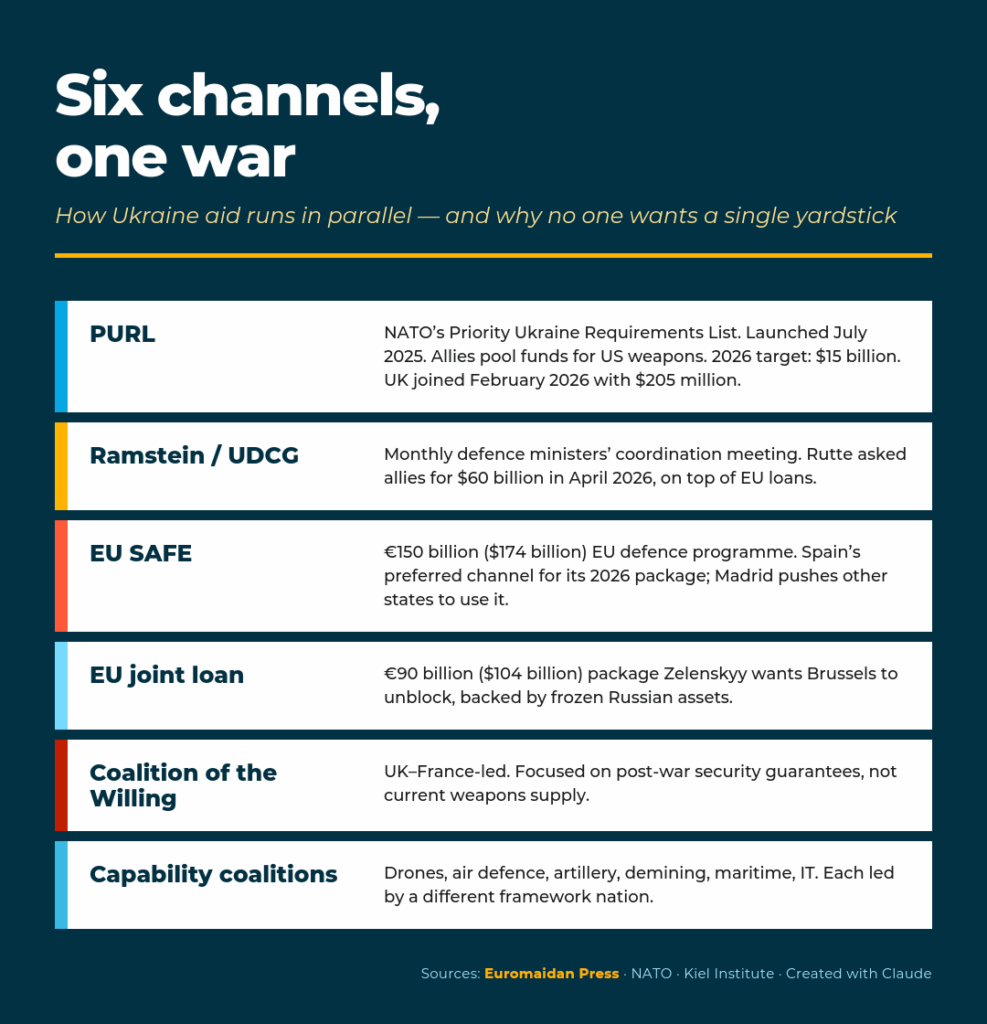
The aid that flows to Kyiv now runs through at least six parallel channels: NATO mechanisms, EU programs, capability coalitions, and bilateral deals. Each donor capital prefers a different one. A unified yardstick would either expose laggards or fail to credit aid given through alternative pipelines.
For Ukraine, that means no single number Kyiv can point to and demand more.
Spain just gave €1 billion. Through the EU.
Take Spain. Two months before the Telegraph revealed it among the blockers, Prime Minister Pedro Sánchez stood beside Volodymyr Zelenskyy in Madrid and pledged €1 billion in military aid for 2026, the Spanish government confirmed on 18 March.
The money will flow largely through the EU’s SAFE instrument—a €150 billion ($174 billion) defense program Sánchez is actively pushing other member states to use. Counting the 2026 pledge, Spain’s bilateral military aid since 2022 totals €3.8 billion ($4.4 billion).
A NATO metric counting national defense budgets would not have flattered that effort. Much of the Spanish package will register as EU spending.
Madrid and Kyiv also signed agreements to co-produce drones, radars, and missiles with Spanish companies Sener and Escribano, Spain’s infodefensa reported.
Sánchez is doing more than funding Ukraine. He’s promoting Spain’s framework. A NATO metric counting national defense budgets would not have flattered that effort. Much of the Spanish package will register as EU spending, not Spanish.
Six channels, one war
Six frameworks now run in parallel, each with its own donor base, accounting, and constituency in different capitals. Plus, the 10-year bilateral security agreements that most major donors have signed since 2024. Plus, what each country still gives directly from its armed forces’ stocks.
Some blockers contribute. Others lag.
The five aren’t the same case. Britain, at around 0.1% of GDP, is the third-largest contributor to Ukraine’s defense after the United States and Germany.
Northern Europe, holding 8% of the combined GDP of the 31 European countries tracked, provided 33% of military aid in 2025.
The size of its package isn’t in question, the Telegraph noted; only the share of GDP is. Spain channels €1 billion through SAFE. France runs the air-defense and artillery capability coalitions.
Italy and Canada are in different columns. Italy’s recorded military allocation for 2025 was €0.3 billion ($348 million)—less than a single US aid package announced in January of that year, before Washington stopped giving, the Kiel Institute reported. Northern Europe, holding 8% of the combined GDP of the 31 European countries tracked, provided 33% of military aid in 2025. Southern Europe, with 19% of GDP, gave 3%.
Trending Now
Rutte didn’t name names. The Telegraph did.
At least seven NATO members already spend more than 0.25% of their GDP on Ukraine—the Nordics, the Baltics, the Netherlands, and Poland—and have backed the proposal. The 0.25% threshold would have made the gap between them and the rest legible.
This week, Rutte conceded that NATO aid to Ukraine isn’t evenly distributed, he told The Telegraph. Rutte didn’t name names. The Telegraph did.
The cost of fragmentation
Without a shared metric, every government can claim it’s doing its share by pointing to whichever framework flatters it most. Italy points to the €90 billion ($104 billion) EU package it might one day help fund. Canada points to its bilateral pledges. Spain points to SAFE.
Rutte’s plan was an attempt at a single yardstick—the kind that would let Kyiv say, in one number, who was doing what.
Each is real. Each is partial. None is comparable. Rutte’s plan was an attempt at a single yardstick—the kind that would let Kyiv say, in one number, who was doing what. That attempt died.
The frameworks remain. The summit in Ankara takes place in July.


