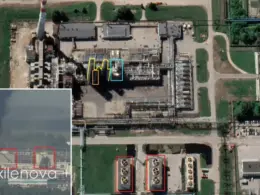
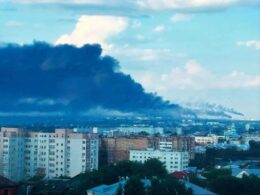
Ukraine's long-range strike units have hit ten major Russian oil-refining and transshipment facilities in the first twenty days of May, Major Robert "Madiar" Brovdi, the commander of the Armed Forces' Unmanned Systems Forces (USF), said. The count covers only sites struck by Unmanned Systems Forces.
Other May strikes on Russian oil infrastructure were conducted without USF involvement. As a result, six of the ten refineries on his list have been forced to halt operations. The kinetic damage is verified and escalating, with the campaign visibly shifting from refinery hits toward Russia's oil-transport network.
Whether that translates into a decisive financial squeeze on Moscow is the contested part — the Iran-war oil-price spike has been cushioning Russian oil revenue even as the strikes intensify.
Some of Russian facilities were struck for fourth time
By Brovdi's accounting, the struck facilities include the refineries in Moscow, Ryazan, Lukoil-Permnefteorgsintez in Perm, Kirishi in Leningrad Oblast, part of the capacity of the Kuibyshev plant in Samara, and the Tuapse refinery on the Black Sea, which he said remains indefinitely closed.
The Primorsk Baltic port and the Yaroslavl refinery were also halted during May, with Yaroslavl later resuming work, he said.
The Tamanneftegaz oil terminal on the Krasnodar coast was hit on 13 May.
The Lukoil-Nizhegorodnefteorgsintez refinery in Kstovo, Nizhny Novgorod Oblast, was struck on both 18 May and 20 May — a fourth strike on the same plant in seven months. The plant has a processing capacity of about 17 million tonnes per year and supplies about 30% of Moscow Oblast's gasoline.
Shift to oil transport
Strikes are increasingly moving from refineries to the pipelines and pumping nodes that move crude between them.
In the last two days alone, seven oil pumping stations and one linear production-dispatch station in the Nizhny Novgorod, Ryazan, and Yaroslavl oblasts were hit. The 19 May strike on the Yaroslavl-3 pumping station, reported separately by Ukraine's General Staff, fits the same pattern.
"A permanent disruption, by the numbers," Brovdi summarized.
Where is picture contested?
The kinetic side is measurable. The financial side is more complicated. The Iran-driven oil-price spike has been cushioning Russian oil revenue even as refining capacity comes offline: the IMF raised its 2026 Russia growth forecast to 1.1%, citing higher commodity prices.
Meanwhile, March oil-extraction taxes doubled to about $9 billion against February on the spike, and the US has extended its waiver allowing buyers to take Russian oil at sea, Euromaidan Press previously reported.
Read also
-
As Russia expands attacks on Kyiv, Ukraine prepares to hit Moscow’s oil industry harder in response
-
Ukraine’s top general wants to end Soviet rules in army. But president’s wartime headquarters may still hold reforms, commander says
-
“No alien quantum modems”: 1 to 3 concealed devices in Kyiv may be why Russian drones keep hitting so precisely, Ukraine’s top tech adviser says