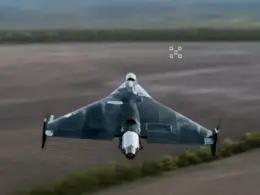
Ukraine has declared its first domestically built guided glide bomb combat-ready, the state-backed defense cluster Brave1 announced on 18 May after 17 months of development. The weapon, built by the Ukrainian company DG Industry, carries a 250-kilogram warhead and can strike targets dozens of kilometers behind the front.
The new bomb is cheap to produce and free of the donor restrictions attached to those weapons, letting Kyiv press the fight at mid-range while conserving scarce long-range Western missiles for deeper targets.
Built from scratch, not glide kit
The bomb is "neither a copy of Western nor Soviet systems but a unique Ukrainian construction," Brave1 said, according to Defence Blog.
The distinction is technical: Russia's UMPK-equipped FAB bombs are glide kits bolted onto Soviet-era bomb bodies never meant to glide, while the Ukrainian weapon is purpose-built from the airframe up.
Developers had to build guidance that withstands Russian electronic jamming and an airframe that remains stable across release speeds and altitudes.
According to Business Insider, which named the weapon the "Vyrivniuvach" or Equalizer, it can be carried by Ukraine's F-16 and Mirage fighters, though that would require additional certification, and preparation for use takes no more than 30 minutes.

Cheaper than JDAM-ER, it has leaned on
The bomb costs roughly a third as much as the American JDAM-ER kit that Ukraine also fields. Ukraine has used JDAM-ER, unguided bombs fitted with guidance kits and wings, with a range of roughly 70 kilometers from altitude, since early 2023, and has requested thousands more, according to Defense Express.
The dependence has not ended: earlier this month, the US approved a potential sale of additional GBU-62 JDAM-ER bombs to Ukraine.
Digital Transformation Minister Mykhailo Fedorov framed the domestic bomb as part of Ukraine's shift "from importing individual solutions to creating its own high-tech weapons."
Effect depends on whether Ukraine can mass-produce it
The Ministry of Defense has placed its first experimental order, and pilots are training with the weapon, with combat deployment described as imminent.
Whether it changes the battlefield math depends on production. If DG Industry and Brave1 move from experimental batches to repeatable manufacturing, the Air Force gains a standoff weapon.
If production stays small, the analysis added, the military effect will be limited, though the program still marks a step toward sovereign precision munitions.
Read also
-
Russia kills 30 in strike on two passenger buses in Kramatorsk
-
Drone attack forces Yandex to shut down its data center on the grounds of a sanctioned Russian machine-tool plant
-
A 3-year-old girl came to visit her aunt in Pryluky, Ukraine. By morning, a Russian missile had killed her grandmother and uncle