


From fall 2025 through spring 2026, the words “aerostat notice” have appeared hundreds of times on Russian Telegram channels that monitor Ukrainian air threats.
This means that somewhere high overhead, carried east by prevailing winds, are Ukrainian helium balloons carrying retroreflective decoys, surveillance equipment, bombs, attack drones, or radio repeaters that allow other drones to strike Russian targets. Ukrainian forces have launched in excess of 1,000 balloons into Russia and more are on the way.
Untethered aerostats have participated in strikes on the deep rear of Russia since 2024, but have become ever more active in 2025-2026, targeting refineries, railways, and other infrastructure.
Euromaidan Press spoke with a few people closely familiar with this tech. Because most people involved with these operations are high on the Russians’ shit list, they spoke on condition of not being identified by name or affiliation.
“Yes, indeed, balloons are actively used by the Defense Forces of Ukraine mainly as support platforms and as means for medium and deep strikes,” said Viktor Kevliuk, a retired Ukrainian colonel and analyst with the Center for Defense Strategies. “They are inexpensive, inconspicuous on radars, can hang in the air for a long time and carry a payload.”
While balloons are indeed inconspicuous—most of them are translucent, blending with the sky—one source said that getting noticed is often the whole idea, to cause Russia’s air defenses to fire everything, from Pantsirs, Tors and Buks, to even their S-300 and S-400 missiles.
“You want to be detected,” they told Euromaidan Press. “They cause panic for the Russians and they are very hard to shoot down,” at high altitudes, causing the Russians to waste their air defenses.
“If you approach a sensitive area like Moscow, they get so scared, they fire everything without hesitation.”
Depending on their size, balloons can lift heavy payloads, can be launched from anywhere, and be used to get above or behind air defenses to strike targets from the rear. They can carry signal repeaters that extend over 100 kilometers, which can be daisy chained together to provide continual control for long-range weapons. Aerostats can go very long distances, with a record mission traveling over 4,000 kilometers into Russia.

While the aerostat industry is still quite niche, sources said that adoption is growing among Ukrainian forces, with more units training up in their use. On the other hand, Kevliuk sees this growth as driven more by innovators and enthusiasts than a systemic defense policy, citing lack of central state will and lack of resources for implementation by individual units.
One of the sources said that it would behoove allies to pay closer attention to this tech, which can deliver strike capabilities and a variety of weapons behind Russian lines, including UGVs and USVs. “Imagine a (Ukrainian) UGV on Red Square,” they said.
Wind be at your back
Ukraine was dragged into the full-scale war with many disadvantages. But it does have one advantage granted by nature and ripe for exploitation: the prevailing wind.
At these latitudes, the Westerlies blow from the direction of Ukraine into Russia. That means that aerostatic balloons require no propulsion in order to make their way into enemy airspace. The Russians have aerostats too but the atmosphere is not on their side in this arena.
Being at the mercy of the wind does limit untethered aerostats as a technology because operators cannot ensure precisely where the balloons will go.
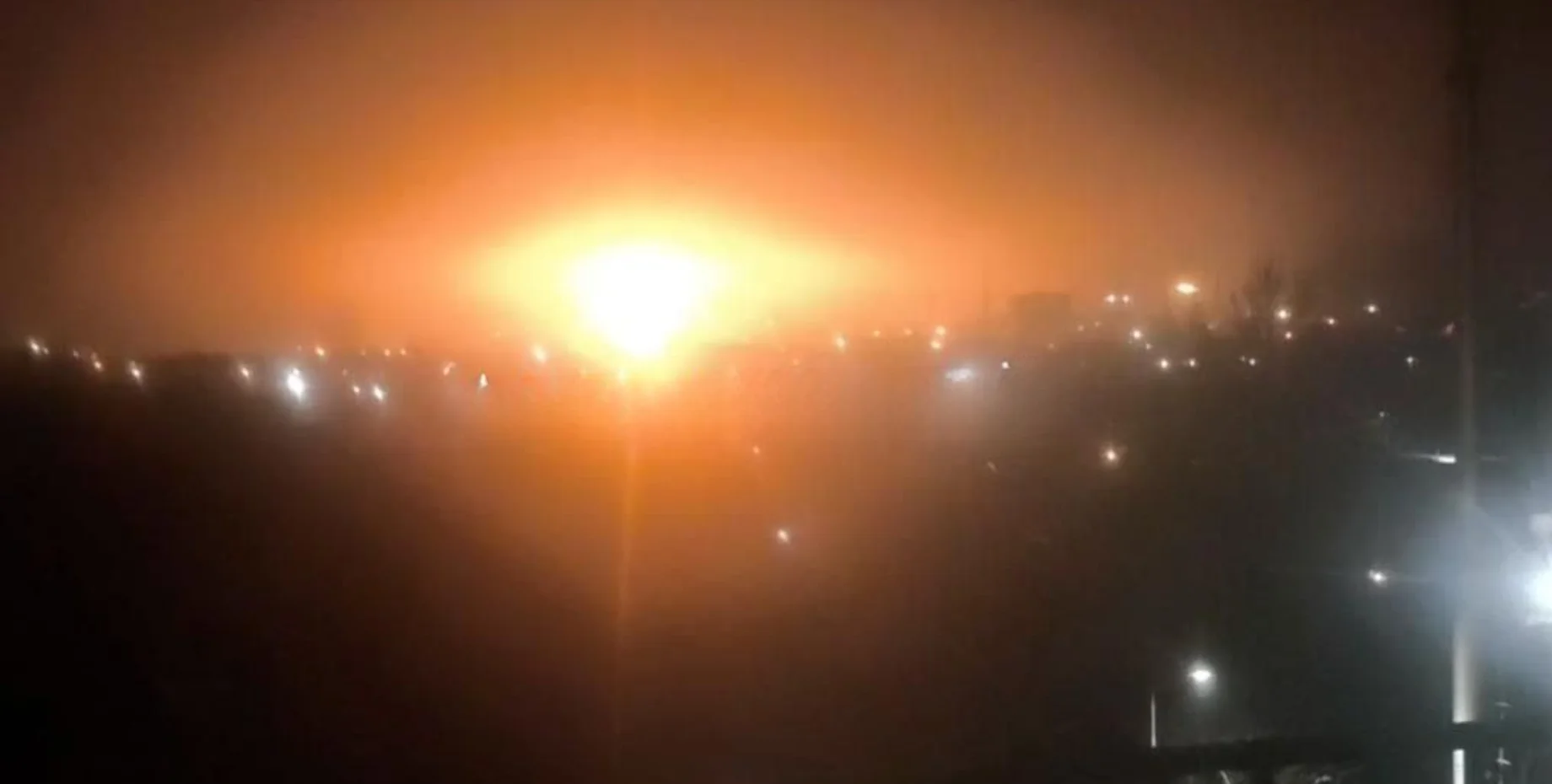
However, there are two enablers, sources said. Firstly, people have a sufficiently advanced understanding of meteorology and ability to predict wind trajectories to make balloons viable tools of war. AI modeling and sophisticated algorithms are bringing still more improvements.
Secondly, the balloons can be launched from anywhere, taking as little as 15 minutes to set up and deploy by a skilled team when conditions are right for the mission. They can also easily go over 10 kilometers into the air, where inclement weather becomes less of an issue.
Evolving technology
On the other hand, GPS becomes more of an issue within certain altitudes. Higher up, the aerostat starts picking up jamming and spoofing waveforms from a very wide area. This makes it harder to guide balloon-launched drones and be certain of their initial launch location.
This, plus the inherent unpredictability of relying on the wind means that there are always sizable error bars sitting around any one operation that involves aerostats. That includes missions that use aerostats as weapons carriers and signal repeaters for separately-launched deep strike or middle strike drones.
Trending Now
Still, this issue is surmountable enough that the tech remains viable. One source said that “there might be issues, but it’s better to have an aerostat than not” when conducting offensive operations.

As signals equipment clashes against electronic warfare on Ukrainian battlefields, both technologies are constantly evolving. Aerostats can also mount satellite terminals. While Starlink doesn’t work over Russia, there are other alternatives.
As well, Ukrainians already use drones that navigate by matching preloaded terrain contours and require less steering. AI models are making this technology more viable over time as sophistication grows, machine learning experts have said in prior interviews.
Tethered aerostats and mid-range strikes
Ukraine also makes increasing use of tethered aerostats—balloons that stay in one place, anchored by a cable. The company Aerobavovna is the best-known Ukrainian player in this space: their models are designed to go up between 500 and 1,000 meters in the air for up to three days at a time. Electricity feeds equipment through the tether.
These provide both defensive and offensive utility to Ukraine’s armed forces. They serve as potent communications relays and provide reconnaissance and monitoring with their cameras and sensor suites, able to detect Shaheds and other drones.

Balloons with explosives reported taking part in Ukrainian drone strike on Russia for first time
They are also instrumental in helping operators communicate with both FPVs and middle range attack drones, which have been increasingly hitting Russian targets at ranges of several hundred kilometers.
According to Kevliuk, only two of these systems have been confirmed shot down, although another source said that they can be vulnerable to friendly fire.
Cost and supply chains
Built from latex, nylon, and polyethylene, the balloons are very cheap and can be made of all-Ukrainian components, unlike many drones, which rely on China as a supplier.
The helium that fills them is slightly more complicated. The US-Israeli war on Iran led to strikes on Qatar, which produces close to a third of the world’s helium supply. The subsequent closure of the Strait of Hormuz has imposed further strain on the global supply.
On the other hand, aerostats don’t need high-purity helium to operate, which brings the cost down significantly. Kevliuk estimates that the daily operating cost of a tethered aerostat is $15.
One source said that the Iran war hasn’t affected operations and that helium is available in sufficient quantities.
“The technology is coming to life as an asymmetric response: cheap, effective for drone warfare,” Kevliuk said. “The trend is clear—balloons have become part of the arsenal for medium/deep strikes.”


