

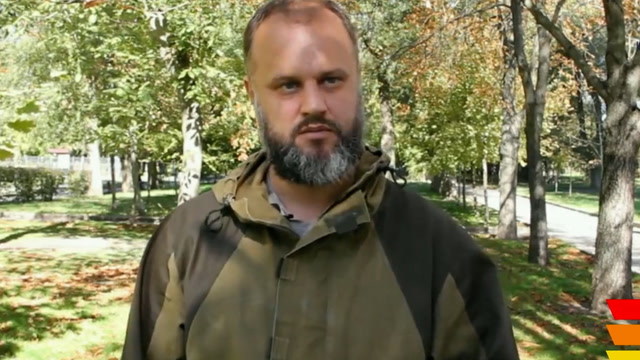
Pavel Gubarev, the self-proclaimed "people's governor" of occupied Donetsk Oblast in 2014 and one of the founders of Russia's proxy DNR formation, says Russia's war on Ukraine has lost its purpose. In an interview with popular blogger Yurii Dud, he argued that Russia has never publicly defined what victory would look like—and that what is unfolding at the front amounts to a "sacrifice."
"What do we want, what are we doing, what is all this for, and what is the end goal—where does the war end, meaning where have we won—this has not been stated", Gubarev told YouTube blogger Dud.
Ukraine, he conceded, has a clear purpose: it was attacked and needs to recover its territory. Russia's so-called "special military operation," he said, has no equivalent clarity.
A warlord reflects
In spring 2014, Gubarev once led his crowd on a two-hour search across Donetsk for the regional treasury, intending to block the transfer of Donetsk funds to Kyiv — only to discover that Donetsk was a subsidized region and that blocking the treasury's operations would leave miners, disabled people, and pensioners without money.
Gubarev also revisited 2014, calling it a "naive" mistake that Russia did not send regular army units into Donbas from the outset. "We were asking: 'Putin, send in troops.' We were naive, fools, we believed in all that," he said. He did not explain what outcome he expected, but acknowledged the logic of those early months had failed.
On Vladimir Putin himself, Gubarev stopped short of open condemnation. He said he is "no longer angry" at the Russian dictator, having concluded that Putin is not a "tsar" but simply "a person who has been working in the wrong place for 25 years"—a man who arrived in power by accident.
"[Putin] is an accidental man — but there are no accidents in power. If you ended up in power by accident, that makes you a Punchinello puppet," Gubarev noted — essentially calling the Russian leader a clown, given the range of meanings the Russian word carries.
The interview comes weeks after Russian authorities opened an administrative case against Gubarev for "discrediting" the Russian army—registered 18 February at Moscow's Tagansky District Court. The charge carries a fine of up to 50,000 rubles (around $650). Gubarev said he does not know what triggered it, but suspected it followed criticism of the Akhmat special forces unit commanded by Apti Alaudinov. "I assess the fact as utterly senseless stupidity," he told RBC. "I don't expect any consequences for myself."
The man behind the grievance
The spectacle of Gubarev complaining that Russia lacks a coherent war aim requires some context about who is doing the complaining.
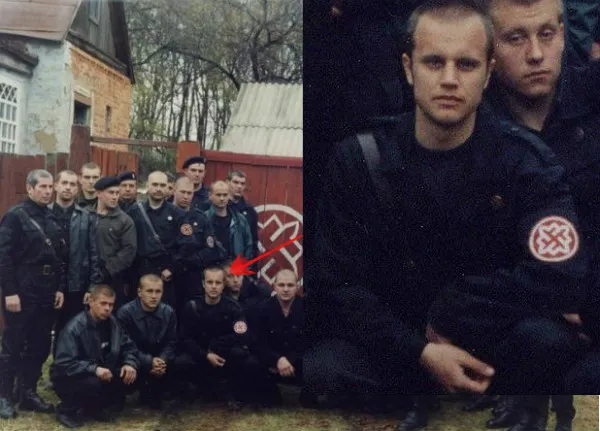
Between 1999 and 2001, he was a member of Russian National Unity, a neo-Nazi paramilitary organization that later took part in the 2014 conflict in Donbas on the pro-Russian side. In March 2014, he led the seizure of the Donetsk Regional State Administration building and proclaimed himself "people's governor," doing so with the apparent backing of Kremlin advisor Sergey Glazyev, according to Gubarev's own memoirs. He was arrested by Ukrainian security services, then exchanged for detained SBU officers and continued political activity in Russian-occupied Donbas, and then fled to Russia. His network was instrumental in connecting Igor Girkin's unit with local collaborators, setting the stage for the seizure of Sloviansk.
In October 2022, after Russia's full-scale invasion, Gubarev recorded a video that drew international condemnation in which he called for a mass murder of Ukrainians.
"We aren't coming to kill you, but to convince you. But if you don't want to be convinced, we'll kill you. We'll kill as many as we have to: 1 million, 5 million, or exterminate all of you," he said.
Gubarev joined the Russian army after the full-scale invasion in 2022.
Girkin's fate, Gubarev's warning
Gubarev has described himself as a close associate of Igor Girkin (also known as Strelkov), the former FSB officer and self-styled DNR "defense minister" who later became Russia's most prominent pro-war dissident blogger. When Moscow courts moved against Girkin in 2023, Gubarev was detained outside the courthouse after staging a public demonstration of support.

Girkin was convicted in January 2024 and sentenced to four years in a penal colony for "public incitement of extremist activity"—charges stemming from Telegram posts in which he called Putin a "nonentity" and a "cowardly bum." Russia's Supreme Court upheld the sentence in November 2024. A parole request was rejected in January 2025. A Dutch court had separately sentenced Girkin in absentia to life in prison for his role in the downing of Malaysia Airlines Flight MH17 in 2014, which killed all 298 people on board.
Gubarev's interview with Dud—and the administrative case that preceded it—suggest he is navigating the same contradiction that destroyed Girkin: loudly lamenting Russia's failures while remaining committed to the war itself. His complaint is not that Russia invaded Ukraine. It is that Russia invaded without a plan.
Whether Moscow will tolerate even that distinction remains to be seen.


