


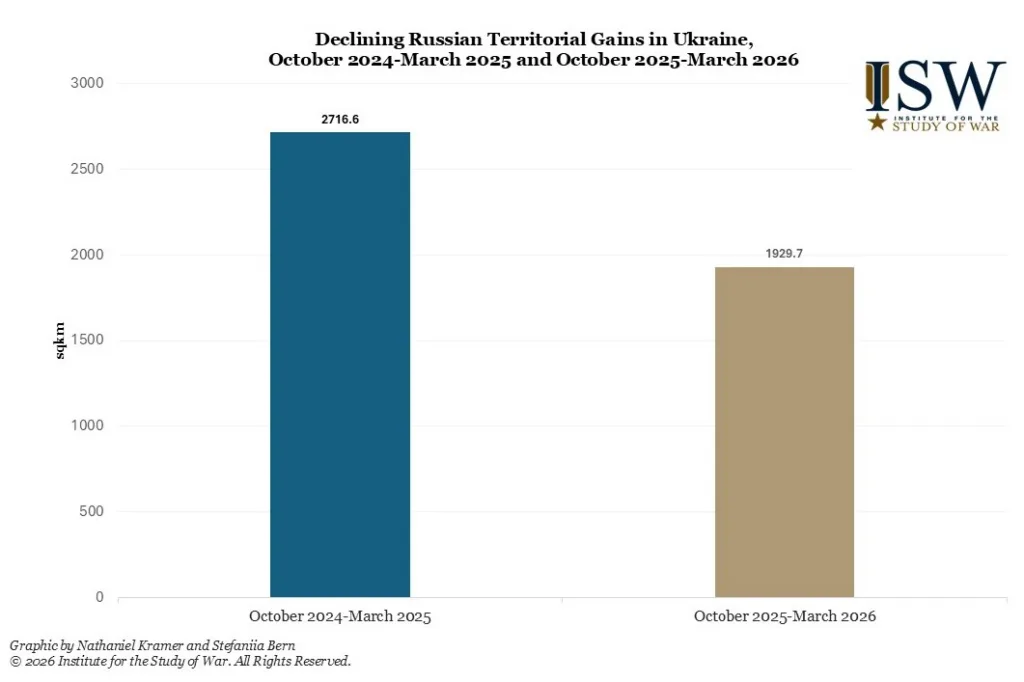
Russian forces are advancing at roughly half the pace of a year ago, and significant territorial gains — let alone a total Russian victory — are neither imminent nor inevitable, the Institute for the Study of War assessed on 31 March. Ukraine's counterattacks and mid-range strikes are likely impeding the Russian advance, with Ukrainian forces liberating the most territory in Ukraine itself since the 2023 counteroffensive.
Russian advance slows to half last year's pace
ISW found that Russian forces seized 1,929.69 km² between October 2025 and March 2026 — a 29% drop from the 2,716.57 km² captured in the same period a year earlier. The average daily advance fell from 14.9 km² to 10.66 km².

The quarterly breakdown is starker. Russian forces advanced at 5.5 km² per day in the first three months of 2026 — exactly half the 11.06 km² daily average in Q1 2025. In March 2026, ISW's data show a net Russian loss of 27 km².
Russian forces have increasingly relied on poorly trained and underequipped infantry to generate gains. Russia shifted to infiltration tactics across the front in 2025, but has recently struggled to consolidate those infiltrations — a failure that, in ISW's assessment, partially enabled Ukraine's counterattacks in the south in February 2026.
Ukrainian counterattacks and mid-range strikes drive the change
Ukrainian forces liberated over 400 km² in the Oleksandrivka and Huliaipole directions from late January to mid-March 2026 in two separate drives. Ukrainian forces also retook at least 183 km² near Kupiansk in December 2025 and have largely held those gains despite Russian efforts to reverse them.
These southern counterattacks have forced Russian forces to choose between defending against Ukrainian pressure and allocating manpower for offensive operations elsewhere along the front. Commander-in-Chief Oleksandr Syrskyi stated on 30 March that Ukrainian forces are prioritizing counterattacks in areas where Russian lines are weakest — precisely to retake and maintain operational and strategic initiative.

Ukraine’s 2026 goal: exhaust Russia, deny it breakthroughs, build reserves — top general says
Ukraine's mid-range strike campaign has compounded the effect. Euromaidan Press reported in March that Ukraine conducted 365 mid-range strikes in the year to March 2026, a third of them in the final three months, degrading Russian air defenses and disrupting offensive preparations.
Kremlin ultimatum on Donetsk has no battlefield basis
The Kremlin's demand that Ukraine abandon Donetsk Oblast is a cognitive warfare tool, not a reflection of battlefield reality, ISW assessed. President Volodymyr Zelenskyy stated on 31 March that Russia is demanding Ukrainian forces withdraw from the remainder of Donetsk Oblast — including the Fortress Belt — within two months, likely by late May 2026.
Kremlin spokesman Dmitry Peskov claimed the same day that Ukraine urgently needs a ceasefire because battlefield dynamics favor Russia. ISW directly rebutted the claim. Russian forces tried and failed to seize the Fortress Belt in 2014 and 2022. Their advance has slowed since the start of 2026. They have shown no capacity to rapidly envelop, penetrate, or storm cities the scale of Sloviansk or Kramatorsk — the northern anchors of the Fortress Belt, ISW noted.

Russia’s spring offensive has stalled at Ukraine’s Fortress Belt — ISW says it won’t break through in 2026
Russia moves to pre-emptively delegitimize Ukrainian elections
ISW says Russia is simultaneously working to undermine any future Ukrainian peace agreement by attacking the legitimacy of Ukraine's political process. Russian Central Election Commission chair Ella Pamfilova claimed on 31 March that the CEC will "ensure" Ukrainians living in Russia can vote in future Ukrainian elections.
The Kremlin has repeatedly used the elections issue to portray Ukraine's leadership as illegitimate, enabling it to stall negotiations and manufacture grounds for future rejection of agreements.
Read also
-
Russia increases ballistic missile strikes: Zelenskyy meets second Patriot interceptor maker within week in Washington to push back
-
New ground launcher means Russia no longer needs rare drone to fire its Banderol missile
-
West of Ukraine is still out of reach of Russia’s guided drones for reason. What is one thing that would close this gap?


