

Russia’s spring offensive has stalled at Ukraine’s Fortress Belt — ISW says it won’t break through in 2026

The 3rd Combined Arms Army, the only Russian force positioned to push directly on Sloviansk, hasn’t gained ground in a week after a month of tactically significant advances east of the city.
russia's spring offensive has stalled ukraine's fortress belt — isw says won't break through 2026 · post destroyed russian tank anti-drone cope cage near novoukrainka pokrovsk district donetsk oblast 29
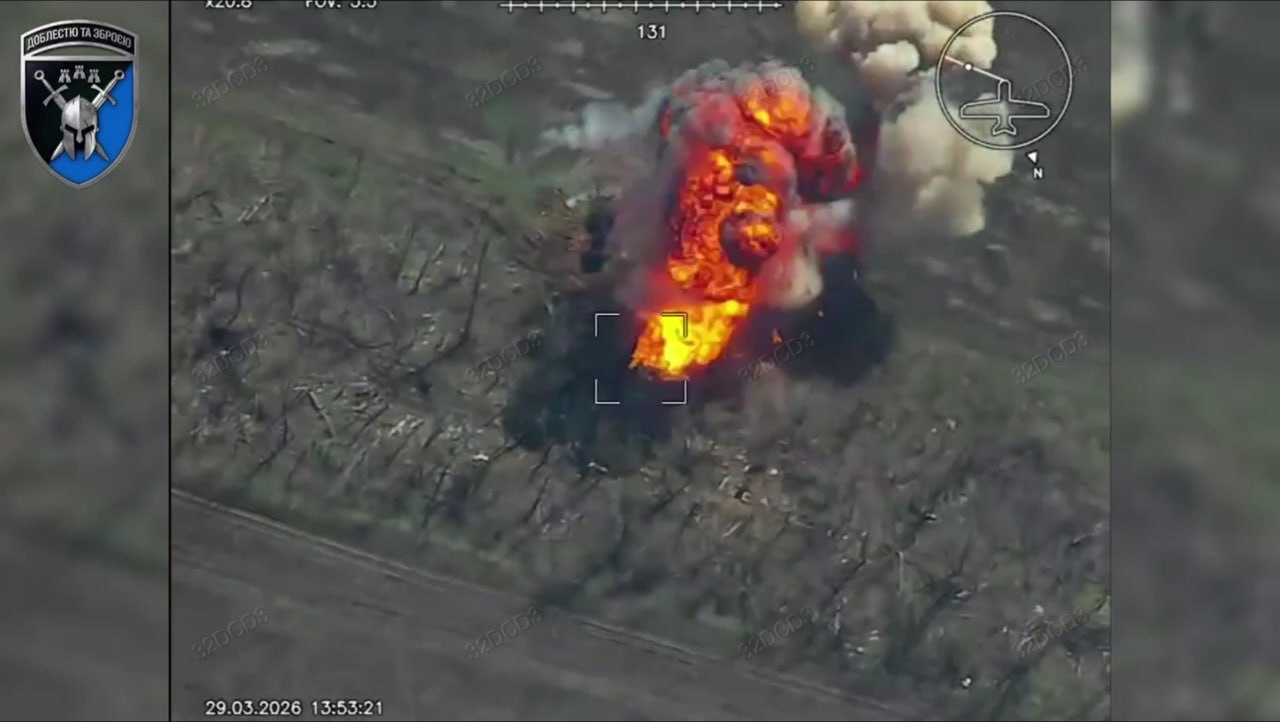
A destroyed Russian tank with an anti-drone cope cage near Novoukrainka, Pokrovsk district, Donetsk Oblast, 29 March 2026. Photo: 42nd Separate Mechanized Brigade
Russia’s spring offensive has stalled at Ukraine’s Fortress Belt — ISW says it won’t break through in 2026

Russia's spring-summer 2026 offensive is struggling to gain ground against the northern section of Ukraine's Fortress Belt in Donetsk Oblast, according to ISW. The think tank assessed that Russian forces remain unlikely to seize the fortified defensive line this year, with the only army positioned for a direct push on Sloviansk already stalled and flanking forces advancing even more slowly.

Russia's war in Ukraine continues to consume manpower at an unsustainable rate, with Moscow unable to simultaneously rebuild battlefield losses and generate the strategic reserves needed for decisive offensive operations in eastern Ukraine. Ukrainian drone-based defenses, fortified terrain, and the sheer attrition of Russian assault forces continue to constrain Moscow's ability to translate numerical advantages into territorial breakthroughs.

Russian 3rd Combined Arms Army stalls east of Sloviansk

Ukrainian military observer Kostyantyn Mashovets reported on 29 March that elements of the Russian 3rd Combined Arms Army fighting near Kryva Luka and Zakitne — east of Sloviansk, the northern anchor of the Fortress Belt — have made no progress since approximately 22 March. The army had achieved a tactical penetration of Ukrainian defenses between Kryva Luka and Riznykivka over the preceding month, since roughly 27 February, but that advance has now ground to a halt.
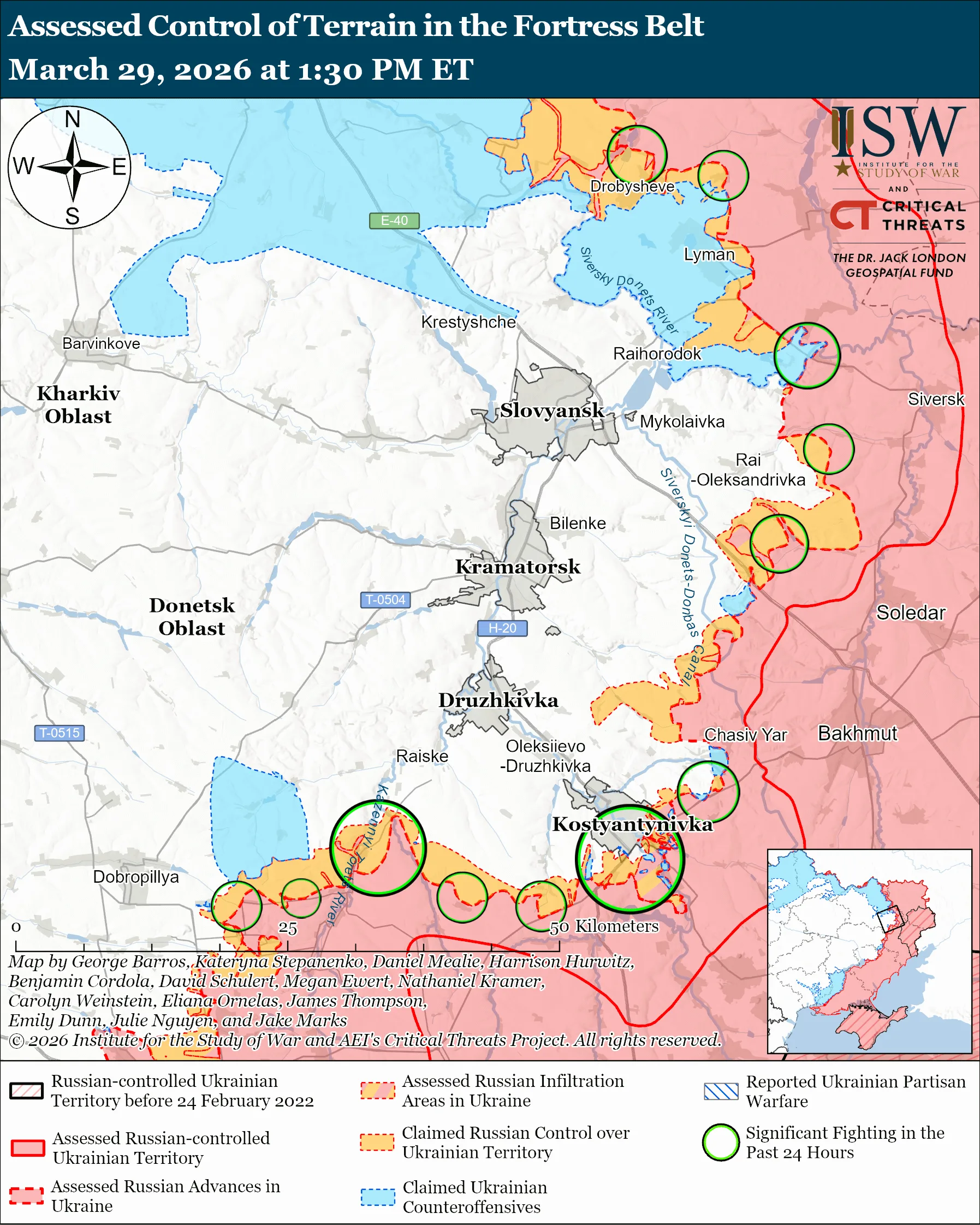
The Fortress Belt — a 50-kilometer chain of fortified cities stretching from Sloviansk through Kramatorsk to Druzhkivka and Kostiantynivka — has been the backbone of Ukrainian defenses in Donetsk Oblast since 2014. Its fall would open routes west toward Kharkiv, Dnipro, and Zaporizhzhia. ISW has long described seizing it as a multi-year effort that would cost Russia dearly in terms of time, manpower, and resources.
Current situation in northwestern Donetsk Oblast. Map: ISW

Mashovets assessed that elements of the 20th and 25th Combined Arms Armies in the Lyman direction and the 8th Combined Arms Army and 3rd Army Corps in the Kostiantynivka direction are all advancing more slowly than the 3rd CAA. He concluded that only the 3rd CAA is positioned to drive directly on the Sloviansk-Kramatorsk agglomeration. ISW assessed that attempting such an operation without mutually supportive flanking advances would likely inflict critically high casualties for disproportionately minimal gains.

ISW assessed on 19 March that Russian forces likely began their spring-summer offensive between 17 and 21 March, after intensifying mechanized and motorized assaults across multiple sectors. A battalion-sized mechanized assault in the Borova-Lyman direction, a surge in drone, artillery, and air strikes, and the movement of heavy equipment marked the offensive's opening. The pace of operations in the Lyman direction has since slowed, suggesting Russian forces cannot sustain the intensity of their earlier mechanized pushes.

Russia's strategic dilemma: push forward or reinforce flanks

Mashovets noted that elements of the 3rd CAA could be diverted to support Russian operations toward Lyman or Kostiantynivka rather than continuing a direct push against the Fortress Belt. Such a diversion would require Russia to temporarily abandon its offensive on the northern section of the fortified line — a move that would undermine the Kremlin's information warfare effort portraying Russian forces as advancing simultaneously across the entire theater and Ukrainian defenses as collapsing.

isw russia has likely begun its anticipated spring-summer 2026 offensive against ukraine's fortress belt donetsk oblast · post assessed control terrain 21 donetsk-oblast-march-21-2026 russian forces have institute study war (isw)
Explore further

ISW: Russia has likely begun its anticipated spring-summer 2026 offensive against Ukraine’s Fortress Belt in Donetsk Oblast

Ukrainian Joint Forces Task Force Spokesperson Colonel Viktor Trehubov assessed on 28 March that Russian forces toward Lyman are likely waiting for spring foliage to emerge, which would provide concealment for assaults and infiltration missions.

"Russian forces remain unlikely to seize Ukraine’s Fortress Belt in 2026, especially if many of the forces involved in such an operation are bogged down in Ukrainian defenses," ISW concluded.

To suggest a correction or clarification, write to us here

You can also highlight the text and press Ctrl + Enter

Please leave your suggestions or corrections here


    Euromaidan Press

    We are an independent media outlet that relies solely on advertising revenue to sustain itself. We do not endorse or promote any products or services for financial gain. Therefore, we kindly ask for your support by disabling your ad blocker. Your assistance helps us continue providing quality content. Thank you!

    Ads are disabled for Euromaidan patrons.

    Support us on Patreon for an ad-free experience.

    Already with us on Patreon?

    Enter the code you received on Patreon or by email to disable ads for 6 months

    Invalid code. Please try again

    Code successfully activated

    Ads will be hidden for 6 months.