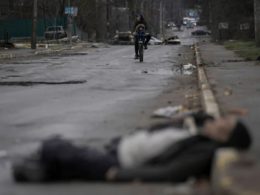
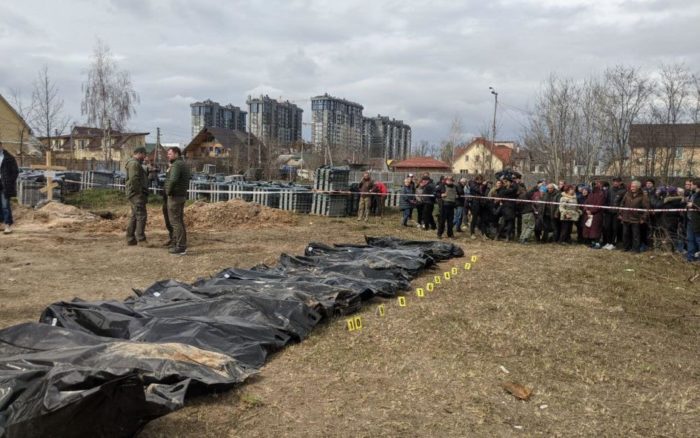
Ukraine has recorded more than 217,000 episodes of war crimes since Russia's full-scale invasion began — yet only 817 indictments have been filed and 245 verdicts handed down, just 23 of them in person, according to the Office of the Prosecutor General. Because the International Criminal Court focuses exclusively on top military and political leadership, the bulk of prosecutions targeting lower-ranking Russian soldiers falls to Ukraine's own courts, according to a Suspilne investigation.
The pace varies sharply. Some cases have spent nearly three years in preliminary hearings; others moved from opening arguments to verdict in six months. Both extremes, the investigation finds, stem from the same structural problem: a court system built for ordinary times, now asked to do something it was never designed for.
Oleksandr Chykmarov walks to the witness stand with a limp. He has a prosthesis — his left leg was amputated below the knee after Russian soldiers shot up his civilian car in Bucha on 5 March 2022, as he was trying to evacuate with his family. His wife and two children died on the spot. So did the driver of the car behind them.
More than four years later, he is still waiting for a verdict. "I want justice. Simply accountability. The aggressor state must answer for its crimes," he told the court in Irpin. That morning's session started 50 minutes late — a chronic occurrence, he noted.
The defendant, Mykyta Chalov, an operator in the 104th Air Assault Regiment of Russia's 76th Air Assault Division, is being tried in absentia. The Irpin court began hearing the case in December 2024. Victims' representative Oleksii Yasiutetskyi explained the early delays: "For a very long time the court had to satisfy itself that the accused had been properly notified — that the prosecution had taken all measures to inform him. But we are operating under a Criminal Procedure Code not designed for such criminals. And in general, this situation and our procedural law are not adapted to war crimes."
Alla Nechypurenko, whose husband and son were shot dead in Bucha by Oleksandr Kashin — a serviceman of Russia's National Guard from Yaroslavl Oblast — has been attending hearings since May 2023. Eighteen months passed in preliminary proceedings before the court moved to substantive hearing in April 2024. "I was not at all prepared for the trial to last so long," she told journalists. "Each court visit is reliving what happened. Each time recalling events that changed my life forever — these sessions are very hard emotionally."
Her lawyer, rights advocate Yurii Bilous of the NGO Justice for Ukrainians, is blunt about what the delays do to survivors: "Lengthy court proceedings really hit victims of war crimes hard. I would even say — as an insult, non-recognition by our state of the tragedy that happened either directly to them or to their family."
Three judges, ten thousand cases, and no time
Ukraine's criminal procedure requires that most war crimes cases — those carrying sentences of 10 to 15 years or life imprisonment under Part 2 of Article 438 of the Criminal Code — be heard by a panel of three judges. Bilous points out what that means in practice: "To schedule even one or two hearings, you first have to coordinate the calendars of three judges. From what I observe, that is never straightforward."
The deeper problem is raw numbers. Suspilne reports that 5.2 million cases entered Ukrainian courts last year, up from 4.5 million the year before. With approximately 4,200 judges in the system — roughly half the number international and national experts say is needed — the average judicial load exceeds 1,000 cases per judge per year. In some courts, the figure reaches 10,000 to 15,000. At Kyiv's District Administrative Court, one judge's workload runs 39 times above the standard, according to Oleh Tkachuk, a judge of the Supreme Court's Grand Chamber and former military court judge of 17 years.
The Irpin court, which handles war crimes from the occupation of the Kyiv region in February–March 2022 — covering Irpin, Bucha, Hostomel, Vorzel, and Kotsyubynske — has just 10 judges against a normative staffing of 28. It is carrying 65 war crimes cases, 43 of them heard collegially. Its total docket has grown from 14,600 cases in 2021 to 19,978 in 2025. Deputy Chief Judge Mykhailo Odariuk, who hears cases by day and volunteers with a territorial defence unit at night, delivered a terse assessment of the court's war crimes output so far — a single verdict, in June 2023: "Little, certainly little. There is no time."
Odariuk does not rank war crimes above other cases. "When an alimony case comes before me, I do not consider that a war crime takes priority, because questions of a child's life and health may be at stake there. The mother has no money. She is waiting for that court order to collect funds from the father to buy something. I will give priority to hearing that case quickly." He adds that in absentia war crimes proceedings, while unlikely to meet the ICC's standards for fair trial recognition, serve another purpose: generating testimony and evidence that can be passed to The Hague. "That is the assistance needed — to question [witnesses], take those initial statements, record them in the trial journal. And then most likely we will provide them to the ICC."
Pavlohrad District Court in Dnipropetrovsk Oblast, which was transferred jurisdiction over cases from 11 courts in temporarily occupied or heavily shelled areas of Donetsk, Luhansk and Dnipropetrovsk regions after the full-scale invasion, sentenced Yuriy Ogurtsov ("Vulkan") of Donetsk to 12 years in January 2026, for war crimes committed in 2016–2017 at the "Isolation" torture facility in occupied Donetsk. The case took nearly three years. Court President Maryan Mytsak attributed the duration partly to crushing additional territorial jurisdiction; the regional deputy prosecutor linked it to having no access to the crime scene or the suspects, who remain in occupied territory or outside Ukraine.
Active combat is a compounding factor. Bilous recalls: "Proceedings are sometimes suspended when air raid alerts are in effect, when there is a missile or drone threat. That is one thing. Then there was the problem with electricity — for example, during January and February 2026. I had two war crimes cases in Odesa relating to Kherson and Kherson Oblast. The power situation there in 2025 repeatedly prevented hearings from taking place."
Prioritization, specialization, and the military justice debate
The Office of the Prosecutor General is developing prioritization criteria for which of the 217,000-plus recorded episodes will proceed to Ukrainian courts. Tарas Semkiv, head of a department in the OPG's war crimes directorate, told Suspilne the criteria include number of victims, public resonance, scale of damage — and, crucially, the accused's rank in the Russian military hierarchy. "If we understand that this crime was committed not by an ordinary serviceman but by some high-ranking official — obviously that is prioritized, because such crimes scale immediately."
Semkiv cited the recent cluster of prosecutions for the execution of Ukrainian POWs — a rare category tried in person — as illustrative of systemic criminal policy rather than individual conduct. Ukrainian courts in Kharkiv, Zaporizhzhia and Kyiv have handed down three verdicts in such cases in recent months. But defense expert Andrii Yakovlev of the Media Initiative for Human Rights questioned whether these prosecutions reach the commanders who gave the orders. In the case of Vladimir Ivanov of Russia's 40th Marine Brigade, sentenced to life for executing Ukrainian POWs in Kursk Oblast, a commander identified by the call sign "Ryazan" is mentioned in the case materials but has not been identified. "You can hold the specific soldier who killed our POW accountable. But that soldier will be replaced tomorrow, because the commander will send another. They will say: kill this one, kill that one. Above all, you need to pursue the people who issue or execute orders at a high level," Yakovlev told Suspilne. "If we fight the consequences rather than the cause, we cannot respond to crimes effectively."
Prosecution and investigation bodies have already moved toward specialization: the OPG has 12 dedicated regional war crimes units, and both the Security Service of Ukraine and the National Police have specialized investigators. Semkiv argues the courts should follow. "It would increase institutional memory and allow deeper specialization in a specific narrow field. And it would definitely improve the quality of such proceedings." Deputy Head of the Presidential Office Iryna Mudra confirmed the idea is under discussion: "The question requires further discussion involving prosecutors, investigators, lawyers, scholars, and human rights defenders."
The most debated structural proposal is restoring military courts — abolished in Ukraine in 2010. Tkachuk, who spent 17 years as a military court judge before that, argues such courts could handle both military and war crimes cases and would have a decisive practical advantage: access to active combat zones. "Right now Russians are killing civilians in areas of active combat every day. But there are no law enforcement officers recording those crimes. The army is focused on liberating territory. And military police lawyers and military prosecutors are not there — they have no access, because they are not combatants, they cannot be sent there." Yakovlev is skeptical of the systemic fix, however: "Theoretically it could increase throughput. But our current judicial system took ten years to build and still does not function properly. Why do we think a new system would be better? The same people would work in it. Optimizing the existing system is also a reasonable option." Semkiv agrees the timeline is the problem: "Creating that court, recruiting the appropriate staff — that takes a long time, and we do not have time to wait."