


Poland and Estonia are building Shahed killer Mark I at sustainable cost. Inspiration came from Kyiv

Shooting down a $20,000 Shahed with a $3 million Patriot is unsustainable.
russia used belarus's cell towers bomb ukrainian power plants hackers got inside operators' chatrooms · post russian geran-2 (shahed-136) drone belarusian markings service military belta militarnyi російський безпілотник герань 2
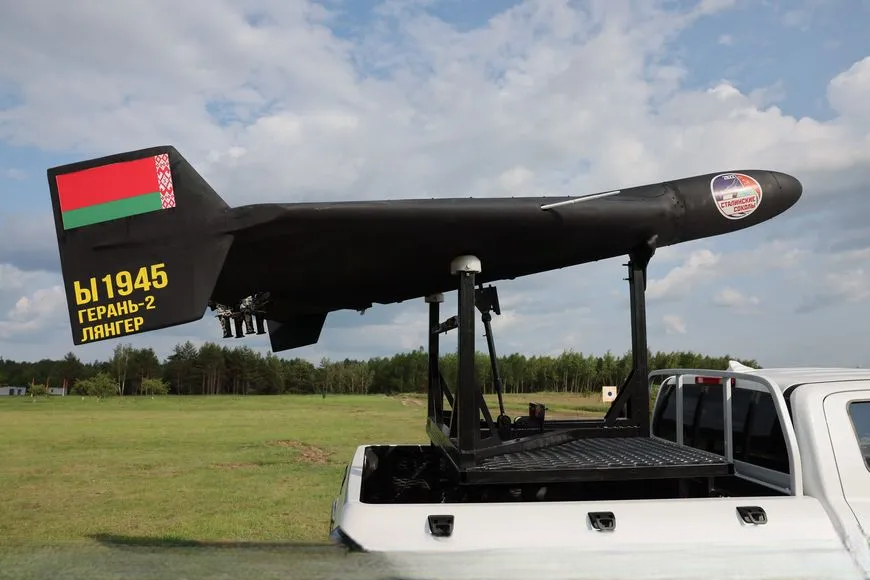
Russian Geran-2 (Shahed-136) drone with Belarusian markings in service with the Belarusian military. Photo: BelTA via Militarnyi.
Poland and Estonia are building Shahed killer Mark I at sustainable cost. Inspiration came from Kyiv

On 27 March 2026, Poland’s state defense group PGZ announced that it had signed a new agreement with the Estonian company Frankenburg Technologies. The agreement focuses on the development and production of the Mark I missile system, designed to engage unmanned aerial vehicles, according to Army Recognition. 

PGZ President Adam Leszkiewicz says that the lessons of the war in Ukraine show that cheap drones are used on a massive scale, and that using more advanced and expensive air defense systems against them is neither operationally nor economically justified. This observation lies at the core of the Mark I concept.

Lessons from war in Ukraine: expensive missiles are no longer effective 

It is primarily positioned against drone threats, especially one-way attack UAVs of the Shahed class, as well as against somewhat faster targets.

The announcement points to a concrete European effort to respond to one of the defining military challenges of current conflicts: how to stop mass drone attacks using interceptors that can be deployed in large numbers at a sustainable cost.

Mark I as a response to “Shahed-style” warfare

PGZ stated that the partnership will include production capabilities in Poland, in particular through the planned creation of a facility capable of producing up to 10,000 missiles per year, as well as laying the foundation for future systems such as the longer-range Mark II.

PGZ and Frankenburg Technologies have begun joint efforts to produce the Mark I missile in Poland at scale to counter mass-drone threats with a low-cost, rapidly deployable interceptor.

The Mark I is described as a compact guided mini-missile approximately 60 to 65 centimeters in length.

The missile uses a solid-fuel engine, reaches speeds of over 1,000 kilometers per hour, and employs terminal guidance with a proximity-fuse warhead to destroy targets.

Not replacement for Patriot, but load reducer

A missile like the Mark I is important not because it replaces systems such as Patriot, CAMM, or other high-end interceptors, but because it can absorb part of the burden of countering drones and prevent defenders from expending scarce and expensive missiles on relatively cheap aerial targets.

At the same time, key implementation details, including the level of investment, plant location, and production start date, have not yet been disclosed, leaving the industrial timeline still to be clarified.

To suggest a correction or clarification, write to us here

You can also highlight the text and press Ctrl + Enter

Please leave your suggestions or corrections here


    Euromaidan Press

    We are an independent media outlet that relies solely on advertising revenue to sustain itself. We do not endorse or promote any products or services for financial gain. Therefore, we kindly ask for your support by disabling your ad blocker. Your assistance helps us continue providing quality content. Thank you!

    Related Posts

    Ads are disabled for Euromaidan patrons.

    Support us on Patreon for an ad-free experience.

    Already with us on Patreon?

    Enter the code you received on Patreon or by email to disable ads for 6 months

    Invalid code. Please try again

    Code successfully activated

    Ads will be hidden for 6 months.