
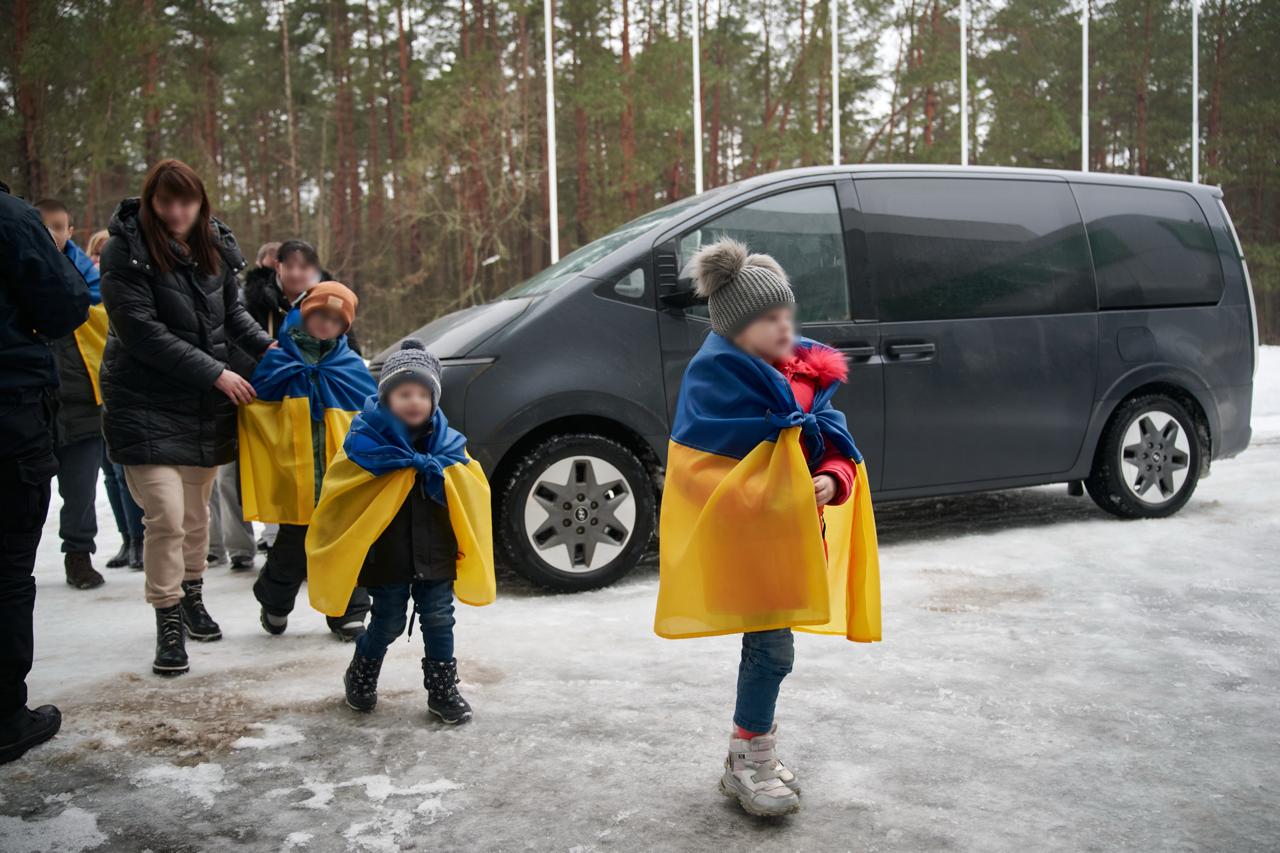
Russian state-linked energy corporations Gazprom and Rosneft facilitated the transfer and political indoctrination of at least 2,158 Ukrainian children between 2022 and 2025, according to a report released March 25 by the Yale School of Public Health's Humanitarian Research Lab (Yale HRL).
The report, titled Willing Accomplices: Gazprom & Rosneft's Role In The Transport and Indoctrination of Ukraine's Children, concludes "with high confidence" that the two companies and their subsidiaries organized the transportation of children from Russian-occupied areas of Ukraine's Donetsk, Luhansk, and Zaporizhzhia regions to at least six camps in Russia and Russian-occupied territories — including facilities directly owned by Gazprom subsidiaries.
"Gazprom and Rosneft are critical components of President [Vladimir] Putin's industrial-scale campaign of child deportation, transportation indoctrination," said Nathaniel Raymond, executive director of the Humanitarian Research Lab, at a press conference accompanying the report's release.
Lead researcher Paige Farrenkopf said the transfers were not historical: children were taken to these camps "as recently as summer 2025." She said the research identified 44 entities — subsidiaries and trade unions tied to the two companies — involved in organizing transport, issuing camp vouchers, and facilitating what the report classifies as "reeducation": exposure to pro-Russian narratives and, in some cases, militarized activities described as "patriotic education." Of those 44 entities, Farrenkopf said, "80 percent are not sanctioned" by either the United States or Europe.
The methodology relied exclusively on open-source material. "Our methodology actually entirely relied on open source information," Farrenkopf said, adding that the companies' own subsidiaries "directly claimed that they were involved…in facilitating the transport and reeducation of Ukraine's children."
Raymond said the findings had been shared with US officials prior to the press conference: "We have communicated the report to both houses of Congress and to the Trump administration," adding that the State Department had been briefed on the initial findings.
Sanctions collision
The report's release coincides with a decision by the US Treasury Department to issue a license temporarily allowing certain Russian oil shipments to proceed — a move that, according to a companion analysis from Stanford University, could allow Gazprom and Rosneft to continue generating revenue despite existing sanctions.
"This matters, because American foreign policy is…putting dollars directly into the pockets of two Russian companies implicated in the forcible transfer and reeducation of Ukrainian children," said Stanford researcher Ruth Gibson.
Congressional response
Five members of the bipartisan Congressional Ukraine Caucus — Co-Chairs Marcy Kaptur (OH-09), Brian Fitzpatrick (PA-01), Mike Quigley (IL-05), and Joe Wilson (SC-02), along with member Greg Landsman (OH-01) — issued a joint statement the same day calling for sanctions to be strengthened rather than eased.
"The new report from Yale HRL shows a direct and deeply disturbing connection between major Russian oil and gas entities and the detention, militarization, and ideological reprogramming of nearly 2,200 of the 20,000+ Ukrainian children Russia has abducted. Findings of this magnitude demand stronger consequences, not sanctions relief," the statement read.
The lawmakers cited a specific facility, referred to in the statement as the "Prometheus Camp," described as owned by a Gazprom subsidiary. "A Gazprom subsidiary publicly described how Ukrainian children are being trained at this camp in hand-to-hand combat, grenade throwing, and riflery to fight for their Russian abductors against Ukraine and the rest of Europe," they wrote.
On the financial stakes, the caucus members warned that easing oil sanctions risks "channeling over $12 billion back into the same state-backed machinery that fuels Dictator Vladimir Putin's war."
The statement called on the administration to "reimpose, maintain, and strengthen sanctions, denying relief to any entity implicated in the detention, indoctrination, or militarization of Ukrainian children."
Broader legal context
The Yale report builds on prior investigations into the deportation of Ukrainian children that led the International Criminal Court to issue arrest warrants for Putin and Maria Lvova-Belova, Russia's children's rights commissioner. According to Yale HRL, the new report is the first to provide detailed evidence directly linking major Russian corporations and their subsidiaries to that campaign.
Raymond framed the corporate involvement as evidence of systemic coordination: "What this report demonstrates…is that this campaign…[is] a whole of government approach…[that] involve[s] Russian private companies."