


Russian forces launched multi-sector assaults along the Donetsk and Zaporizhzhia fronts on 17–18 March, suffering heavy casualties without advancing at any point, according to Robert "Magyar" Brovdi, commander of Ukraine's Unmanned Systems Forces (SBS). Brovdi assessed that Russia's anticipated spring-summer offensive can be considered "partially uncorked," while Ukraine's General Staff reported sharply rising daily casualty figures on 17 and 18 March.
Fog and horses: how Russia opened the assault
A sudden weather change on 17–18 March in the Dobropillia, Pokrovsk, and Huliaipole sectors of Donetsk and Zaporizhzhia oblasts triggered the Russian assault. Brovdi reported that Russian forces had waited throughout March for exactly this kind of fog to resume operations under cover. Pre-infiltrated groups had been sitting in forward positions for some time. They activated before midnight on 17 March under drizzle and mist — and ran into a drone ambush. SBS drones killed more than 100 of them before midnight.

At dawn on 17 March, Russia escalated. Infantry, motorcycles, armored vehicles, and horses pushed at Ukrainian positions across "a good dozen sections" of the front simultaneously, according to Brovdi. By the end of 17 March, SBS drone units alone had reportedly killed 292 Russian soldiers and wounded 221 others. By noon on 18 March, Brovdi noted another 277 Russian troops added to the count — 141 killed, 136 wounded. The 36-hour total reached 900 — what Brovdi called "somewhat of a new mark." Total Russian losses across the section were significantly higher, he added, as other drone units and ground forces also contributed.
Zero breakthroughs in 36 hours
Despite the scale of the assault, Russian forces failed to break through at any point along the entire Rodynske–Huliaipole stretch, Brovdi said. Ukrainian infantry held every position. Ground-based drone crews from frontline brigades also struck heavily, with Brovdi crediting the combined arms effort — SBS drone pilots, adjacent brigade drone operators, and infantry — for the result.

Brovdi described Russia's bet on bad weather as a failure.
"The fog trap, or the irony of war," he wrote, noting how drone systems removed the concealment that low visibility was supposed to provide.
He warned that "the rest of March will be heavy and prolonged fighting."
Casualty spike across the front
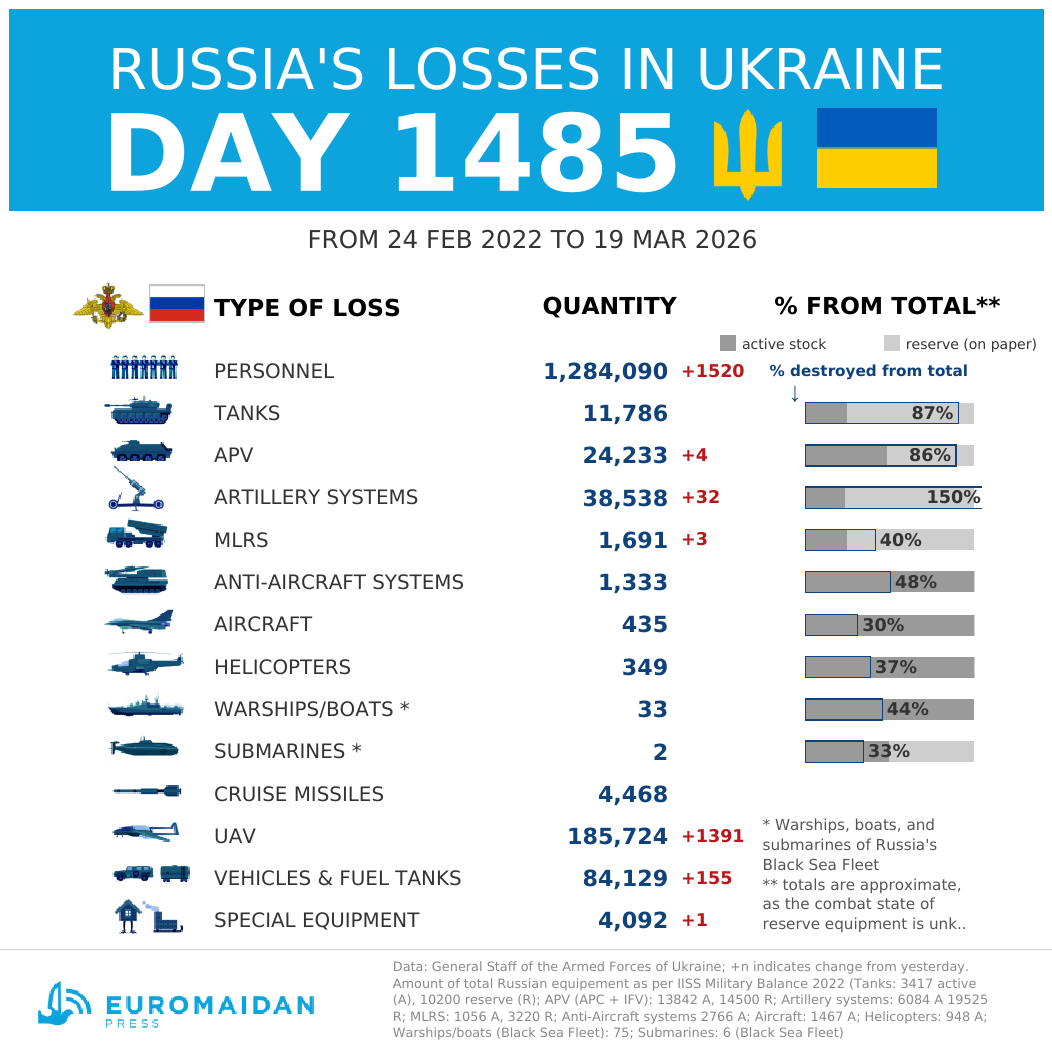
The escalation showed in the General Staff's daily front-wide figures. The reported Russian losses stood at 760 on 16 March. On 17 March — the first day of the assault — the figure reached 930, according to the General Staff. The following day, the General Staff reported 1,710 casualties. On the morning of 19 March, the daily figure for 18 March already stood at 1,520. These figures cover all Ukrainian fronts and all casualty categories, not just the Rodynske–Huliaipole section.
Read also
-
Ukraine’s half-month air defense blitz: 27 Russian anti-air assets destroyed, including S-400s, Pantsirs, radars, and EW stations
-
Ukraine’s counterattacks in Dnipropetrovsk Oblast are burning Russia’s operational reserves — ISW says Russia’s spring offensive may be spoiled
-
‘We detect and destroy everything’: Ukraine’s drone battalions hold off three Russian armies west of Pokrovsk


