


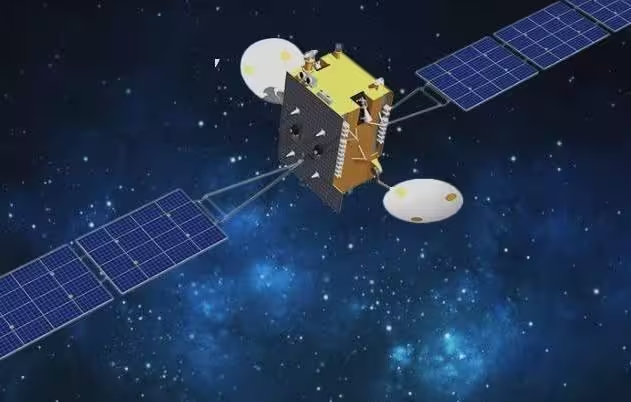
Russia's Express-AT1 communications satellite failed on 4 March for unknown reasons and is beyond repair, the state-owned Russian Satellite Communications Company confirmed, according to The Moscow Times.
The collapse knocked out broadcasting for three major providers, including Russkiy Mir—a channel created specifically to beam Russian propaganda into occupied Ukraine. A replacement satellite, Express-AT3, won't reach orbit until 2030.
The blackout exposes a structural weakness in Russia's propaganda infrastructure: sanctions have removed the safety net. Commercial operator Tricolor moved within days to lease capacity from the foreign satellite ABS-2A and asked subscribers to retune their dishes. NTV-Plus gave affected customers temporary free access to digital channels.
Russkiy Mir had neither option. Built in 2022 by Putin's All-Russia People's Front as an instrument of cultural occupation, the channel is simply off the air.
"Built in 2022 by Putin's All-Russia People's Front as an instrument of cultural occupation, Russkiy Mir is now simply off the air in the territories it was designed to control."
Industry analysts estimate the satellite's failure affected around 5 million households across Russia—but for occupied Ukraine, the disruption carries a different weight.
Russian propaganda infrastructure in occupied Ukraine
Russia has spent years constructing a media ecosystem designed to replace Ukrainian broadcasting in captured regions.
As recently as December 2024, occupation authorities launched a program to extend radio and TV signal coverage to every captured settlement.
The Russian government allocated a record $1.4 billion for state media and propaganda in 2025—a 13% increase from the previous year, according to Euromaidan Press.
Russkiy Mir sat at the center of that system. Unlike commercial operators serving paying subscribers, it was a political project: built to normalize Russian governance, crowd out Ukrainian identity, and make occupation feel permanent.
In a number of occupied regions, authorities reinforced Russkiy Mir's reach by banning residents from using satellite antennas tuned to European satellites. The signal residents could receive was the signal Moscow chose to send.
With Express-AT1 gone, the RSCC has opened bidding to build a replacement. Some customers may regain service after their equipment is reconfigured to a different orbital position, but others may experience outages lasting up to a month.
A telecoms industry source told the business newspaper Kommersant that the failure could have been caused by anything from an external impact to a cyberattack, The Moscow Times reported.
Setbacks for Russian propaganda since the full-scale invasion
The satellite failure is the latest in a sequence of blows to Russian state media's reach since February 2022. The EU banned RT and Sputnik across all 27 member states within weeks of the full-scale invasion, then extended restrictions to RIA Novosti, Izvestia, Rossiyskaya Gazeta, and Voice of Europe in May 2024.
By December of that year, Brussels had imposed its first-ever sanctions specifically targeting Russian disinformation operations and the intelligence officers running them.
Western pressure has progressively closed off the channels Russia uses to spread its narratives abroad. The Express-AT1 failure shows that, within occupied territory, the infrastructure is equally fragile—and that sanctions, by eliminating the commercial workaround, have turned a technical failure into something that cannot be easily repaired.
Read also
-
Moscow builds new propaganda broadcast network in occupied Ukrainian territories, blocks access to independent media
-
Russia spends over $ 1 billion annually on disinformation campaigns
-
EU Council bans Russia’s RIA Novosti, Izvestia, Rossiyskaya Gazeta, and Medvedchuk’s Voice of Europe
-
EU targets Russian intelligence with first-ever disinformation sanctions


