- All eyes are on Ukraine's southeastern counteroffensive just west of Pokrovske
- A few kilometers to the south, the Russians are the ones attacking
- Their goal: to breach the fortified settlement of Verkhnia Tersa in order to march west toward Zaporizhzhia city
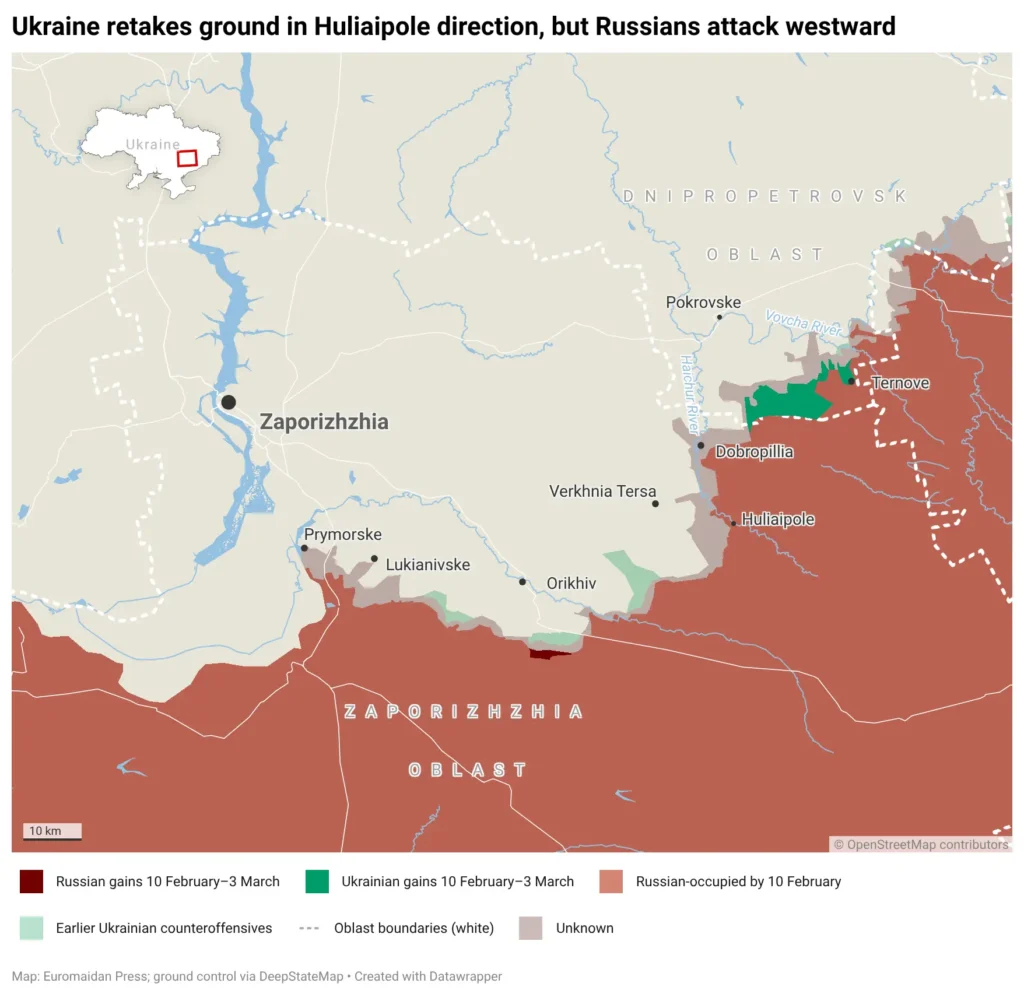
Ukrainian forces may be counterattacking along the right flank of the Russian 5th Combined Arms Army in southern Ukraine's Zaporizhzhia Oblast. But that hasn't stopped the 5th CAA from conducting its own attacks west of the town of Huliaipole—40 of them in a single day on 2 March, more than on any other sector of the 700-mile front.
Even after losing Starlink access and front-line comms in February, Moscow is throwing everything it has at this axis. That tells you how badly it wants the road to Zaporizhzhia city.
The 5th CAA's objective is clear. It aims to break the dense Ukrainian fortifications around the village of Verkhnia Tersa, 9 km west of Huliaipole, a critical logistics base that the Russians captured in late December. If the 5th CAA can march from Huliaipole through Verkhnia Tersa, it might have a shot at laying siege to the town of Orikhiv, 25 km west of Verkhnia.
Orikhiv is one of the most daunting Ukrainian strongpoints standing between the Russians and the free city of Zaporizhzhia, 80 km west of the southeastern gray zone.
In other words, the Russians need to crack Verkhnia Tersa in order to crack Orikhiv. They need to crack Orikhiv in order to have any chance of capturing the ultimate southern prize: Zaporizhzhia city.
It's for this reason that the 5th CAA is so intensely focused on the first objective in this sequence, Verkhnia Tersa. The Russian field army continues to assault in the direction of Verkhnia Tersa despite the recent meltdown in Russian communications—and despite the recent Ukrainian advances to the north, which could expose the 5th CAA's right flank to Ukrainian attacks.
Early last month, Elon Musk’s Starlink bricked Russia’s stolen and smuggled satellite terminals all along the 1,100-km front line of Russia’s 48-month wider war on Ukraine. At the same time, the Kremlin recklessly blocked military access to non-government social media platforms, including Telegram, which many Russian troops had used for front-line communication.
The twin moves threw the Russian armed forces in Ukraine into disarray. Many drones couldn’t fly. Many headquarters couldn’t coordinate their subordinate units. Assault groups got lost—and got ambushed. Sensing opportunity, the Ukrainian armed forces attacked, especially in the southeast just east of Pokrovske, 35 km north of Huliaipole.
Debated counteroffensive
The Ukrainian counteroffensive has been the subject of intensive debate as observers disagree over just how much territory the Ukrainians are actually liberating from Russian control. That debate threatens to distract from the very real Russian threat to Verkhnia Tersa.
Clearly determined to take the town, the Russians concentrated troops and firepower along the axis in early February despite the chaos in their comms—and despite the risk they might lose ground farther north.
Trending Now
And the 5th CAA isn't fighting alone. Russia has been steadily reinforcing the broader Zaporizhzhia axis for weeks, shifting troops from Kherson and Crimea and routing marine infantry through occupied Mariupol. Petro Andriushchenko, head of Ukraine's Center for the Study of Occupation, reported that Russia appears to have finished accumulating forces on the direction—suggesting the assault on Verkhnia Tersa is part of something larger.
First, the Russian air force bombed Verkhnia Tersa and bombarded it with artillery and ground-to-ground rockets. "Under the cover of this bombardment," analyst Thorkill noted, "Russian assault groups spent the following weeks of February trying to clear the eastern approaches to the settlement of Ukrainian subunits."

Ukraine’s southeastern counteroffensive is now recapturing villages Russia once firmly held
The problem for the Russians is that Ukrainian engineers have been steadily building up trenches and anti-tank and anti-personnel defenses around Verkhnia Tersa since 2022. "It can be called a fortress," Thorkill noted.
The Ukrainian Center for Defense Strategies is optimistic that Verkhnia Tersa will hold. "The adversary will be unable to continue advancing along a broad front without redeploying forces to the Huliaipole direction, but even this will not allow it to achieve a significant operational result," CDS asserted.
But Thorkill is less certain of the outcome. "The battle for Verkhnia Tersa is far from over and will likely continue through all of March."