


Russian manufacturers cut jobs at the fastest rate since June 2025, even as the country’s factory sector showed faint signs of stabilizing in February, according to data from S&P Global published on Monday.
The question for Western policymakers: is this stabilization, or a war economy learning to run on less?
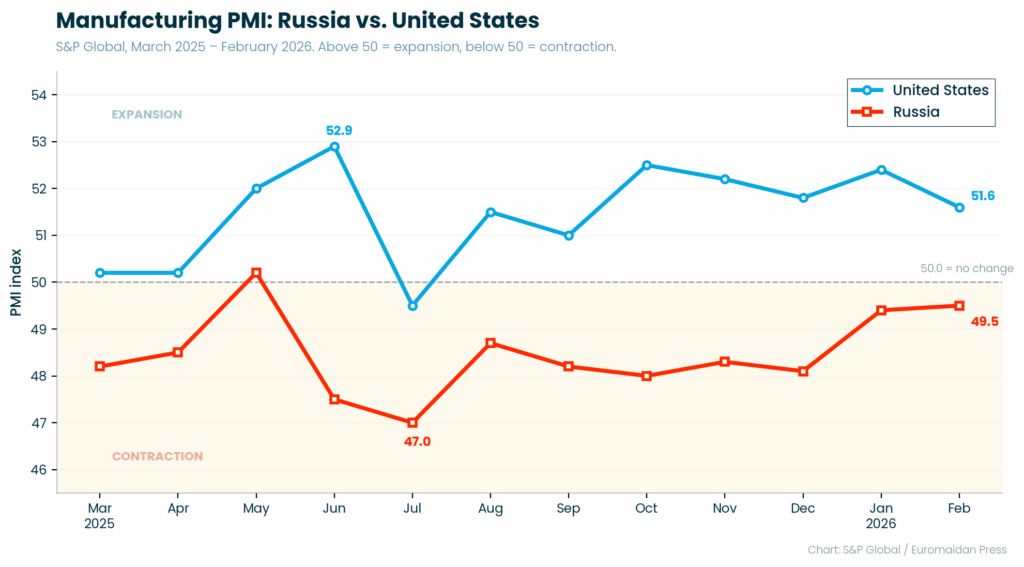
The Purchasing Managers’ Index—a monthly survey of factory bosses that tracks orders, output, and hiring, where anything below 50 signals shrinking activity—edged up to 49.5 from 49.4 in January.
But factories have now been cutting production for twelve consecutive months, and the marginal improvement came not from new activity but from firms running down existing stocks. The question for Western policymakers tracking whether economic pressure on Russia is working: is this stabilization, or a war economy learning to run on less?
Twelve months of falling output
Factory production declined for the twelfth straight month, the longest manufacturing decline in years. New domestic orders stopped contracting for the first time in eight months—a bright spot, on paper. But new export orders fell faster than in January, and manufacturers drew down inventories at the quickest rate in four months rather than producing fresh goods to meet demand.
US manufacturing expanded for the seventh consecutive month in February, with a PMI of 51.6. Global factory output also grew.
Business confidence dropped to one of its lowest points in over three and a half years. Delivery times for inputs lengthened for the fourth consecutive month.
For comparison, US manufacturing expanded for the seventh consecutive month in February, with a PMI of 51.6. Global factory output also grew, led by India, the US, and Southeast Asia.
From hiring to firing
Until late 2025, Russian factories were still adding workers even as production fell—hoarding labor in anticipation of a rebound. Employment fell for the third month running in February, with the pace of job losses accelerating to the fastest since June.
Small and medium business loans are hit hardest, with 19% classified as problematic.
Trending Now
A Kremlin-linked think tank declared in January that Russia’s banking system now meets the IMF’s formal criteria for systemic crisis, with problem assets exceeding 10% of total bank holdings.
Small and medium business loans are hit hardest, with 19% classified as problematic. GDP growth collapsed from 4.3% in 2024 to 1% in 2025; the IMF forecasts 0.8% for 2026.

Russia’s GDP growth collapsed 76%—a Kremlin think tank says worse is coming (INFOGRAPHIC)
War budget crowds out civilian economy
Input and output price inflation cooled in February after a spike triggered by Russia’s January VAT hike from 20% to 22%. But inflation rates remained the second-fastest in a year, with firms citing higher fuel and raw material costs.
US-Israeli strikes on Iran have already pushed Urals crude back to $59.8 per barrel after months of trading well below it, giving the Kremlin unexpected fiscal breathing room.
Russia’s civilian manufacturing has been running nearly 5% below December 2024 levels for months. Interest payments consume 38% of company profits—a historic maximum. Military spending and debt service are set to take up 46% of Russia’s 2026 federal budget, while healthcare, education, and housing combined take up 13%.
However, the US-Israeli strikes on Iran that began on 28 February have already pushed Urals crude back to $59.8 per barrel—right at Moscow’s budget target—after months of trading well below it, giving the Kremlin unexpected fiscal breathing room.
Kremlin-linked analysts assess the probability of recession by July 2026 as “practically impossible to avoid.”


